-
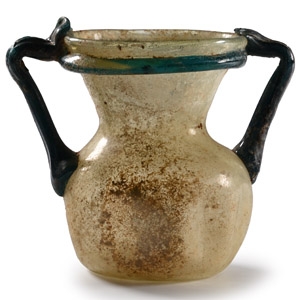
Roman Glass Handled Jar
4th century A.D.Estimate: £300 - 400 (+bp*)
With dimpled base, bulbous body with opposed dimples to the sidewall, applied flange to the neck, applied trails forming lateral handles. 39.4 grams, 78 mm wide
From an important London collection of glass, 1990s. This lot is accompanied by an illustrated lot declaration signed by the Head of the Antiquities Department, Dr Raffaele D'Amato.
These biconical jars with opposed handles, rounded lips and overhanging tubular flanges, are typical of the late Roman period, There are Syro-Palestinian types, with similar examples having been found in Beit Fajjar, West Bank, Palestine. -
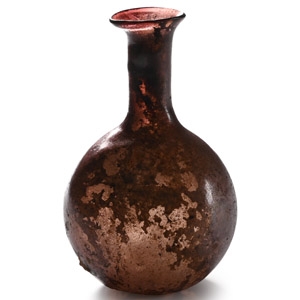
Roman Aubergine Glass Bottle
1st century B.C-1st century A.D.Estimate: £300 - 400 (+bp*)
With bulbous body, tubular neck, broad everted rim; extensive iridescence. 10.6 grams, 70 mm
From an important London collection of glass, 1990s. This lot is accompanied by an illustrated lot declaration signed by the Head of the Antiquities Department, Dr Raffaele D'Amato.
Similar bottles were found in the Cemetery of Ein-Gedi in the Judaean Desert, in a settlement abandoned in 40-37 B.C, and in Homs, Syria, dated to the first half of the first century A.D. These are among the first earliest datable blown bottles. -
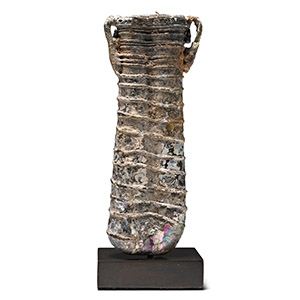
Late Roman Glass Double Unguentarium
5th-6th century A.D.Estimate: £350 - 450 (+bp*)
Composed of two conjoined tapering tubular cells, with lateral applied handles at the shoulder, decorated with applied trails; mounted on a custom-made stand. 53.7 grams, 11.6 cm (116 grams total, 13.5 cm including stand)
From an important London collection of glass, 1990s. This lot is accompanied by an illustrated lot declaration signed by the Head of the Antiquities Department, Dr Raffaele D'Amato.
These late Roman double cosmetic tubes were mainly produced in the Eastern provinces. They were formed as two tubes, side by side, made from a single bubble of glass by pinching the sides vertically to form a diaphragm. The decoration consisted of a trail wound once around the body just below the rim, and a further trail wound in a spiral several times around the body. -
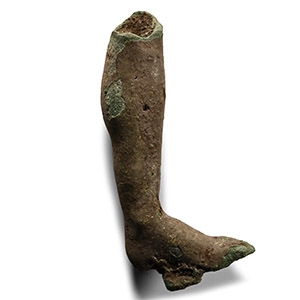
Roman Bronze Votive Statue Leg
2nd-3rd century A.D.Estimate: £120 - 170 (‡+bp*)
Modelled as the lower left leg with anatomical detailing, sprue to the foot. 435 grams, 12.9 cm
Acquired in the mid 1980s-1990s. Private collection, Switzerland, thence by descent. Private collection, since the late 1990s. -
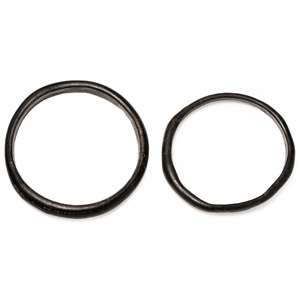
Roman Brown-Black Glass Bangle Pair
1st-4th century A.D.Estimate: £100 - 140 (+bp*)
Each plano-convex in section in chestnut-tinted glass. 44 grams total, 80-87 mm
Acquired on the UK art market in the late 20th century A.D. From the private collection of the late David King (1940-2024), Hoddesdon, Hertfordshire, UK. -
.jpg)
Roman Bronze Seal Box with Phallus
2nd century A.D.Estimate: £100 - 140 (‡+bp*)
The box with a piriform body and hinged lid, three holes to the underside; the face with inset chevron and ring of mosaic glass, high-relief stylised phallus to the centre with enamel panel. 12.2 grams, 42 mm
Acquired in the early 1970s. Ex property of a Surrey, UK, collector. -
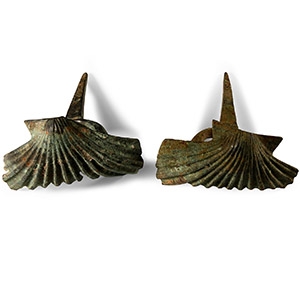
Roman Bronze Scallop Shell Attachment Pair
Circa 2nd-3rd century A.D.Estimate: £500 - 700 (+bp*)
Each composed of shell-shaped body with a D-shaped lug to reverse, the lug with tapering spike to the centre. 343 grams total, 12.5 cm each
Private collection, Rosenheim, Germany, 1960s.
This pair could have been used as a double key or door lock, based on comparison with some keys from the territory of Gaul (Boucher, 1971, pp.200-201). They comprised a strong ring with polygonal-section stem and a rectangular point. -
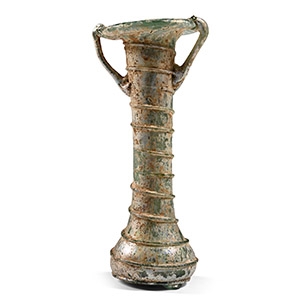
Roman Iridescent Glass Cosmetic Flask with Spiral Trail
3rd-4th century A.D.Estimate: £200 - 300 (+bp*)
Bulbous body with long funicular neck and everted rim, applied strap handles to the top, applied spiral decoration to the body. 14.6 grams, 76 mm
Ex London gallery, UK, 1986. Ex private UK collection. This lot is accompanied by an illustrated lot declaration signed by the Head of the Antiquities Department, Dr Raffaele D'Amato.
Small cosmetic flasks with tubular bodies, conical feet and trailed decoration were a common product of the Syro-Palestinian workshops in the Eastern Roman Empire, during the 4th-5th century A.D. Many such vessels had elaborate basket-handles, from which they could be suspended. -
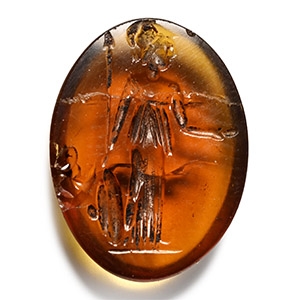
Roman Gemstone with Minerva
2nd century A.D.Estimate: £200 - 300 (+bp*)
Plano-convex in section with incuse image of Minerva standing with one hand extended, holding her spear and shield. 1.18 grams, 17 mm
Acquired 1970s-1996. Property of a North American collector. London collection, 2016. -
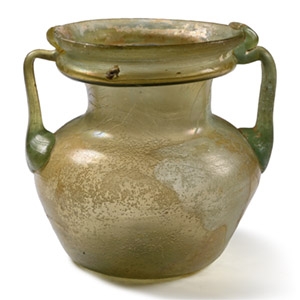
Roman Twin-Handled Pale Green Glass Jar
4th century A.D.Estimate: £700 - 900 (‡+bp*)
With a globular body, a short neck and an everted rim with a raised rib below, applied handles and a dimpled base. 90 grams, 89 mm
Private collection Mrs G. W-V-H., Zurich, Switzerland. with Galerie Rhéa, Zurich, Switzerland. -
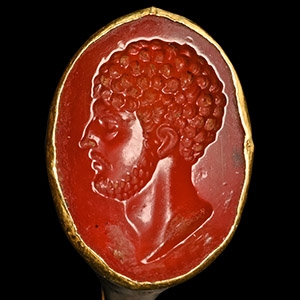
Roman Gold Ring with Later Profile Bust Gemstone
1st century B.C. and laterEstimate: £2,500 - 3,500 (+bp*)
Hollow-formed with inset later carnelian cloison, intaglio profile bust of a bearded male with curly hair and beard. 2.29 grams, 22.65 mm overall, 16.16 mm internal diameter (approximate size British K, USA 5 1/2, Europe 16, Japan 11).
Ex K collection, London, 1990s. This lot has been checked against the Interpol Database of stolen works of art and is accompanied by search certificate number no.13003-246372. -
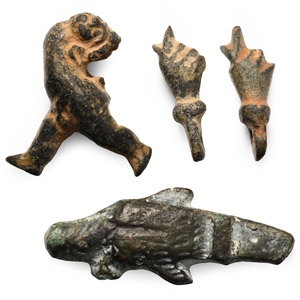
Roman Bronze Artefact Group
1st-4th century A.D.Estimate: £100 - 140 (+bp*)
Comprising: a lion-headed nude male figure in running position; two hand pendants making the fica gesture; a wolf-head(?) shaped mount. 38.7 grams total, 25-45 mm
From the collection of a gentleman, acquired on the London art market in the 1990s.

