-
.jpg)
Roman Gemstone Collection
2nd-3rd century A.D.Estimate: £500 - 700 (+bp*)
Including profile bust, standing figure and other types; each supplied with a museum-quality impression. 3.89 grams total, 9-14 mm
From the collection of a gentleman, acquired on the London art market in the 1990s. -
.jpg)
Roman Carnelian Intaglio with Spes
2nd-3rd century A.D.Estimate: £200 - 300 (‡+bp*)
Standing and facing left with her right hand raised an holding a budding flower; inscription in Greek 'KAΛ(OΣ)' (= beautiful) on the left. 0.74 grams, 13 mm
Ex R. Sebastia Coch (1908-1969) collection, Barcelona; thence by descent. English art market, 2018. Accompanied by a copy of an Art Loss Register certificate no.S00143341. -
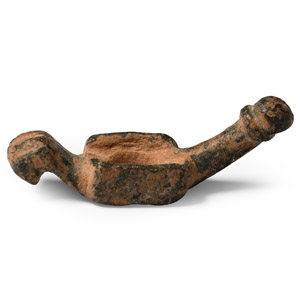
Roman Bronze Phallic Dagger Quillon or Pendant
1st-2nd century A.D.Estimate: £100 - 140 (+bp*)
With a rectangular plaque with central void, phallus to one short edge and a stylised fist to the other. 25.5 grams, 55 mm
Acquired 1980-2015. Ex Abelita family collection. This lot is accompanied by an illustrated lot declaration signed by the Head of the Antiquities Department, Dr Raffaele D’Amato.
In the Roman world the phallus was symbol of luck or fertility, and it as well was believed to have apotropaic functions. Pendants, amulets and small objects were worn by all sorts of people as symbols of protection, especially from young children according to Varro and Pliny the Elder. The phallus is commonly found on reliefs, frescoes and lamps from the Graeco-Roman world. This object can have been the quillon of a small dagger, but also hung as a charm from a tintinnabulum, a wind chime adorned with bells and intended to ward off evil. -
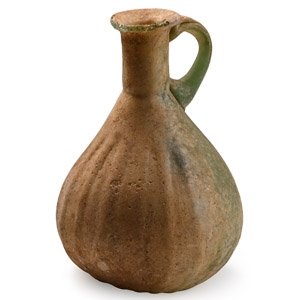
Eastern Roman or Parthian Green Glass Sprinkler Pitcher
1st-4th century A.D.Estimate: £180 - 240 (+bp*)
A single-handled mould-blown pitcher, doubling as a sprinkler flask, the inner diaphragm at the junction of the neck and body with a small piercing to restrict the flow of liquid from the vessel; twenty individual ribs which radiate upwards from the pontil mark on the base towards the neck; flared and rolled rim, handle applied separately at the end of the process, formed from folded glass creating a scrollwork effect; one face of the pitcher shows the original rich green glass colour, while the other side has an area of milky oxidation. 191 grams, 13.5 cm
Originally in an old English collection. Ex property of a Florida, USA, gentleman.
Scholars sometimes call this rare type a 'squash glass', the reason for which is apparent when viewing the piece from beneath. -
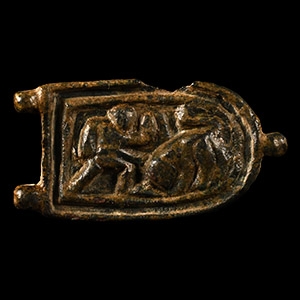
Late Roman Bronze Buckle-Plate with Combat Scene
Circa 5th century A.D.Estimate: £150 - 200 (+bp*)
Tongue-shaped in plan with knop finial and three pierced lugs to the reverse; raised rim enclosing a scene with advancing gladiator and a lion(?) preparing to attack. 19.1 grams, 49 mm
Ex London and Home Counties gentleman, R.W., 1970s. This lot is accompanied by an illustrated lot declaration signed by the Head of the Antiquities Department, Dr Raffaele D'Amato.
All E38 buckles probably originally had a kidney-shaped bow (T-shaped), a prong with a rectangular, undecorated shield, and a U-shaped hinge fitting with a finial depicting a man fighting a lion. This could be a rider stabbing the prone animal with his lance, or a gladiator with a raised shield killing a lion with a sword or lance. The reliefs are surrounded by a border of varying design. Depending on the width of the fitting, the number of rear pierced pegs varies between from two to three. -
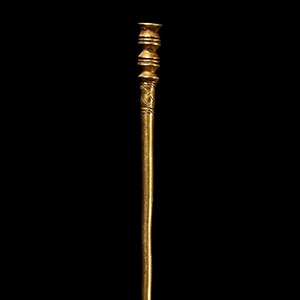
Roman Decorated Gold Dress Pin
1st-4th century A.D.Estimate: £700 - 900 (‡+bp*)
Slender body with balustered finial, a band of hatched herringbone decoration beneath the finial. 2.74 grams, 72 mm
Ex 'Neuburg' Collection, Germany, 1970. with Gorny & Mosch, Munich, Germany. with Galerie Rhéa, Zurich, Switzerland. -
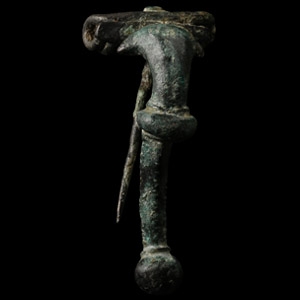
Roman Bronze Bow Brooch
2nd century A.D.Estimate: £100 - 140 (+bp*)
With chord and pin (now detached) at the head, D-section bow with lateral spurs, collar and swept foot with notched detailing, bulb finial, catch to the reverse. 26.6 grams, 54 mm
Ex important German collection, 1990s. This lot is accompanied by an illustrated lot declaration signed by the Head of the Antiquities Department, Dr Raffaele D’Amato.
This type of fibula, common in Pannonia, was typically worn in men's clothing. It closed the paenula on the chest, arranged horizontally. Naturally, it could also be worn with military attire. -
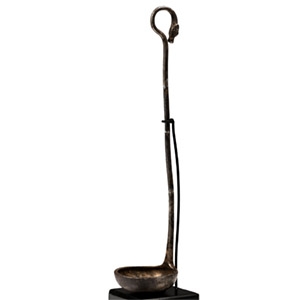
Roman Silver Ladle with Beast Finial
1st-3rd century A.D.Estimate: £800 - 1,000 (‡+bp*)
With broad bowl and in-turned rim, square-section long handle looped at the end with a beast-head finial; repaired and mounted on a custom-made display stand. 70 grams, 22.5 cm (317 grams total, 25.5 cm including stand)
Acquired in the mid 1980s-1990s. Private collection, Switzerland, thence by descent. Private collection, since the late 1990s. -
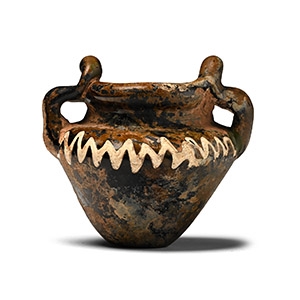
Roman Miniature Glass Amphora
1st-3rd century A.D.Estimate: £400 - 600 (+bp*)
With broad shoulder and conical body, everted rim, two loop handles and applied undulating band to the shoulder. 51.34 grams, 47 mm wide
Acquired 1970s-1996. Property of a North American collector. London collection, 2016. -
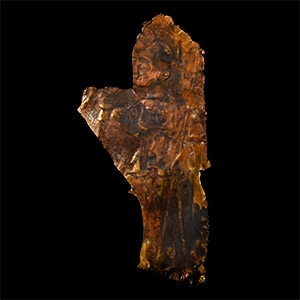
Roman Bronze Appliqué with Athena and Gorgon
Circa 4th century A.D.Estimate: £150 - 200 (+bp*)
Irregular sheet-bronze fragment with repoussé figure of Athena standing wearing a long robe and gripping the shaft of a spear, wearing a Corinthian-style crested helmet and sporting a gorgoneion at the chest. 1.67 grams, 83 mm
From the collection of a Buckinghamshire, UK, collector established from the earlier 1960s. -
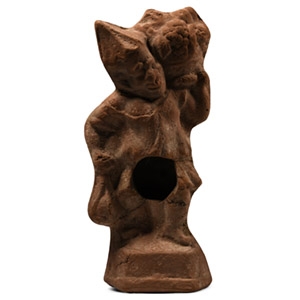
Romano-Egyptian Terracotta Figure of a Slave with Fruit Basket
1st century A.D.Estimate: £250 - 350 (+bp*)
Hollow-formed figure of a servant with grotesque facial features, pointed cap and a short tunic, carrying a pouch in the right hand and shoulders an overflowing fruit basket on the left; a large recess between his legs may be for the insertion of an oversized model phallus; pierced lug to rear of neck for suspension. 286 grams, 17.5 cm
Acquired from Galerie Puhze, Freiburg, between 2002 and 2010. From the collection of R. L., Lower Saxony. Ex Gorny & Mosch, auction 300, Munich, no.75. Accompanied by a certificate from Galerie Günter Puhze and a German export licence. -
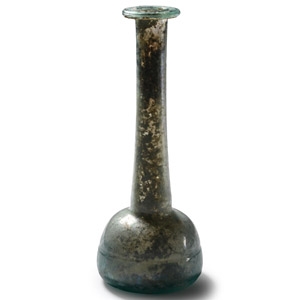
Roman Glass Unguentarium
1st-3rd century A.D.Estimate: £120 - 170 (+bp*)
With plano-convex body and dimple base, tall slender neck, folded rim; iridescent green surface. 78 grams, 15 cm
From an important London collection of glass, 1990s. This lot is accompanied by an illustrated lot declaration signed by the Head of the Antiquities Department, Dr Raffaele D'Amato.
This kind of toilet bottle was called ‘candlestick unguentarium’ by the academics due to the shape of its neck. This specific type, with its transparent grayish green glass, is especially found in Roman Cyprus (Hayes's fabric 2 of Cypriot blown glass).

