-
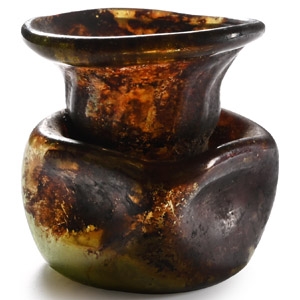
Roman Square Green Glass Flask
6th-7th century A.D.Estimate: £180 - 240 (+bp*)
With dimple to the underside, squat square body and wide everted rim. 34.7 grams, 49 mm
From an important London collection of glass, 1990s. This lot is accompanied by an illustrated lot declaration signed by the Head of the Antiquities Department, Dr Raffaele D'Amato.
The object is certainly Late Roman in shape, although similar typologies did also exist in early Islamic glasswork. The bottle was probably blown into a flat mould to produce the ribs, then expanded and tooled to form the body. -
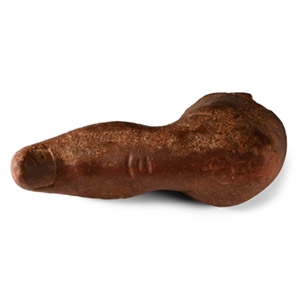
Roman Red Marble Thumb Pestle
3rd-6th century A.D.Estimate: £1,000 - 1,400 (‡+bp*)
Pestle or grinding tool, the handle formed as a thumb with knuckle and nail detailing; old collector's label '2' to underside. 312 grams, 12 cm
Ex private collection, Mrs L.S., 1980s. Acquired from the above, 1999. Private European collection. This lot has been checked against the Interpol Database of stolen works of art and is accompanied by a search certificate number no.12096-218201.
Such items were mainly used by medical staff for grinding ingredients such as medicinal compounds, cosmetics and culinary spices. -
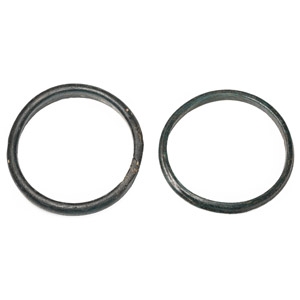
Roman Blue Glass Bangle Pair
1st-4th century A.D.Estimate: £100 - 140 (+bp*)
Each elliptical in section in blue-tinted glass. 34 grams total, 70-71 mm
Acquired on the UK art market in the late 20th century A.D. From the private collection of the late David King (1940-2024), Hoddesdon, Hertfordshire, UK. -
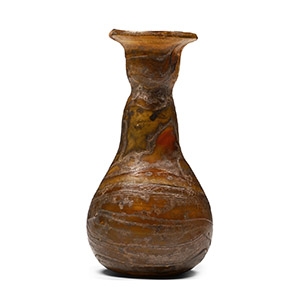
Eastern Roman Marbled Glass Bottle
4th-6th century A.D.Estimate: £300 - 400 (+bp*)
A heavy pear-shaped amber-green coloured glass vase with u-shaped neck and everted rim, decorative marbling over the body. 101 grams, 98 mm high
Acquired early 1990s. Ex private American collection; thence by descent. Private collection since 1998. -
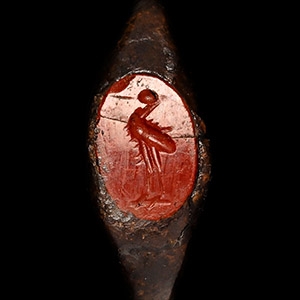
Roman Bronze Ring with Stork Gemstone
2nd-3rd century A.D.Estimate: £500 - 700 (‡+bp*)
Slender round-section hoop with red jasper intaglio engraved with a standing stork. 2.57 grams, 23.68 mm overall, 19.66 mm internal diameter (approximate size British O, USA 7, Europe 14.98, Japan 14)
Ex Prof. Dr Emil Vogt (1906-1974), the former Director of the Swiss National Museum, Zürich, in his collection before 1970. with Galerie Rhéa, Zurich, Switzerland. -
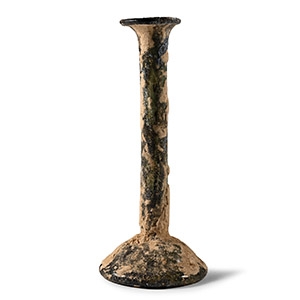
Roman Glass Vessel
1st-3rd century A.D.Estimate: £100 - 140 (+bp*)
Tall thin translucent pale green vessel with wide foot and dimpled base, tapering stem and flared rim. 27.6 grams, 12.5 cm
From a London, UK, collection, 1990s. This lot is accompanied by an illustrated lot declaration signed by the Head of the Antiquities Department, Dr Raffaele D’Amato.
Similar bottles were produced in Roman Cyprus, mainly. Hayes had divided the Cypriot products into three classes on the basis of the character of the glass. This example belongs to the third class, i.e. ‘very thin walled pieces in a pale fabric, almost colorless in parts’. -
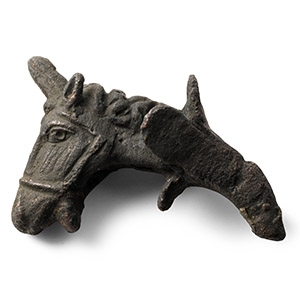
Roman Bronze Horse Head Terminal
1st-4th century A.D.Estimate: £400 - 600 (+bp*)
Modelled as a caparisoned horse-head emerging from a four-petalled flower. 60.1 grams, 57 mm
From the collection of a gentleman, acquired on the London art market in the 1990s. -
.jpg)
Late Roman Bronze Ring with Bust
4th-6th century A.D.Estimate: £120 - 170 (+bp*)
Substantial hoop with a raised rectangular bezel bearing a profile bust facing left, flanking inscription '+VI TVS'. 8.85 grams, 29.60 mm overall, 17.30 x 20.72 mm internal diameter (approximate size British O, USA 7, Europe 14.98, Japan 14)
Ex German art market, 2000s. Acquired from an EU collector living in London. From the collection of a Surrey, UK, gentleman. -
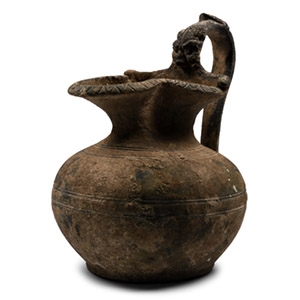
Roman Vessel with Actor's Mask Handle
Early 3rd century A.D.Estimate: £2,500 - 3,500 (‡+bp*)
A squat jar in lead-rich copper-alloy with concentric rings to the base, bulbous body, trefoil mouth with egg-and-dart detailing, strap handle with vine-leaf detailing, actor's mask at the lower end and a lion's head with open mouth at the other. 695 grams, 13.2 cm
Acquired on the Swiss art market, 2001. Private European collection. Accompanied by an academic report by Dr Raffaele D'Amato. This lot has been checked against the Interpol Database of stolen works of art and is accompanied by search certificate number no.12586-232162. -
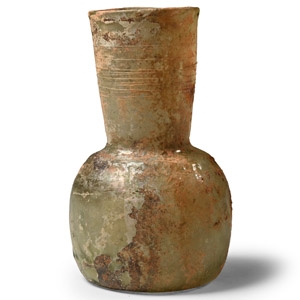
Roman Glass Flask with Everted Spout
4th century A.D.Estimate: £100 - 140 (+bp*)
Piriform in profile in aqua glass with broad flared neck; applied trails to the neck, dimple base; areas of iridescence. 38 grams, 98 mm
From a London, UK, collection, 1990s. This lot is accompanied by an illustrated lot declaration signed by the Head of the Antiquities Department, Dr Raffaele D’Amato.
The flask is a common Late Roman type, especially diffused in Syria and Palestine. Hayes suggested that examples with straight necks are relatively early in date, while those with necks having a bulge at the top and are narrow below were produced slightly later. -
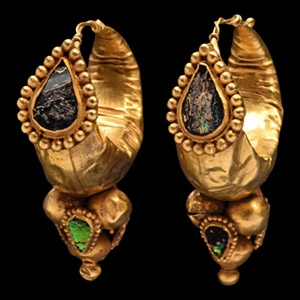
Eastern Roman Gold Hoop Earrings with Stone Inlays
3rd-4th century A.D.Estimate: £1,500 - 2,000 (‡+bp*)
Each with a hollow-formed crescentic hoop, piriform plaque with inset glass panel and granulated border, hollow-bulb cluster beneath with three applied piriform plaques and granule finial. 9.26 grams total, 37-38 mm
Acquired in the mid 1980s-1990s. Private collection, Switzerland, thence by descent. Private collection, since the late 1990s. This lot has been checked against the Interpol Database of stolen works of art and is accompanied by a search certificate number no.12393-226929.
As a result of the expansion of the Roman Empire, jewellery became more and more elaborate in its designs and materials used, such as precious and semi-precious gemstones. This pair of earrings represent a highly baroque evolution of the boat-shaped type, already visible in Etruscan jewellery and certainly in Roman jewellery, as demonstrated by the excavations of Herculaneum. Using the body of the boat-shaped earrings, the late Imperial artist added decorative clusters and applications of pearled borders and precious stones, according to the taste of Eastern Hellenism rooted for centuries in the provinces of the Black Sea and Roman Asia. -
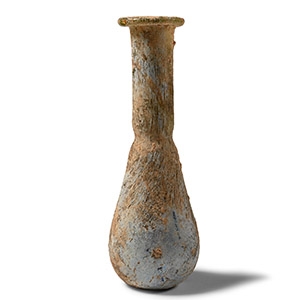
Roman Glass Vessel
1st-2nd century A.D.Estimate: £100 - 140 (+bp*)
With piriform lower body, extended cylindrical neck and flange rim; iridescent surfaces. 31.4 grams, 10.1 cm
From a London, UK, collection, 1990s. This lot is accompanied by an illustrated lot declaration signed by the Head of the Antiquities Department, Dr Raffaele D’Amato.
This toilet bottle (Clairmont balsamarium type F) is characterised by the cylindrical neck with slight constriction at the bottom. Similar examples have been found in the Wadi Eshari, Jordan (Wadi-Es-Sir).

