-
.jpg)
Enamelled Gold Hawking Whistle
Mughal, 1830-1890 A.D.Estimate: £5,000 - 7,000 (+bp*)
Of tapering cylindrical form, extensively decorated in red, white, green and blue enamel in a foliate and floral design with scalloped borders, plain suspension loop; in 23 carat gold, unmarked, enamel restored; possibly of Indian workmanship. 4.84 grams, 42 mm
By repute found in the UK. Acquired Noonan's, London, UK, 15 September 2020, no.202. Property of a British collector. This lot has been checked against the Interpol Database of stolen works of art and is accompanied by search certificate number no.12997-244313.
The enamelling is similar to Indian enamelled works from the Mughal period, all of which are rare, and these are regarded as gifts for a royal child. This whistle, however, is reported as originally being found in the UK and may be earlier in date. -
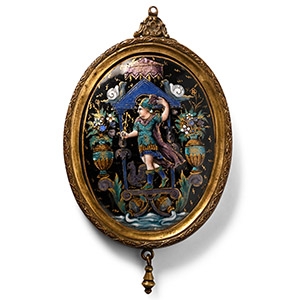
Post Medieval Gilt Enamelled Mirror Case Depicting Mercury
Limoges, early 17th century A.D.Estimate: £3,500 - 4,500 (+bp*)
Finely wrought oval mirror case featuring a vivid polychrome enamel scene on a black ground, enclosed within a gilt-copper frame; the front adorned with a depiction of Mercury, identifiable by his winged helmet and caduceus, standing beneath a classical arch flanked by stylised columns and vases of flowers; above the entablature, a canopy held aloft by two snails, while twin pouring ewers crown the upper corners, issuing stylised streams; the architectural and ornamental elements highlighted with translucent and opaque enamel, highlighted with gilding and intricate punchwork; the frame with a guilloche border, surmounted by a pierced rocaille loop with a scallop motif, and terminating below in a turned pendant finial; the sides of the frame engraved with a delicate foliate frieze, the reverse flat-chased with three vases of stylised flowers issuing from scrolled supports, framed above by draped swags, butterflies, and a winged cherubic mask; the case hinges open at the top, the interior, originally fitted with mirrored glass, now partially oxidised but retaining areas of reflection. 168 grams, 14.4 cm
Private collection, France. Private collection, UK. This lot has been checked against the Interpol Database of stolen works of art and is accompanied by search certificate number no.12998-246011.
The enamel composition is directly derived from a print by Étienne Delaune (1518/19-1583), from his series Grotesques à Fond Noir, Dieux et Déesses, created in France c.1550–1572 prior to his departure for Strasbourg. Delaune’s engravings were a principal source for Limoges enamellers of the late 16th and early 17th centuries, particularly in the production of oval mirror plaques for personal toilette or cabinet display. -
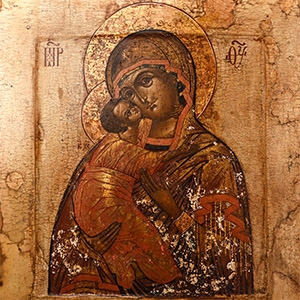
Painted Wooden Icon with the Virgin of Vladimir
Russia, 18th century A.D.Estimate: £1,200 - 1,700 (+bp*)
With veiled head and wearing a fringed golden maphorion mantle over a dark blue robe with gold cuffs, inclined towards the infant Jesus supported by her right hand; monograms and titling, on each side of her head 'ΜΡ ΘΥ' (Μήτηρ (τοῦ) Θεοῦ = Mother of God), over the child inscription in Greek letters 'ΙϹ ΧϹ' (ΙΗϹΟΥϹ ΧΡΙϹΤΟϹ = Jesus Christ), three letters (only two visible) inside the nimbus of Christ representing the continuous divine self-existence of Christ as God ('O ѾN' = The Only One who always exists); rectangular wooden board with mounting bar to reverse; Moscow School; old label on the back with inscription in Dutch 'A209 Moeder Gods van Wladimir'. 1.3 kg, 35.7 x 31 cm
Acquired on the UK art market. Private collection, London, UK.
The original icon prototype of these smaller icons was the icon of the Virgin Mother of Vladimir with the infant Jesus (the original preserved in the Tretyakov Gallery, Moscow), probably the most famous icon of Russia, which was thought to have been created in Constantinople in the early part of 1100s. This image is sometimes referred to as the ‘tenderness icon’, with artists attempting to show the close relationship of mother and son with their cheeks touching as they embrace. -
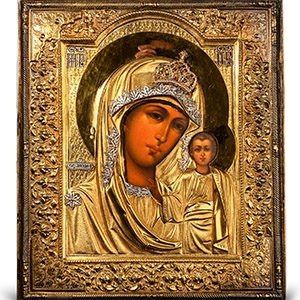
Russian Wooden Icon of the Virgin of Kazan with Silver-Gilt Riza
Circa 1890 A.D.Estimate: £6,000 - 8,000 (+bp*)
Head of Mary with gilded nimbus and russet-coloured veil, standing infant Jesus similarly nimbate with right hand raised in blessing gesture; the Virgin, with veiled head and mantle inclined towards Jesus, the head inclined left, wearing a red-gold maphorion mantle with elaborate golden saltires on the shoulders, over a dark blue robe; the infant facing away to left, supported on Mary's right arm, dressed in blue tunic and wrapped in a red orange shawl, right hand extended towards his mother; on right and left of the Virgin’s head Greek inscriptions 'ΜΡ ΘΥ' (Μήτηρ (τοῦ) Θεοῦ = Mother of God) and over the left shoulder of Mary inscription in Cyrillic 'Казанская Богоматерь Б.М.' (Mother of God of Kazan); over the child an inscription in Greek letters 'ΙϹ ΧϹ' (ΙΗϹΟΥϹ ΧΡΙϹΤΟϹ = Jesus Christ); inside the nimbus of Christ three letters (only two visible) representing the continuous divine self-existence of Christ as God (O ѾN = The Only One who always exists); rectangular wooden board with mounting slots to sides; gilt oklad with draped head-covering and garments, filigree ornament to borders, openwork crown with inset red glass jewel and applied calligraphic panels with enamel detailing. 1.79 kg, 31.5 x 27 cm
Acquired on the UK art market. Private collection, London, UK. Accompanied by an academic report by Dr Raffaele D'Amato. This lot has been checked against the Interpol Database of stolen works of art and is accompanied by search certificate number no.12925-246336.
This specimen most probably comes from a private aristocratic Russian household. It has a superb quality and consists of a refined representation of the Mother with the Child (Mother of the Consolation), of Kazan. The original icon prototype of this one, also known as the Theotokos of Kazan, is thought to have originated in Constantinople in the 13th century before it was taken to Russia. When the Turks took over Kazan in 1438, the icon was most probably hidden to keep it safe. Ivan the Terrible liberated Kazan in 1552, and the town was destroyed by fire in 1579, after which the icon was found and brought to the Church of Saint Nicholas. It was subsequently stolen in 1904 and never found again, though there are many copies in existence. -
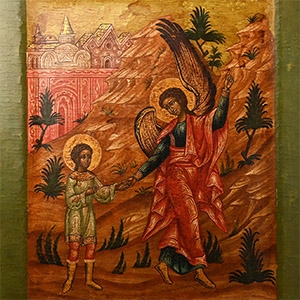
Painted Wooden Icon with Tobias and the Angel
Russia, 19th century A.D.Estimate: £1,200 - 1,700 (+bp*)
Rectangular board with mounting bar to reverse; central recess with painted scene of Tobias and angel Raphael in a landscape, city wall to rear; the Archangel dressed in a blue long sleeved tunica talaris, and wrapped in a red chlamys, the wings, shoes and the embroidery of the tunic’s cuffs in gold, his left hand raised with his finger pointing up to the sky; Tobias dressed in a short light green chiton with gold embroidery, red trousers and gold boots. 1.7 kg, 36 x 29 cm
Acquired on the UK art market. Private collection, London, UK.
The icon represents the well known biblical episode of Tobias (Book of Tobit), who, assisted by the Archangel Raphael, went to Ecbatana to meet his cousin Sarah. Raphael told the boy Tobias to catch a fish and to remove its organs, which when burnt were able to drive out the Demon Asmodeus. -
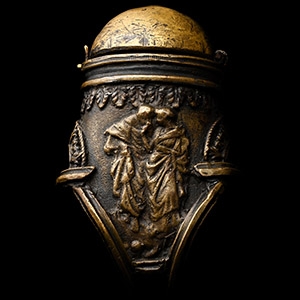
Renaissance Bronze Glove Ring with an Inkwell
Italian, 17th-18th century A.D.Estimate: £700 - 900 (+bp*)
Flat-section hoop with raised rim to each edge, tubular shank with frieze of robed figures between decorated arches and with pendant fronds above; domed lid with hinge and catch, stepped rim and chamber. 115 grams, 64.40 mm overall, 22.38 mm internal diameter (approximate size British Y 1/2, USA 12 1/4, Europe 28.2, Japan 27)
Private collection, UK. -
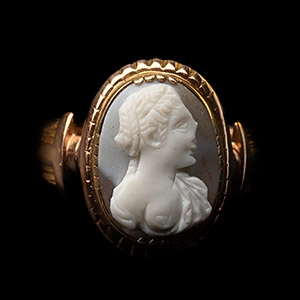
Gold Ring with Renaissance Sardonyx Cameo of a Muse
Italy, 16th century A.D.Estimate: £600 - 800 (+bp*)
Comprising a wide hoop supporting a large oval bezel with piecrust edge, set with a two-tone sardonyx cameo depicting a profile bust of a female, her hair dressed in elaborate style, garment wrapper over her left shoulder leaving her right breast exposed. 6.05 grams, 26.27 mm overall, 19.10 mm internal diameter (approximate size British S, USA 9, Europe 20, Japan 19)
Private collection, UK. -
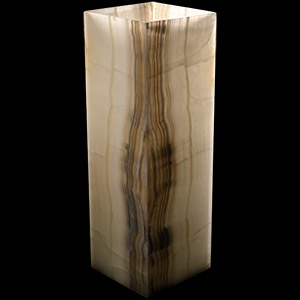
Large Ivory Onyx Lamp
Estimate: £1,200 - 1,700 (+bp*)
Comprising a tall, rectangular body formed of translucent cut slabs of milky stone with contrasting banding; accompanied by a separate light fitting on a stone base with US plug (not tested). 12.8 kg total, 60 cm
From Mexico. Property of a London lady. -
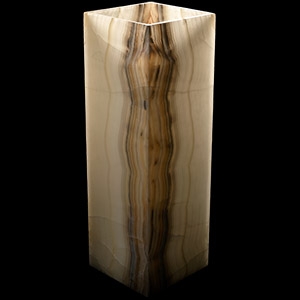
Large Ivory Onyx Lamp
Estimate: £1,200 - 1,700 (+bp*)
Comprising a tall, rectangular body formed of translucent cut slabs of milky stone with contrasting banding; accompanied by a separate light fitting on a stone base with US plug (not tested). 13.05 total, 60 cm
From Mexico. Property of a London lady. -
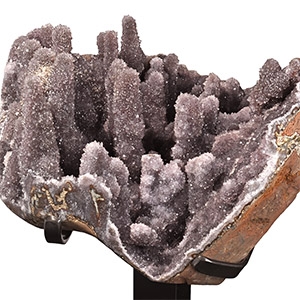
Monumental Geode Section with Druzy Quartz Stalagmites
Estimate: £5,000 - 7,000 (+bp*)
A rounded geode section with towering stalagmites with druzy grey quartz; mounted on a custom-made display stand. 68.4 kg total, 100 cm including stand
From Artigas, Uruguay. Property of a London lady. -
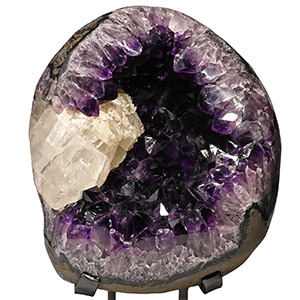
Egg-Shaped Amethyst Crystal Geode Display with Calcite
Estimate: £2,000 - 3,000 (+bp*)
Large, polished section of geode showing prismatic dark purple amethyst crystals on the inner surface with a large mass of calcite to one side, the calcite with clusters of small quartz crystals; mounted on a custom-made display stand. 17.1 kg total, 34.5 cm including stand
From Artigas, Uruguay. Property of a London lady. -
.jpg)
Amethyst Crystal Geode Display
Estimate: £1,200 - 1,700 (+bp*)
A rounded geode section, the undulating inner surface lined with small prismatic amethyst crystals; mounted on a custom-made display stand. 10 kg total, 35 cm including stand
From Artigas, Uruguay. Property of a London lady.

