-
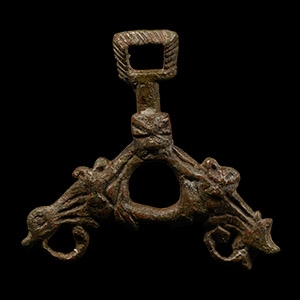
Viking Bronze Bridle Strap Junction with Beast Heads
10th-11th century A.D.Estimate: £800 - 1,000 (‡+bp*)
Comprising a rectangular suspension loop with D-section shank and mask below, two flanking arms each with a zoomorphic (bear?) face, one terminating in a wolf's head and the other in a bird's head; small loops below the terminals. 30 grams, 63 mm
Found Bardney, Lincolnshire, UK, in the early 1990s.
This bridle junction is decorated in the Anglo-Scandinavian Ringerike style. On each side of the central hole is an outward facing animal, their beaked heads positioned on the outer edges. The details on the face are carried out in moulded relief as well as engraving. -
.jpg)
Medieval Silver-Gilt Brooch with Garnets
13th-14th century A.D.Estimate: £500 - 700 (+bp*)
An annular brooch decorated with oak leaves surrounding tall collets set with garnet cabochons, dagger-shaped pin. 5.42 grams, 27 mm
Private collection, UK.
The brooch would have been a deeply romantic gift combining the garnets, which are emblematic of love and the oak leaves, which symbolised strength and stability, as well as bearing strong religious significance. -
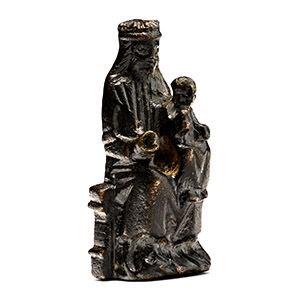
Medieval Bronze Seated Figure of Madonna and Child
England, 14th century A.D.Estimate: £450 - 650 (+bp*)
Modelled in the half-round, Mary crowned and seated, holding the infant Jesus on her left knee, the infant having his right hand raised in blessing gesture. 24.6 grams, 40 mm
Private collection, UK. -
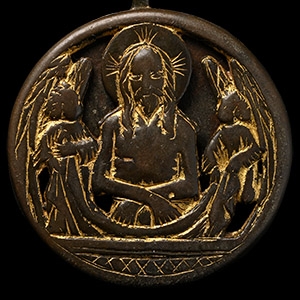
Medieval Gilt Copper Devotional Reliquary Pendant
German, 15th century A.D.Estimate: £700 - 900 (+bp*)
A large circular openwork pendant with a fitted lid, the lid depicting Christ between two angels holding a shroud; the reverse with seated and crowned Virgin Mary holding infant Jesus on her lap. 57.2 grams, 57 mm
Private collection, UK. -
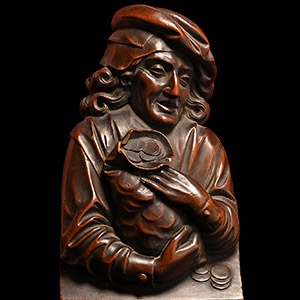
Medieval Bas Relief Representing a Gentleman Illustrating an Allegory of Avarice
Netherlands, 16th century A.D.Estimate: £2,000 - 3,000 (+bp*)
Carved in the half-round, clean-shaven male figure wearing a floppy chaperon hat, clutching a bulging sack of coins to his chest, with some stray coins on the surface of the table below; mounted on a velvet-covered board in a carved wooden frame. 694 grams, 33.2 x 27.1 cm
Private collection, Spain, until 2024. This lot has been checked against the Interpol Database of stolen works of art and is accompanied by search certificate number no.12992-246434. -
.jpg)
English Medieval Silver Seal Matrix for Harvey, Rector of the Church of Swainsthorpe Magna
Early 15th century A.D.Estimate: £2,000 - 3,000 (+bp*)
An ellipsoid seal matrix with a strap to the reverse; incuse motif of crowned Mary seated on a throne with infant Jesus; legend to the edge within pelletted borders '*hERVIV’ ECC[’]E SWINThORPE’ MA’ (Harvey, rector of the church of Great Swainsthorpe); later replacement loop to the verso. 5.29 grams, 24 mm
The Matrix Collection, formed by David Morris since the late 1980s. Found near the site of the church of Saint Mary in October 2002. Recorded with Norwich Castle Museum, retained for consideration as Treasure and subsequently returned to the finder. Matrix Collection catalogue no.1036. Many of the seals within the collection were published in a book titled 'The Matrix Collection', by David Morris in 2012. Accompanied by a copy of the illustrated collection notes. Accompanied by a copy of Norwich Castle Museum record slip no.9724 SWAINSTHORPE (G. Linton m/d Oct 02). This lot has been checked against the Interpol Database of stolen works of art and is accompanied by search certificate no.11655-198742.
The village of Swainsthorpe is situated in Norfolk, some few miles to the south of Norwich and once boasted two churches (one now ruined). Recorded and assessed by the Secretary of State’s Expert Adviser as an object of cultural interest. The RCEWA reviewed an export application and determined that it meets the third Waverley criterion, making it currently non-exportable. -
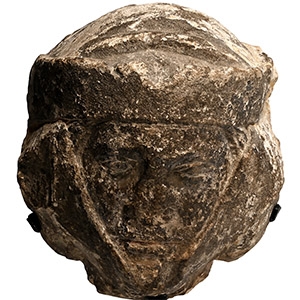
Medieval Stone Female Head
France, 14th century A.D.Estimate: £1,000 - 1,400 (+bp*)
Carved in the half-round with brow-band and chin-band; narrow triangular face with slit mouth and lentoid eyes; lateral bunches of hair beneath the wimple; mounted on a custom-made stand. 3.11 kg total, 24 cm high including stand
Private collection, UK. -
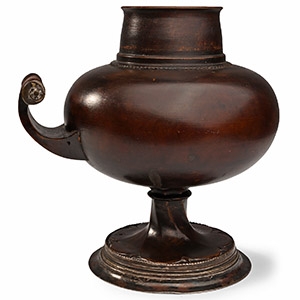
Medieval Boxwood Drinking Cup
Southern Germany, circa 1500 A.D.Estimate: £6,000 - 8,000 (+bp*)
Comprising a barrel-shaped turned wooden body with a broad neck and an everted rim, a slender stem and stepped base; a single scrolled handle to reverse. 445 grams, 19.6 cm high
Pfyffer von Sltishofen (1914), a well known family in Switzerland. with Artcurial Beurret Bailly Widrner, 2025. This lot has been checked against the Interpol Database of stolen works of art and is accompanied by search certificate number no.12993-246435. -
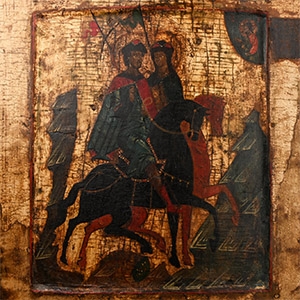
Painted Wooden Icon with Saints Boris and Gleb
Russia, 16th-17th century A.D.Estimate: £2,000 - 3,000 (+bp*)
Painted on a wooden board with gessoed surface, tempera on wood panel with kovcheg (recessed central panel on the obverse) executed on a pale yellow ground; Boris and Gleb depicted on horseback wearing Russian 16th century Boyar costume, both with nimbus, each with a lance and pennant; on the right upper corner, God is represented as a half figure making a blessing gesture, inscription in Greek letters 'ΙϹ ΧϹ' (ΙΗϹΟΥϹ ΧΡΙϹΤΟϹ = Jesus Christ); rectangular wooden board with mounting slots to reverse. 1 kg, 32 x 26.5 cm
; good condition, losses to the borders, areas of retouching.
Acquired on the UK art market. Private collection, London, UK. Accompanied by an academic report by Dr Raffaele D'Amato. This lot has been checked against the Interpol Database of stolen works of art and is accompanied by search certificate number no.12927-246338.
Boris and Gleb, Princes of old Rus Nation, were the sons of Vladimir of Kiev, the first Christian Prince of Rus; according the history they were killed in 1015 and 1019 in the civil struggles for the succession to the Kiev’s throne, and sanctified for their faith. Standards with their image were worn by the medieval Russian army. -
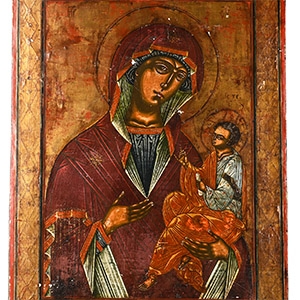
Large Painted Wooden Icon of Mother of God of Tikhvin
Russia, 16th century A.D.Estimate: £5,000 - 7,000 (+bp*)
Oil and tempera, depicting the Virgin Mary and the infant Jesus on a plain gold field; Mary wearing a red maphorion mantle over a blue robe, with golden brocade to the hem, in the style of Hodegetria (She who shows the way); the Virgin pointing at Jesus with her right hand, while looking towards the spectator; the infant facing left, resting on Mary's left arm, dressed in white tunic, wrapped in a red-orange shawl, right hand blessing the mother, left hand extended holding a scroll of the Holy Scriptures, while crossing his legs to reveal the naked sole of one of his feet; very effaced Greek inscriptions in red lettering 'ΜΡ ΘΥ (Μήτηρ (τοῦ) Θεοῦ = Mother of God)' flanking Mary's head; inscription in Greek 'ΙϹ ΧϹ' (ΙΗϹΟΥϹ ΧΡΙϹΤΟϹ = Jesus Christ) above the infant; rectangular wooden board with mounting bars to reverse and old collector's label 'Vierge Hodigitria, type Tikhvin, Icone russe du 16eme siècle, achetée á Constantinople…chez Monsieur Captain…peinture transmise sur nouvelle planche [Virgin Hodigitria, Tikhvin type, Russian icon from the 16th century, purchased in Constantinople...from Monsieur Captain...painting moved on a new board]'; border with pointillé lozenges and other detailing. 4.7 kg, 70.3 x 52.5 cm
Acquired on the UK art market. Private collection, London, UK. Accompanied by an academic report by Dr Raffaele D’Amato. This lot has been checked against the Interpol Database of stolen works of art and is accompanied by search certificate number no. 19929-246334.
According to the legend, this particular icon of the Mother of God appeared in Rus' in 1383 near Veliky Novgorod over Lake Ladoga, and travelled through the air to the Tikhvin River, stopping at several points along the way and performing miracles. On Tikhvin, where the icon came to rest, a stone Dormition Cathedral was built by order of Grand Prince of Moscow Vasil III in 1515, and in 1560, Ivan the Terrible founded the Tikhvin Dormition Monastery near this cathedral. In 1613, the Dormition Monastery withstood the Swedish invasion, and in 1617, the Treaty of Stolbovo was concluded with Sweden. These events were associated with the miraculous intercession of the icon. Until 1936, the icon was kept in the Dormition Cathedral. In 1936, services in the cathedral were discontinued, and the icon was housed in various churches in Tikhvin. In November 1941, Tikhvin was occupied by German troops. The icon was taken abroad and remained in Chicago since the 1950s. In 2004, the icon was again ceremoniously transferred to the Dormition Cathedral of the Tikhvin Monastery. -
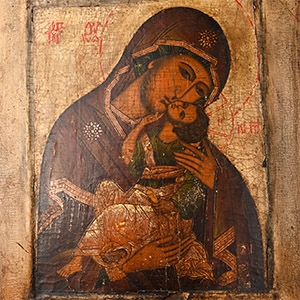
Painted Wooden Icon with the Virgin of Tenderness
Russia, 16th-17th centuries A.D.Estimate: £3,000 - 4,000 (+bp*)
Executed in oil and tempera with painted image of nimbate Mary embracing the nimbate infant Jesus; head of Mary with gilded nimbus and russet-coloured veil; the Virgin is shown in half length, wearing a red-gold fringed maphorion with elaborate golden saltires on the shoulders, over a dark blue robe, visible only on the gold embroidered cuffs; the child touching his mother's chin, holding a furled scroll in his left hand and dressed in blue tunic and wrapped in a gold-orange shawl; on upper left of the Virgin’s head Greek inscriptions 'ΜΡ ΘΥ' (Μήτηρ (τοῦ) Θεοῦ = Mother of God) and beside the Divine Child inscription in Greek letters 'ΙϹ ΧϹ' (ΙΗϹΟΥϹ ΧΡΙϹΤΟϹ = Jesus Christ); inside the nimbus of Christ three letters (only two visible) representing the continuous divine self-existence of Christ as God (O ѾN = The Only One who always exists); rectangular wooden board with mounting slots and bar to reverse. 1.78 kg, 45 x 35.5 cm
Acquired on the UK art market. Private collection, London, UK. Accompanied by an academic report by Dr Raffaele D'Amato. This lot has been checked against the Interpol Database of stolen works of art and is accompanied by search certificate number no.12928-246333.
This splendid specimen comes most probably from an ancient private aristocratic Russian household. It has a superb quality and consists in a refined representation of the Mother of God known as Eleousa (Umilyenie in Russian), in which the Virgin tenderly embraces the Christ Child. Characterised by an affectionate embrace of Mary and the Christ Child, the image combines the themes of maternal love and the Passion of Christ. -
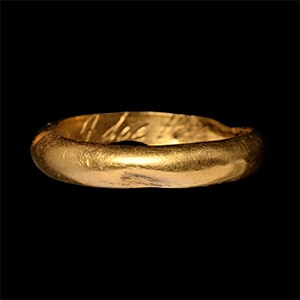
Post Medieval Gold 'For Vertues Sake I Doe Thee Take' Posy Ring
17th century A.D.Estimate: £800 - 1,000 (+bp*)
Comprising hollow-form D-section ring with inscribed 'For Vertues Sake I Doe Thee Take' with a maker's mark 'PR'. 1.99 grams, 22.85 mm overall, 18.80 mm internal diameter (approximate size British Q, USA 8, Europe 17.49, Japan 16)
Ex Silbury Coins. Acquired on the UK art market.

