-
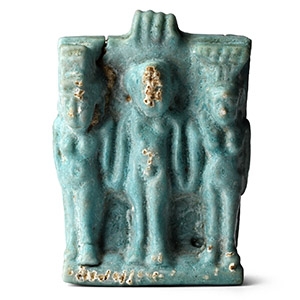
Egyptian Faience Triad Amulet
Late Period, 664-332 B.C.Estimate: £500 - 700 (+bp*)
Comprising in high relief the Osirian triad (Nephthys, Horus, Isis) standing side by side on an integral plinth against a dorsal pillar; Nephthys (right) and Isis (left) shown frontally wearing headdresses with their own attributes, each holding the hands of Horus in the centre, naked and wearing the side-lock of youth; ribbed loop at the top for suspension. 8.56 grams, 33 mm
From the collection of a Swedish noble family, 1920s. -
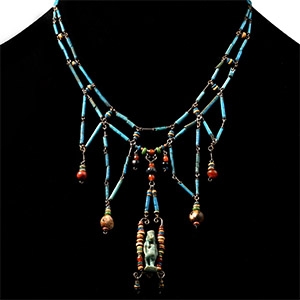
Egyptian Blue Faience Bead Necklace with Taweret
Ptolemaic Period, 332-30 B.C.Estimate: £600 - 800 (+bp*)
A restrung designer necklace composed of cylindrical and annular beads, central feature composed of polychrome annular beads flanking a Taweret amulet; modern clasp. 21.2 grams, 27.6 cm
Private collection, UK.
The ancient Egyptian goddess Taweret is mainly associated with fertility, childbirth, motherhood, and the protection of women during pregnancy and labour. She is depicted as a composite creature, combining various animal features, and is one of the more unique and striking deities in the Egyptian pantheon. Taweret’s name comes from the Egyptian word for "great" or "large" (tꜣwꜣrt), reflecting her formidable and protective nature. -
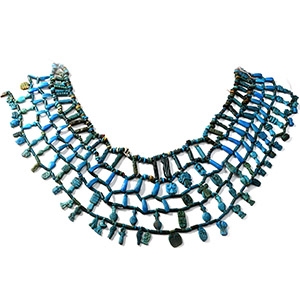
Egyptian Faience Broad Collar Amulet Necklace
Late Period, 664-332 B.C.Estimate: £2,500 - 3,500 (+bp*)
A restrung group of annular and figural beads forming a collar of five descending tiers including djed pillar, atef crown, cartouche and other types. 53 grams total, 32.5 cm wide
Property of a North London, UK, gallery. This lot has been checked against the Interpol Database of stolen works of art and is accompanied by search certificate number no.12935-246384.
Several faience collars found in the tomb of Tutankhamun use amuletic forms, the hes-vase, nefer-sign, and cartouche pendants as part of primarily plant-form collars. Depictions of collars on the sarcophagi and gold mask from the tomb of Tuiya and Yuia also show nefer-signs and palmettes used alongside the more common plant designs. -
.jpg)
Egyptian Turquoise Scarab
Late Period, 664-332 B.C.Estimate: £400 - 600 (+bp*)
Carved in the round with longitudinal piercing, ellipsoid base. 1.21 grams, 15 mm
Ex Belinda Elliston collection, a member of the Egyptian Exploration Society, 1940s onwards. -
.jpg)
Egyptian Hardstone Scarab
Late Period, 664-332 B.C.Estimate: £500 - 700 (+bp*)
With detailed clypeus and head, raised ridge separating the wing case, resting on an oval base with plain underside. 10.1 grams, 27 mm
From the property of a London, UK, gentleman, 1970-2000s.
The scarab, which represented the dung beetle, was the most popular amulet in ancient Egypt for approximately two thousand years until the Ptolemaic Period when it gradually fell out of favour. The popularity of scarabs extended beyond the borders of Egypt, and they were also distributed and produced in other regions, such as Phoenicia and Israel. The beetle is named khepri, derived from the verb 'to come into existence', and was considered the embodiment of the creator god Khepri, who was self-created. The ancient Egyptians mistakenly believed that the young beetle emerging from the dung ball was the result of an act of self-creation. -
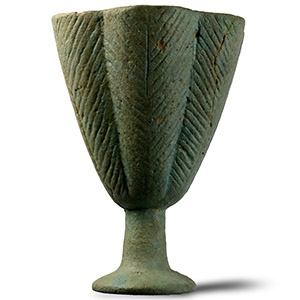
Egyptian Blue-Glazed Faience White Lotus Chalice
New Kingdom-Third Intermediate Period, 1315-945 B.C.Estimate: £5,000 - 7,000 (+bp*)
The lotiform cup modelled as an open lotus flower with incised petal detailing to the outer face, short stem and flared foot; some restoration. 205 grams, 12.1 cm
Acquired 1970s-1996. Property of a North American collector. London collection, 2016. This lot has been checked against the Interpol Database of stolen works of art and is accompanied by search certificate number no.12937-243177.
Faience chalices shaped like the flowers of the white lotus (Nymphaea albicans) first appeared in the 18th Dynasty and are believed to be drinking vessels. -
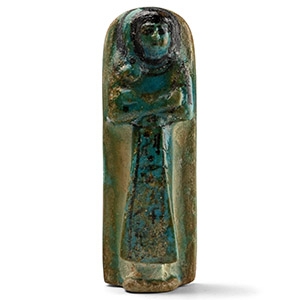
Egyptian Turquoise Faience Shabti of Prince Khaemwaset
New Kingdom, Ramesside Period, 19th Dynasty, 1282-1225 B.C.Estimate: £8,000 - 10,000 (+bp*)
Wearing daily dress and carrying agricultural implements, with dark blue details including his short wig with side-lock, designating him as a Sem-priest of Ptah at Memphis, the text on the kilt naming him as 'Sem-priest and King's son Khaemwaset'; with round-topped back support, the reverse with two columns of hieroglyphs with part of the shabti formula: "He says: O shabti, if one counts, if one is reckoned to do all the works that are to be done there in the God’s land—now indeed obstacles are implanted therewith—as a man at his duties, ‘Here I am,’ you shall say when you are counted off to cultivate the fields, transport by boat the sand of the east to the west and vice versa; ‘Here I am,’ you shall say". 284 grams, 15.1 cm
With Barakat, Beverly Hills: reputed to be from the Omar Pasha Sultan collection, (1806-1871) but unpublished in the 1929 catalogue of the collection, nor in Aubert's 1976 article on the shabtis in the collection. Bonhams, London, 1 May 2013, no.282. Accompanied by copies of the relevant Bonhams catalogue pages. Accompanied by an academic report by Egyptologist Paul Whelan. This lot has been checked against the Interpol Database of stolen works of art and is accompanied by search certificate number no.12938-243536.
Prince Khaemwaset was the fourth-ranked son of Ramesses II and the second born to Queen Isetnofret. More is known about Khaemwaset than any other son of Ramesses II, attested by over 150 objects, ranging from statues to temple reliefs. He is traditionally regarded as the “first Egyptologist” for his restoration of monuments belonging to earlier kings, including the pyramids at Giza and Saqqara. Recent reassessment, however, suggests that some of these activities involved dismantling parts of ancient structures for reuse in his father’s temple constructions. -
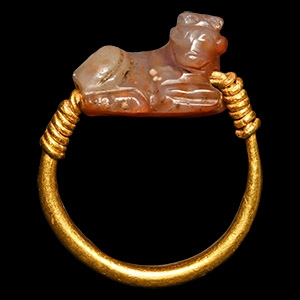
Egyptian Gold Ring with Agate Bull
New Kingdom, 1550-1292 B.C.Estimate: £6,000 - 8,000 (+bp*)
Comprising a round-section swivel ring set with a carved Apis bull depicted recumbent with its head turned to right. 4.71 grams, 27.98 mm overall, 19.07 mm internal diameter (approximate size British N, USA 6 1/2, Europe 13.72, Japan 13)
Private collection, UK. This lot has been checked against the Interpol Database of stolen works of art and is accompanied by search certificate number no.12939-245988.
The Apis bull was a sacred animal in ancient Egyptian religion, worshipped as a living manifestation of the god Ptah and later associated with Osiris and Ra. Regarded as an intermediary between the gods and humanity, the Apis bull was chosen based on specific physical characteristics, such as a black coat with unique white markings. Once identified, it was housed in a grand temple in Memphis, where it was treated with great reverence, adorned with jewellery, and participated in important religious ceremonies. Upon its death, the bull underwent elaborate mummification and burial rituals, symbolising its transition to the afterlife and its continued divine role. The cult of the Apis bull highlights the Egyptians’ deep connection to animals as symbols of divine power and their belief in the interconnectedness of the mortal and spiritual worlds. -
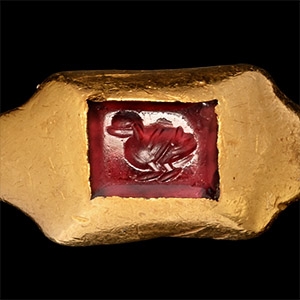
Romano-Egyptian Gold Ring with Duck Intaglio
1st century B.C.-1st century A.D.Estimate: £3,000 - 4,000 (+bp*)
Comprising a flat-section hoop and a raised rectangular bezel, the tapering bezel set with a garnet intaglio engraved with a standing duck. 3.85 grams, 23.13 mm overall, 18.91 mm internal diameter (approximate size British Q 1/2, USA 8 1/4, Europe 18.12, Japan 17)
Private English collection. Private collection, London, UK. This lot has been checked against the Interpol Database of stolen works of art and is accompanied by search certificate number no.12940-245981. -
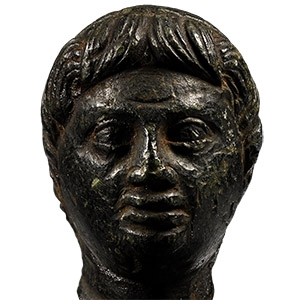
Egyptian Steatite Portrait of a Ptolemaic Prince
2nd-1st century B.C.Estimate: £2,500 - 3,500 (‡+bp*)
With a round face, large eyes, a narrow nose that broadens at the end, and full lips downturned at the corners; the forehead with a distinctive deep furrow above the brow; a narrow, twisted diadem encircling his wavy hair; mounted on a custom-made display stand. 84 grams total, 10 cm including stand
Private collection, Bern, Switzerland. with Galerie Rhéa, Zurich, Switzerland. This lot has been checked against the Interpol Database of stolen works of art and is accompanied by a search certificate number no.12631-236408.
The Greek hairstyle is a characteristic feature of Ptolemaic royal portraiture, as is the twisted diadem - a Greek interpretation of the Egyptian headband (the sšd) - which appears on several portrait heads of Ptolemaic boy-kings and princes. The distinctive furrow is intriguing, as it contrasts with the typically blemish-free physiognomy of most Ptolemaic royal sculpture. However, a similar furrow can be seen on the portrait head of a provincial governor from Dendera, dated to the 2nd century B.C. (Bothmer, B.V., Egyptian Sculpture of the Late Period 700 B.C. to A.D. 100, New York, 1960, pp. 144-143, pl. 112, nos. 301-302), which may indicate an artistic trend employed in high-status sculpture at that time. It has been suggested that small royal portrait heads, such as this example, may have served as votives. The lack of an Egyptian-style back pillar on this and similar pieces supports the possibility that they were inserted into statues made of different materials (Ashton, S.-A., Ptolemaic Royal Sculpture from Egypt, BAR International Series 923, Oxford, 2001, p.12). -
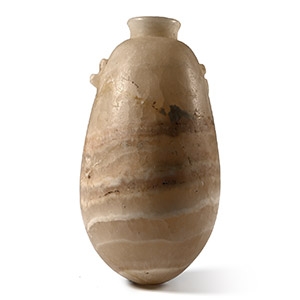
Egyptian Alabaster Alabastron
Late Period, 664-332 B.C.Estimate: £700 - 900 (‡+bp*)
Ovoid jar with a rounded base, concave shoulders and flared neck; remains of lug handles, restored. 332 grams, 14 cm
Acquired in the mid 1980s-1990s. Private collection, Switzerland, thence by descent. Private collection, since the late 1990s. -
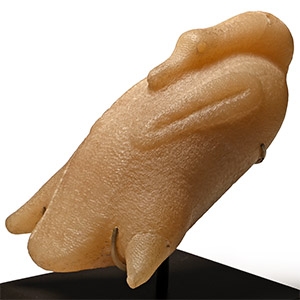
Egyptian Alabaster Trussed Duck
Old Kingdom, 6th Dynasty, circa 2345-2181 B.C.Estimate: £7,000 - 9,000 (+bp*)
Carved in the round with the head and neck laid backwards along the spine; mounted on a custom-made stand. 890 grams total, 10 cm wide including stand
Acquired before 1970. Private French collection. with Bonhams, New Bond Street, London, 29 April 2009, lot 58. Ex Middle Eastern royal family, living in the UK, 2013-2017. Accompanied by a copy of a French cultural passport no.099505. Accompanied by a copy of an Art Loss Register certificate, no.S000149104. Accompanied by a copy of the relevant Bonhams catalogue pages. This lot has been checked against the Interpol Database of stolen works of art and is accompanied by search certificate number no.12942-245247.
In ancient Egypt, the duck (actually the Egyptian goose) was considered a sacred and very popular animal, often depicted in art and associated with symbolic meanings. It was a common bird in the Nile Valley and considered a symbol of fertility, life, and family, which is why it frequently appeared in scenes of daily life and rituals, and in the artworks.

