-
.jpg)
Migration Period Iron Sword with Rock Crystal, Gold and Garnet Sword Bead
5th-6th century A.D.Estimate: £2,000 - 3,000 (+bp*)
Comprising a double-edged blade with pointed tip, battle nicks to both cutting edges; short bronze guard and a long tang; accompanied by a facetted rock crystal hilt pendant with a granulated gold mount above, set with a garnet cabochon; Eastern Roman or Alano-Gothic. 750 grams, 4-91.5 cm
From the private collection of a London gentleman, from his grandfather's collection formed before the early 1970s. Accompanied by an academic report by Dr Raffaele D’Amato. This lot has been checked against the Interpol Database of stolen works of art and is accompanied by a search certificate number no.12041-216428.
A characteristic type of the Migration period, originally used by nomadic people such as the Alans and Sarmatians. An important element of these swords was the presence (in tombs) of amber or rock crystal fittings, which some authors have identified being part of the pommel (Zasetskaya), and others as pendants hanging from the hilt of the sword. Interestingly the sword of grave 9 from the Necropolis of Novohryhorivka is decorated with a similar pendant, made of amber and fitted with a silver mount decorated with a filigree border. -
.jpg)
Migration Period Iron Sword with Bronze Pommel
5th-6th century A.D.Estimate: £2,000 - 3,000 (+bp*)
A spatha with a double-edged parallel-sided blade, battle nicks to both cutting edges; long tang with a fastening rivet in situ; small trapezoidal bronze pommel. 707 grams, 91 cm
From the private collection of a London gentleman, from his grandfather's collection formed before the early 1970s. Accompanied by an academic report by Dr Raffaele D’Amato. This lot has been checked against the Interpol Database of stolen works of art and is accompanied by a search certificate number no.12040-216429.
The spatha, often with an elegantly decorated hilt with golden elements, was characterised by a relatively light handle so that the centre of gravity of the weapon was moved towards the tip. The evolution of the 'barbarian' long sword in the west, during the invasions, began around the 5th century. -
.jpg)
Stone Age Double-Sided Axehead
Neolithic, 3rd millennium B.C.Estimate: £1,000 - 1,400 (‡+bp*)
Boat-shaped in plan with central drilling; small chip to on edge; mounted on a custom-made stand. 738 grams total including stand, axehead: 18.2 cm
Private collection, Raguse, Switzerland. with Kölner Munzkabinett, Germany, before 2016. Private European collection. Accompanied by a copy of the 2016 invoice. -
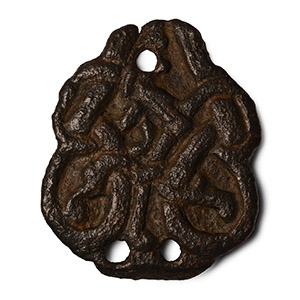
Anglo-Scandinavian Viking Bronze Apex Stirrup Mount with Urnes Entwined Beasts
9th-11th century A.D.Estimate: £400 - 600 (+bp*)
An exceptionally rare tulip-shaped mount with Urnes Style interlace, pierced at the apex and twice at the base above the shallow rear ledge. 23 grams, 48 mm
Found whilst searching with a metal detector in East Anglia, UK. -
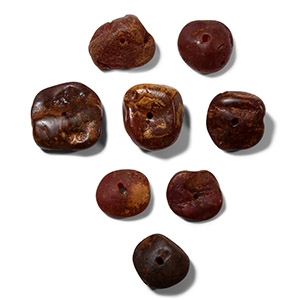
Large Saxon Amber Bead Group
Circa 6th-7th century A.D.Estimate: £600 - 800 (+bp*)
Comprising eight large beads, the larger ones of amorphous form and the smaller ones worked into regular shapes. 106 grams total, 33-44 mm
From the private collection of a London gentleman, from his grandfather's collection formed before the early 1970s. -
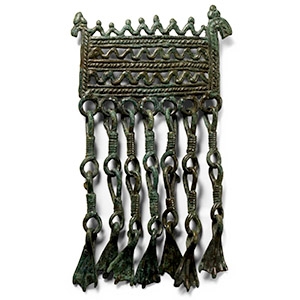
Viking Age Bronze Pendant with Duck-Foot Pendants
8th-10th century A.D.Estimate: £500 - 700 (+bp*)
A rectangular bronze pendant formed as a pair of addorsed horse-heads in profile and openwork panel; bar with seven articulated chains each terminating in a pendant formed as the foot of a wading bird, Finno-Ugric type. 146 grams, 15 cm
From the private collection of a London gentleman, from his grandfather's collection formed before the early 1970s. -
.jpg)
Merovingian Belt Plate with Garnets
6th-7th century A.D.Estimate: £500 - 700 (+bp*)
Or Ostrogothic, comprising a rectangular panel with four fixing studs, central ellipsoid cell surrounded by garnet cloisons with stepped edges; central cell replaced. 9.81 grams, 33 mm
UK private collection before 2000. On the UK art market. Property of a London gentleman. -
.jpg)
Carolingian Bone Comb
8th-10th century A.D.Estimate: £1,000 - 1,400 (‡+bp*)
Lentoid in section with thick-cut teeth to one edge and fine-cut to the other. 15.09 grams, 82 mm
Ex private central European collection. with Tkalec AG, Limmatquai 48, Zurich, early 2000s. Acquired from the above, 2006. -
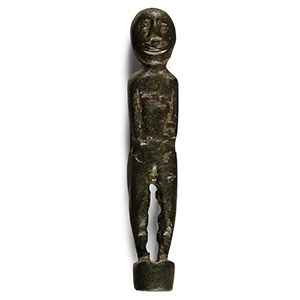
'The Hoxne Priory' Anglo-Saxon Bronze Anthropomorphic Figurine
600-700 A.D. or laterEstimate: £2,000 - 3,000 (+bp*)
Modelled in the round standing naked with both feet on a drum-shaped base; the head bulbous with small lentoid eyes placed high on the face, wedge-shaped nose and slit mouth; the arms poorly defined but apparently extending to the hips (and perhaps bent flat across the body); the legs separated by a rotary device with small feet, the genital area blank with a shallow socket in the shape of a phallus and testes. 43.6 grams, 75 mm
Found whilst searching with a metal detector approximately 100 yards from the ruins of Hoxne Priory, Suffolk, UK, on 27th August 2023 by Richard Hudson. Accompanied by a report by Anglo-Saxon and Viking specialist Stephen Pollington. Accompanied by a copy of the British Museum's Portable Antiquities Scheme (PAS) report no.SF-F804CE. Accompanied by a copy of the Suffolk County Council archaeological finds recording service receipt dated 27th August 2023. Accompanied by a handwritten signed letter from the finder explaining the circumstances of finding including copies of photographs taken shortly after finding. This lot has been checked against the Interpol Database of stolen works of art and is accompanied by a search certificate number no.12134-217182.
The piece is unusual in that the arms are poorly defined and the lower arms and hands not easily discernible, the columnar base is not normally present, and the legs were apparently connected by metal which needed to be drilled out, possibly due to a poorly-prepared mould allowing leakage across from one leg to the other. Metal analysis by X-ray fluorescence (XRF), and the trace elements found therein, seems to support an early Anglo-Saxon date: Cu 59.8, Sn 20.7, Pb 8.1, Fe 7.0, Zn 2.1, As 1.2, Bi 0.8, Ti 0.2. The find spot is near Hoxne, Suffolk, which has a long and interesting history. In 1992, a huge hoard of Roman silverware was discovered in the vicinity, with the largest collection of gold and silver coins of the 4th-5th century found anywhere within the Roman Empire. This suggests that the area was always important economically and socially. The local Priory dates from the mid-tenth century (i.e. mid-Saxon period) but the site was already associated with the kings of East Anglia, who held land here; it is usually said to be the spot where King Edmund defied the Danish leader Hinguar (Ivarr) and met his death. It is probable that the priory's location was chosen because it was already a site of religious worship: Pope Gregory's instruction to the missionaries attempting to convert the Anglo-Saxons was to preserve their festivals and sites of religious worship, but to alter the religious content (Chaney, 1967). It is thus likely that the location of the Priory was already a (pre-Christian) holy place with a temple. -
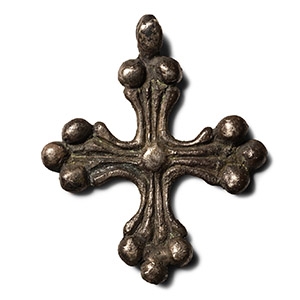
Viking Age Silver Cross Pendant
10th-11th century A.D.Estimate: £500 - 700 (+bp*)
Cross pommée with raised ribs to the obverse, central boss, pierced lug above. 19.2 grams, 53 mm
From the private collection of a London gentleman, from his grandfather's collection formed before the early 1970s. -
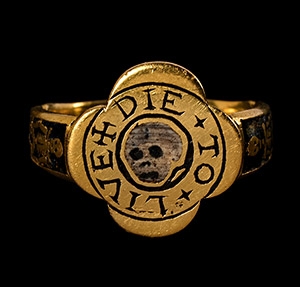
Post Medieval Enamelled Gold Memento Mori Ring with Skull and Skeletons
Circa 16th century A.D.Estimate: £8,000 - 10,000 (‡+bp*)
Comprising a D-section hoop with coffin-shaped shoulder plaques, each plaque with a full skeleton on black-enamelled background; flower-shaped bezel with a central white-enamelled skull in three-quarter view with black detailing, inscription '+ DIE x TO x LIVE' surrounding. 7.57 grams, 22.30 mm overall, 19.16 x 17.53 mm internal diameter (approximate size British R, USA 8 1/2, Europe 18 3/4, Japan 18)
Ex private collection, UK. with Notaras Coins and Antiquities, before 2014. European private collection, acquired from the above. This lot has been checked against the Interpol Database of stolen works of art and is accompanied by a search certificate number no.12144-218185. -
.jpg)
Post Medieval Gold Ring with Cabochon Garnet
17th century A.D.Estimate: £1,200 - 1,700 (+bp*)
With flat shoulders, rosette bezel with inset garnet cabochon. 2.76 grams, 23.72 mm overall, 19.94 x 16.02 mm internal diameter (approximate size British N, USA 6 1/2, Europe 13.72, Japan 13)
Ex property of a late Japanese collector, 1970s.

