-
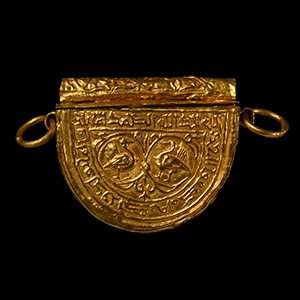
Seljuk Gold Pendant with Two Birds
12th-13th century A.D.Estimate: £2,000 - 3,000 (+bp*)
D-shaped in plan hollow-formed sheet gold pendant with lateral attachment loops; repoussé design to each broad face of two opposed birds within a circle formed by the branches of a tree, band of calligraphic text to the border; lid with rolled tubular panel, repoussé quatrefoil design, rim with running vinescroll; repaired. 11.18 grams, 41 mm
UK private collection before 2000. On the UK art market. Property of a London gentleman. -
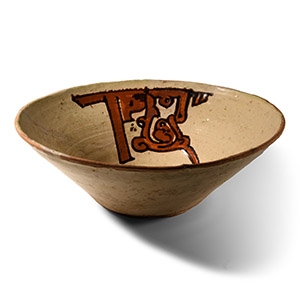
Nishapur White Glazed Plate with Kufic Inscription
9th-10th century A.D.Estimate: £2,000 - 3,000 (+bp*)
Funnel-shaped with stepped foot, cream-glazed inner face with large orange Kufic script motif outlines in black and a band of dense calligraphic text opposite. 628 grams, 24.1 cm wide
with a London, UK gallery 1971-early 2000s. This lot has been checked against the Interpol Database of stolen works of art and is accompanied by a search certificate number no.12129-217322. -
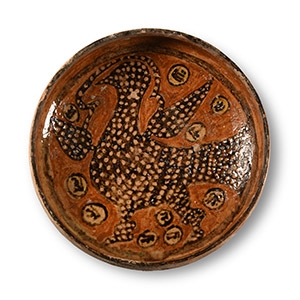
Nishapur Calligraphic Pottery Bowl
Persia, 9th-10th century A.D.Estimate: £800 - 1,000 (+bp*)
Of carinated profile with reserved orange shapes on a field of white pellets on black, roundels with legends; intact. 334 grams, 17.5 cm wide
with a London, UK gallery 1971-early 2000s. -
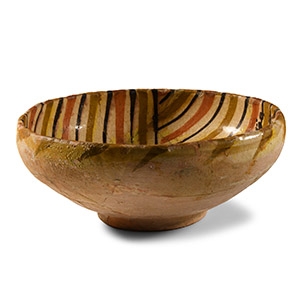
Central Asian Pottery Bowl with Kufic Inscription
Circa 10th century A.D.Estimate: £500 - 700 (+bp*)
Of rounded profile with painted design to inner face: quartered design of black, olive green and coral stripes on a cream field, one and a half lines of Kufic text across the centre; repaired. 384 grams, 16.5 cm wide
with a London, UK gallery 1971-early 2000s. -
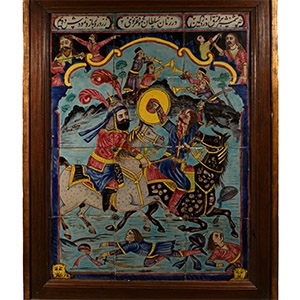
Qajar Tiles Decorated with Persian Battle Scene
19th century A.D.Estimate: £3,000 - 4,000 (+bp*)
A panel of twelve glazed pictorial tiles in vibrant colours depicting a battle scene from the epic poem 'Shahnameh', written during the reign of Sultan Mahmoud Ghaznavi (979-1030 A.D). and presented to him by the poet Ferdowsi, with two warriors on horseback fighting with swords, four trumpeters above and wounded figures and discarded arms below; with three small cartouches of nastaʿlīq script inscription at top; the tiles set with ornamental studs at intersections; all mounted within a substantial part-gilt wooden frame for hanging or display. 24.5 kg, 87 x 68.5 cm
Ex Habib Anavian Galleries Ltd, New York, USA. with Mahboubian Gallery, London, UK. Accompanied by the original 1979 catalogue where this piece is published. This lot has been checked against the Interpol Database of stolen works of art and is accompanied by a search certificate number no.12129-217321. -
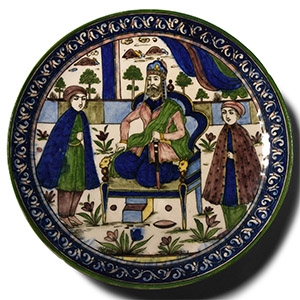
Large Iranian Ceramic Plate with Enthroned Nobleman
Early 20th century A.D.Estimate: £1,800 - 2,400 (‡+bp*)
With running foliage border enclosing a scene with a bearded nobleman sitting on a four-legged throne with lion-head finials and flanked by two attendants; flowers and other details in the field. 1.24 kg, 34.1 cm wide
Ex private collection, Belgium. with d'Arts d'Orient et Orientalisme, Paris, France, 1 June 2015, no.73. Ex Weber Kunsthandel, Cologne, Germany, 2015. This lot has been checked against the Interpol Database of stolen works of art and is accompanied by a search certificate number no.12131-218137. -
.jpg)
Luristan 'Mistress of Animals' Bridle Bit
Circa 9th-7th century B.C.Estimate: £3,000 - 4,000 (+bp*)
Each cheekpiece comprising the figure of a goddess on a rectangular base, standing in a long fringed robe and tiara with horns emerging from his head, grasping an attacking rampant winged griffin or winged lion in each hand, three loops to the reverse, perforated through the body through which the long mouthpiece passes. 1.03 kg, 24.5 cm
Acquired on the London art market, 1995. Ex Christie's London, 2nd April 2014, no.32. From the private collection of a North West London, UK, gentleman. Accompanied by a previous collection photograph and copies of the relevant Christie's catalogue pages. Accompanied by an academic report by Dr Raffaele D'Amato. This lot has been checked against the Interpol Database of stolen works of art and is accompanied by a search certificate number no.12049-217395.
The image of a deity holding two animals is ancient and found in many cultures and can depict either a male or female divinity. The goddess was known by the Greek as Potnia Theron, or "Lady of the Animals", a term first used by Homer in the Iliad. -
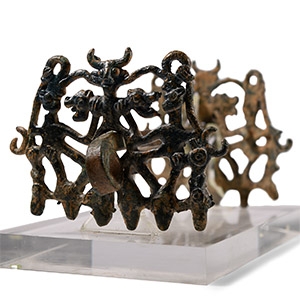
Luristan 'Master of Animals' Bridle Bit
Circa 9th-7th century B.C.Estimate: £3,000 - 4,000 (+bp*)
Comprising: a square-section bar with the ends scrolled in opposite directions; matched pair of outward-facing detailed openwork castings, each cheek-piece showing a god with a horned head above a figural scene with two opposed human figures in profile advancing towards a column with profile animal heads and other detailing; accompanied by a custom-made stand. 1.17 kg total, 19.5 cm wide including stand
From an old private Japanese collection. Acquired from Shimojo Art, Tokyo, Japan, in 2014. From the private collection of a North West London, UK, gentleman. Accompanied by a previous collection photograph, and the original official Japanese cultural export certificate issued by the Director of Art and Curatorial Division, Cultural Properties Department, Agency for Cultural Affairs, and invoice, dated 7th November 2014. Accompanied by an academic report by Dr Raffaele D'Amato. This lot has been checked against the Interpol Database of stolen works of art and is accompanied by a search certificate number no.12050-217397.
In the Mesopotamian world the forces of chaos are often represented by animals and the gods are seen as the restraining force to these unpredictable powers that could harm the human world. The presence of horns on these figures distinguishes them as being divine and is often found being worn by kings who saw themselves as close to the gods. -
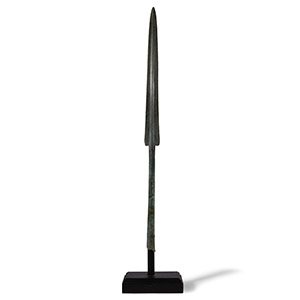
Marlik Bronze Spearhead with Linear Decoration
14th-10th century B.C.Estimate: £600 - 800 (+bp*)
Of triangular shape with projecting midribs with vertical grooves alongside, long folded socketted shaft with eighteen horizontal grooves at the base, hole for attachment to a wooden shaft. 436 grams total, 61 cm high including stand
Ex German collection, 1980s. From a Surrey, UK, private collection, 1990s.
This specimen belongs to the type VIII, subtype B of the Khorasani classification. Similar specimens were excavated in the Marlik Royal cemetery by Dr Negahban. The spearheads of this type are characterised by well projecting mid-ribs and long, folded sockets. -
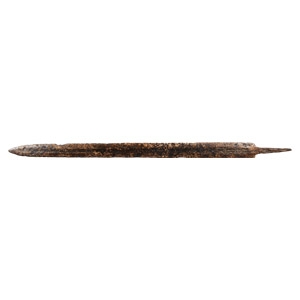
Roman Pattern-Welded 'Damascus' Iron Sword
3rd-4th century A.D.Estimate: £2,000 - 3,000 (+bp*)
A spatha with double-edged blade of Osterburken-Kemathen Type, fullers with damask pattern (rosette damask technique B.II.I.2), sturdy tang with remains of wood; the blade cleaned and conserved on one side. 659 grams, 85.5 cm
Excellent preserved blade
From the private collection of a London gentleman, from his grandfather's collection formed before the early 1970s. Accompanied by an academic report by Dr Raffaele D’Amato. This lot has been checked against the Interpol Database of stolen works of art and is accompanied by a search certificate number no. 11923-209660. -
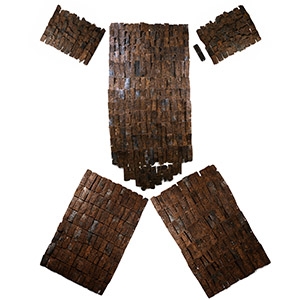
Jin Jurchen Warrior Signed Suit of Iron Plate Armor
Jin Dynasty, early 13th century A.D.Estimate: £8,000 - 10,000 (+bp*)
A complete suite of rectangular iron plates to form a protective coat; the plates provided with a series of holes close to the long edges by which they were laced together into articulating panels; one plate with inscription in Chinese script recording: 'first month of the Datong era / control of the propagation of Armour. Yanhui'. 8.5 kg total, 3-11.1 cm
From the private collection of a London gentleman, from his grandfather's collection formed before the early 1970s. Accompanied by an academic report by Dr Raffaele D’Amato. This lot has been checked against the Interpol Database of stolen works of art and is accompanied by a search certificate number no.12051-216403.
The Datong Era (大同, 1224–1233) is a name used for the reign of Puxian Wannu, a Jurchen warlord who established the Eastern Xia Dynasty in 13th century China. However, the war with the Jurchen states took more than 30 years: having first invaded the Jurchen borders in 1211, the Mongols finally defeated the Jin Empire only in 1234, while the Eastern Xia fell in 1246. -
.jpg)
Migration Period Iron Spatha Sword with Garnet Inlaid Hilt
5th-7th century A.D.Estimate: £5,000 - 7,000 (+bp*)
Comprising a double-edged parallel-sided blade showing battle nicks on both cutting edges, medium length tapering tang; lentoid-shaped lower-guard with inset garnets to one side; accompanied by an amber sword bead with a bronze stud with garnet inlay. 753 grams total, 1.9-80 cm
From the private collection of a London gentleman, from his grandfather's collection formed before the early 1970s. Accompanied by an academic report by Dr Raffaele D’Amato. This lot has been checked against the Interpol Database of stolen works of art and is accompanied by a search certificate no. 12063-217911.
This type of swords (cf. Lebedinsky 2001, p.117) usually had stones hanging from the pommel or hilt, like the one preserved here. This typology was widespread in central Europe by the Huns and there are also specimens attested in Gaul in the 5th century.

