-
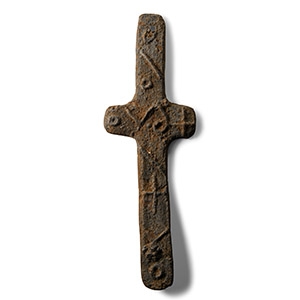
Byzantine Lead Cross
5th-7th century A.D.Estimate: £600 - 800 (‡+bp*)
Flat-section cruciform mount with stub arms and attachment point at one end; high-relief saltires, hoops and other detailing. 357 grams, 21.5 cm
Acquired in the mid 1980s-1990s. From the family collection of Mr S.A., Switzerland, thence by descent. Private collection since the late 1990s. -
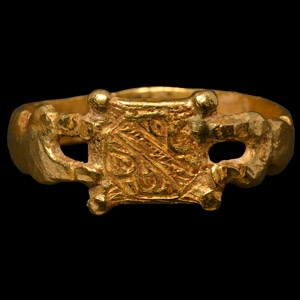
Byzantine Gold Ring with Foliate Motifs
Circa 11th-12th century A.D.Estimate: £1,200 - 1,700 (+bp*)
Comprising a flat-section hoop with a starburst motif to the base; openwork shoulders and a square bezel with a pellet to each corner, the bezel engraved with foliate motifs. 3.65 grams, 19.99 mm overall, 18.00 mm internal diameter (approximate size British L, USA 5 3/4, Europe 11.24, Japan 10)
Acquired from London galleries during the 1990s. From the jewellery collection of a London, UK, gentleman.
Some rings from the Balkan territories of the Eastern Empire (for example the ring from Dobrača) bear a square thickened bezel engraved with schematic representations. What sets them apart are the widened shoulders emphasised by a plastic rib and the raised and flattened head, which places them in the group of rings which dates mainly to the 11th century (from the end of the 10th to the first decades of the 12th century). -
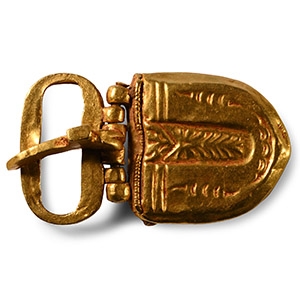
Byzantine Decorated Gold Belt Buckle
8th century A.D.Estimate: £4,000 - 6,000 (+bp*)
Comprising a D-shaped plate with acanthus-leaf motif in low-relief, beaded wire band above the hinge, kidney-shaped rectangular-section loop, flat tongue with spur to the upper face; three mounting studs to reverse. 33.02 grams, 55 mm
Acquired from Bernard Hern, 1970s. From an old UK collection, 1970s-1980s. This lot has been checked against the Interpol Database of stolen works of art and is accompanied by a search certificate number no.12113-217070. -
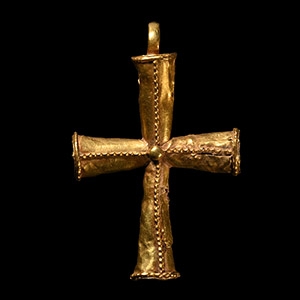
Byzantine Gold Cross Pendant
5th-6th century A.D.Estimate: £1,800 - 2,400 (‡+bp*)
Hollow-formed sheet gold cruciform pendant with filigree ropework to the end of each expanding tubular arm, band of beading to the upper face of each arm and central pellet; bale to the upper end. 3.67 grams, 40 mm
Acquired in the mid 1980s-1990s. From the family collection of Mr S.A., Switzerland, thence by descent. Private collection since the late 1990s. This lot has been checked against the Interpol Database of stolen works of art and is accompanied by a search certificate number no.12114-218167. -
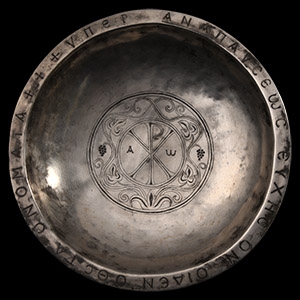
Byzantine Inscribed Silver Bowl with Chi Rho
Circa 11th-12th century A.D.Estimate: £10,000 - 14,000 (+bp*)
With rounded underside and flange rim; tondo with incised symmetrical vinescroll with bunches of grapes enclosing central disc with niello-filled Chi Rho flanked by alpha and omega; legend to the rim in capitals: '+++ ΥΠΕΡ ΑΝΑΠΑΥϹΕΩϹ ΕΥΧΗϹ ΟΝ ΟΙΔΕΝ ΟΘϹ ΤΑ ΟΝΟΜΑΤΑ' (For the eternal rest of him who had knowledge in the name of the Lord). 395 grams, 23.5 cm wide
From a European family collection formed in the 1990s; thence by descent to a UK gentleman. Accompanied by an academic report by Dr Raffaele D’Amato. Accompanied by professional drawings of the object. This lot has been checked against the Interpol Database of stolen works of art and is accompanied by search certificate no.11963-210867.
The decorative apparatus of this plate could be associated with Eastern Roman art of the 11-12th century A.D., although we cannot exclude an earlier dating. -
.jpg)
Byzantine Fresco Panel of Crowned Women
14th century A.D.Estimate: £30,000 - 40,000 (‡+bp*)
Fragment of a fresco panel depicting a group of young women wearing crowns, possibly depicting queens or wise virgins, three in the foreground with suggestion of others behind them; a vertical line to the left marking the border of the painting; two outer women's eyes turning towards a point high on the right, and the middle one lowering her eyes; wearing clothes richly decorated with precious stones and pearls, and crowns consisting of a band encrusted with gems and bordered with pearls, topped with points adorned with coloured stones in the style of Western European crowns. 5.08 kg, 40 x 40 cm
Acquired in the early 1980s. Ex old German private collection. From the private collection of Mr S.A., before 1992. Thence by descent. Accompanied by a copy of an Art Loss Register certificate no.PHO00064. Accompanied by an academic report by Dr Raffaele D'Amato. This lot has been checked against the Interpol Database of stolen works of art and is accompanied by a search certificate number no.12115-218166.
This painting possibly comes from a representation of the Last Judgment including the representation of the crowned men and women mentioned in the Apocalypse (chapter IV, verse 4). The crowned women present the signs of adoration specific to this type of representation, their eyes turned or lowered as a sign of respect towards a point where Christ seated on a throne was painted in glory. Perhaps attributable to the Balkans in the 14th century, a region divided among the realms of Hungary, Venice, Greater Serbia and others. Another possibility is that the panel represents the five wise virgins of the parable of Matthew 25, who are crowned brides by Christ. -
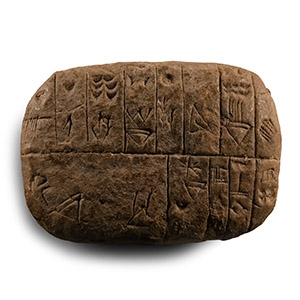
Proto-Sumerian Terracotta Pictographic Tablet for the Distribution of Barley
Circa 3300-3000 B.C.Estimate: £5,000 - 7,000 (‡+bp*)
Pillow-shaped tablet with dense cuneiform text to two broad faces and one edge. 130 grams, 82 mm
Private collection Mr S.A., acquired in 1994; thence by descent. This lot has been checked against the Interpol Database of stolen works of art and is accompanied by a search certificate number no.12116-218146. -
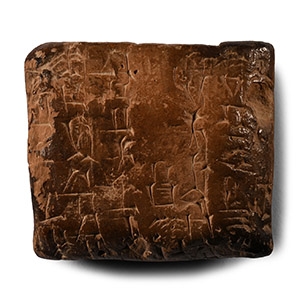
Proto-Sumerian Terracotta Pictographic Tablet
3rd Dynasty of Ur, circa 2036 B.C.Estimate: £2,000 - 3,000 (‡+bp*)
Pillow-shaped tablet with columns of pictograms to two broad faces and one edge. 27.6 grams, 40 mm
Ex De Groot collection, Belgium, acquired in the 1930s. with Bonhams, London, 13 April 2011, no.137. Accompanied by copies of the relevant Bonhams catalogue pages. This lot has been checked against the Interpol Database of stolen works of art and is accompanied by a search certificate number no.12118-218148. -
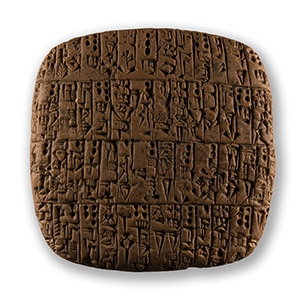
Early Dynastic Terracotta Cuneiform Administrative Tablet Recording Livestock and their Owners
IIIb, 2400-2340 B.C.Estimate: £18,000 - 24,000 (‡+bp*)
Pillow-shaped tablet with dense cuneiform text to two broad faces and one edge, concerning the listing of 146 sheep and their owners or shepherds. 202 grams, 78 mm
with Laemmle Gallery, San Vicente Boulevard, Los Angeles, USA. Acquired from the above in the early 1970s. with Bonhams, London, 13 April 2011, no.133. Private central European collection. Accompanied by copies of the relevant Bonhams catalogue pages. This lot has been checked against the Interpol Database of stolen works of art and is accompanied by a search certificate number no.12121-218147. -
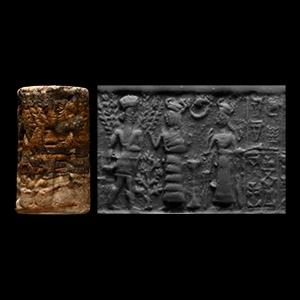
Akkadian Banded Agate Cylinder Seal with Inscription
2nd millennium B.C.Estimate: £500 - 700 (+bp*)
With figural panel depicting a standing male in short tunic with fronds extending from his shoulders facing a female in a tiered robe standing beside a tree; to her rear, a second figure in floor-length garment holding staves, objects in the field; two and a half columns of cuneiform text; supplied with a museum-quality impression. 10.7 grams, 25 mm
From the property of late Mr SM, London, UK, 1970-1990s, thence by descent. Examined by Professor Wilfrid George Lambert FBA (1926-2011), historian, archaeologist, and specialist in Assyriology and Near Eastern archaeology, in the late 1980s and early 1990s. -
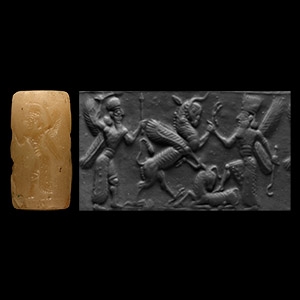
late Babylonian Stone Cylinder Seal with Contest Scene
1000-800 B.C.Estimate: £800 - 1,000 (+bp*)
With incuse frieze depicting a winged male figure wearing a tall headdress and holding a khopesh hooked sword, one foot placed on the corpse of a goat or ram, grappling with a rearing bull-headed winged beast and gripping its raised foreleg; behind, a second winged male figure with a sceptre and raised club to strike the bull-headed beast from behind; supplied with a museum-quality impression. 32.6 grams, 40 mm
From the property of late Mr SM, London, UK, 1970-1990s, thence by descent. Examined by Professor Wilfrid George Lambert FBA (1926-2011), historian, archaeologist, and specialist in Assyriology and Near Eastern archaeology, in the late 1980s and early 1990s. -
.jpg)
Large Mesopotamian Stone Stamp Seal with Lamassu
Circa 2000 B.C.Estimate: £800 - 1,000 (+bp*)
Plano-convex in section with broad face, incuse profile image of a lamassu (winged bull with a human head) with pellets and objects in the field. 70 grams, 59 mm
Collected from 1969-1999. From the collection of the late Mr S.M., London, UK.

