-
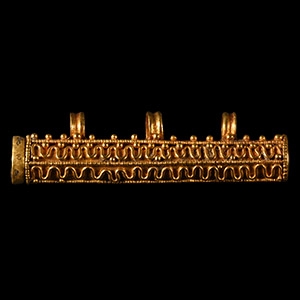
Roman Gold Amulet Holder
1st-4th century A.D.Estimate: £1,200 - 1,700 (+bp*)
Hexahedral in section, hollow with gusseted suspension loops, applied filigree meanders with granules. 7.40 grams, 47 mm
Ex German art market, 2000s. Acquired from an EU collector living in London. From the collection of Surrey, UK, gentleman. -
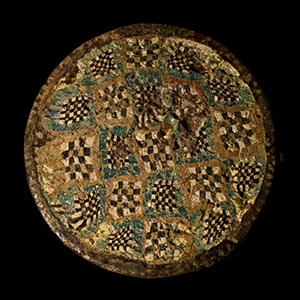
Roman Bronze Plate Brooch
2nd century A.D.Estimate: £600 - 800 (‡+bp*)
Comprising a discoid plaque and hinged S-curved pin to the reverse, the obverse with a millefiori glass insert. 5.61 grams, 24 mm
Acquired in the mid 1980s-1990s. From the family collection of Mr S.A., Switzerland, thence by descent. Private collection since the late 1990s. -
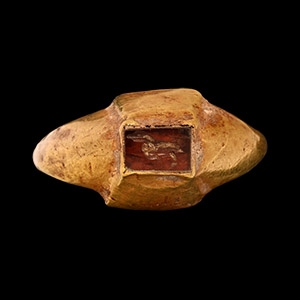
Roman Gold Ring with Bird Gemstone
2nd-4th century A.D.Estimate: £1,000 - 1,400 (+bp*)
With hollow-formed bezel set with a carnelian cloison, intaglio bird motif. 3.30 grams, 22.60 mm overall, 15.67 mm internal diameter (approximate size British H, USA 3 3/4, Europe 6.18, Japan 6)
Ex property of a late Japanese collector, 1970s. -
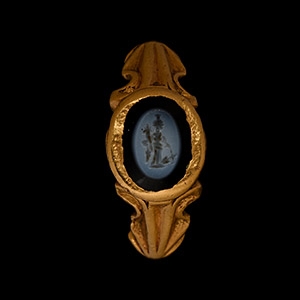
Large Roman Gold Ring with Tyche Gemstone
Mid-late 3rd century A.D. and laterEstimate: £7,000 - 9,000 (+bp*)
A substantial D-shaped ring with floral decoration, set with a later nicolo intaglio engraved with the figure of Tyche, holding a cornucopia and rudder, wearing a kalathos on her head; supplied with a museum-quality impression. 27.45 grams, 31.67 mm overall, 22.21 x 16.71 mm internal diameter (approximate size British O, USA 7, Europe 14.98, Japan 14)
Marcus Hollersberger, Solothurn, 1982. Ex Galerie Schönbrunn, Vienna, 1987. with Christie's, London, 7 December 2022, no.80. Accompanied by a copy of the relevant Christie's catalogue listing. This lot has been checked against the Interpol Database of stolen works of art and is accompanied by a search certificate number no.12105-217766. -
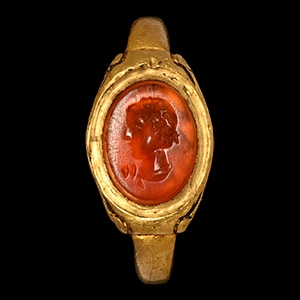
Roman Gold Ring with Portrait Gemstone
2nd-3rd century A.D. and laterEstimate: £2,500 - 3,500 (+bp*)
With ellipsoid plaque, stepped cell with inset later carnelian gemstone, intaglio female profile bust; supplied with a museum-quality impression. 6.51 grams, 24.31 mm overall, 20.37 mm internal diameter (approximate size British M, USA 6, Europe 12.46, Japan 12)
From the collection of a London, UK, gentleman, 1980-1990s. This lot has been checked against the Interpol Database of stolen works of art and is accompanied by a search certificate number no.12106-217761. -
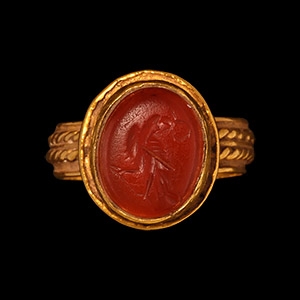
Roman Gold Ring with Imperial Eagle Holding Victory Wreath
4th-5th century A.D.Estimate: £1,500 - 2,000 (+bp*)
Comprising a broad hoop with applied ropework bands to the exterior, cup bezel with cell and inset carnelian intaglio of an eagle holding a wreath in its beak; Eastern Empire. 7.90 grams, 33.15 mm overall, 17.50 mm internal diameter (approximate size British O, USA 7, Europe 14.98, Japan 14)
Ex European private collection, 1990s. Property of an Essex gentleman. -
.jpg)
Roman Yellow Glass Flask
Circa 1st-2nd century A.D.Estimate: £1,800 - 2,400 (+bp*)
Mould-blown from translucent glass, the globular body on a circular flat base tapering at the shoulders to a cylindrical neck with an everted rim; a single applied handle; the body decorated with a horizontal band of a continuous Vitruvian wave framed by a double circumferential line, decorative ridges above and below; accompanied by a custom-made display stand. 16.7 grams, 66 mm (33.9 grams total, 79.4 mm high including stand)
From the property of the late Mr SM, London, UK, 1948-2000. Ex J.L. collection Surrey, UK. -
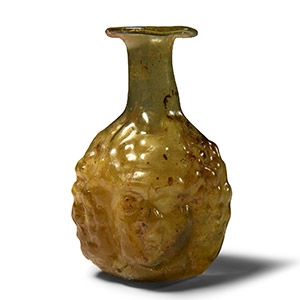
Roman Golden Glass Janus Head Flask
Circa 1st-2nd century A.D.Estimate: £800 - 1,000 (+bp*)
Formed as two addorsed heads with a short cylindrical neck and flaring mouth; both heads with abundant hair framing the face. 22 grams, 77 mm
Ex property of a late Japanese collector, 1970-2000s. -
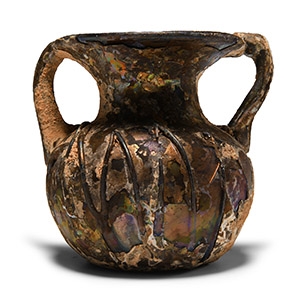
Roman Iridescent Aubergine Glass Jar with Two Handles
4th century A.D.Estimate: £700 - 900 (+bp*)
With squat bulbous body, dimple base, flared trumpet neck; applied trails to the shoulder, two strap handles. 51 grams, 76 mm
Ex property of a late Japanese collector, 1970-2000s. -
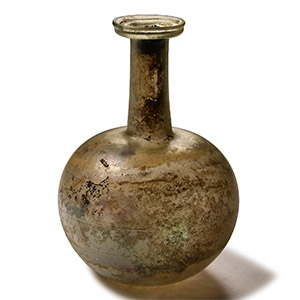
Roman Glass Vessel with Wheel-Cut Design
1st-3rd century A.D.Estimate: £600 - 800 (+bp*)
With globular body and long tubular neck, dimple base, everted rim with gusset to the outer edge; wheel-cut horizontal lines to the body. 115 grams, 13 cm
Acquired on the German art market, 1989-1995. with The Museum Gallery, 19 Bury Place, London, WC, UK, 1998-2003. Property of a London based academic, 2003-present. -
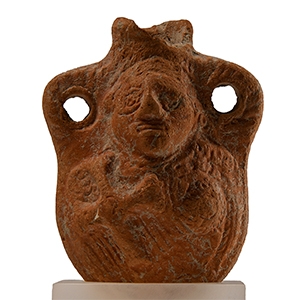
Byzantine Terracotta Pilgrim Flask with a Saint
6th century A.D.Estimate: £1,800 - 2,400 (‡+bp*)
Piriform in profile with two thick lug handles to the shoulder, obverse with low-relief facing figure holding a large cross and orb, reverse with facing figure with hand held up in the orans posture; with a display stand. 47.2 grams, 77 mm (71.4 grams total, 91 mm including stand)
Ex private collection, Mrs L.S., 1990s. Acquired from the above, 2001. Private European collection. This lot has been checked against the Interpol Database of stolen works of art and is accompanied by a search certificate number no.12110-218216. -
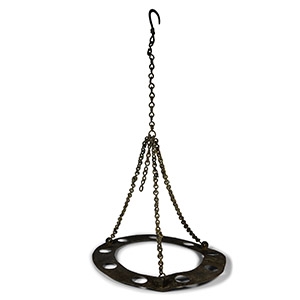
Large Byzantine Hanging Bronze Polycandelon
Circa 8th-10th century A.D.Estimate: £1,800 - 2,400 (+bp*)
Flat-section ring with nine round holes and attachment fittings for three substantial chains with suspension hook, forming a polycandelon chandelier with multiple candles. 1.52 kg, 68 cm hanging height
Ex Surrey, UK, collection of a gentleman, 1960-2000s. This lot has been checked against the Interpol Database of stolen works of art and is accompanied by a search certificate number no.12111-217545.
In 563 AD, Paul the Silentiary visited Hagia Sophia in Constantinople and described the wondrous lighting effects, ‘Thus is everything clothed in beauty…no words are sufficient to describe the illumination in the evening: you might say that some nocturnal sun filled the majestic church with light.’ The church was lit by polycandela, an early type of candelabra that held glass oil lamps rather than candles. The lamps were either conical or shaped like round bowls with an elongated stem attached beneath. An effective and very atmospheric source of lighting, polycandela required considerable skill in casting and glasswork. Amidst the burning of incense and the chanting of prayers, the flickering light must have helped to inspire pious devotion. Contemporaries certainly attest to this feeling and among the surviving accounts, that of Arculf, Bishop of Gaul, is particularly affecting. In 670 he went on a pilgrimage to Jerusalem and visited the Church of the Ascension, ‘…to the customary light of the eight lamps…on the night of the feast of the Lord’s Ascension it is usual to add innumerable other lamps; and under the terrible and wondrous gleaming of these, pouring out copiously through the shutters of the windows, all Mount Olivet seems not alone to be illuminated, but even to be on fire, and the whole city, situated on the lower ground nearby, seems to be lit up.’

