-
.jpg)
Late Roman Rosso-Antico Thumb Pestle
3rd-6th century A.D.Estimate: £1,800 - 2,400 (‡+bp*)
Red marble pestle or grinding tool, the handle formed as a thumb with knuckle and nail detailing; old collector's label '2' to underside. 312 grams, 12 cm
Ex private collection, Mrs L.S., 1980s. Acquired from the above, 1999. Private European collection. This lot has been checked against the Interpol Database of stolen works of art and is accompanied by a search certificate number no.12096-218201.
Mainly used by medical staff for grinding ingredients such as medicinal compounds, cosmetics and culinary spices. -
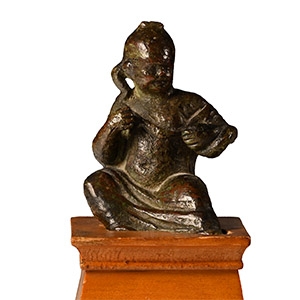
Roman Bronze Statuette of Harpocrates
1st-3rd century A.D.Estimate: £3,000 - 4,000 (‡+bp*)
Presented as a very young child sitting on the ground, wearing a long tunic which covers his body and legs down to his feet; right arm bent and hand raised to the shoulder, left hand curved around an object (absent); sporting the conventional sidelock behind the right ear; mounted in a custom-made tiered wooden stand. 213 grams, 73 mm (276 grams total, 10.2 cm including stand)
Ex Hanna Saba collection, Ambassador to Egypt-USA-France (1909-1992). Private European collection. This lot has been checked against the Interpol Database of stolen works of art and is accompanied by a search certificate number no.12098-218159.
His name was Hellenized in the Ptolemaic era and adopted by the Romans, indicating the mythological figure of Horus the child; he was the son of Isis and Osiris, and adored especially in Alexandria. -
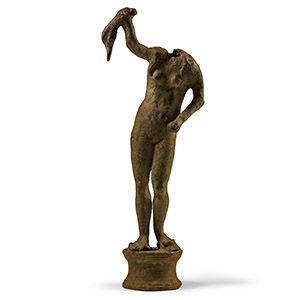
Roman Lead Figure of Aphrodite Holding a Severed Swan's Head
1st-3rd century A.D.Estimate: £1,200 - 1,700 (‡+bp*)
Modelled in the round nude and and raising her right arm, holding the neck of the swan (her animal attribute); left arm descending towards her pubis, legs in contrapposto stance; gusseted drum-shaped base. 327 grams, 19.5 cm
Acquired in the mid 1980s-1990s. From the family collection of Mr S.A., Switzerland, thence by descent. Private collection since the late 1990s. This lot has been checked against the Interpol Database of stolen works of art and is accompanied by a search certificate number no.12099-218223.
Although the presence of the swan in this position is rather rare, iconographically, this image is part of the abundant series of statuettes of Aphrodite/Venus widely distributed during the Roman Imperial era. -
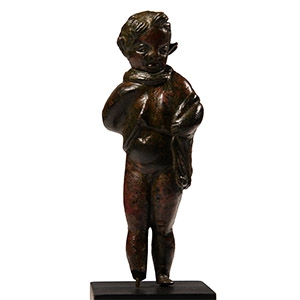
Roman Bronze Figure of a Young Satyr of Dionysian Cortege
Circa 1st-2nd century A.D.Estimate: £2,000 - 3,000 (+bp*)
Modelled in the round with putto-like features, holding a nebris draped over his shoulders in the manner of Dionysus, with tousled hair and pointed ears; one foot absent; mounted on a custom-made stand. 316 grams total, 15 cm high including stand
Acquired on the German art market, 1989-1995. with The Museum Gallery, 19 Bury Place, London, WC1A 2JB, 1998-2003. with Bonhams, London, Knightsbridge, 16-17 May 2002, no.305. Property of a London based academic, 2003-present. Accompanied by copies of the relevant Bonham's catalogue pages. This lot has been checked against the Interpol Database of stolen works of art and is accompanied by a search certificate number no.12052-217493.
The young satyr is covered by a nebris, a deer skin, similar to an aegis, originally worn as an item of clothing by hunters and subsequently attributed to Dionysus. Consequently, it was adopted by his followers in the processions and ceremonies held in his honour, during the liturgical celebrations of the Dionysia. It was commonly worn in the same way as an aegis, tying the two front legs over the right shoulder to allow the body of the skin to cover the wearer's left side (Ovid, Metamorphoses, VI, 593). In ancient works it is seen worn by characters of the Dionysian procession: Maenads, Bacchae, Satyrs, and Sileni. -
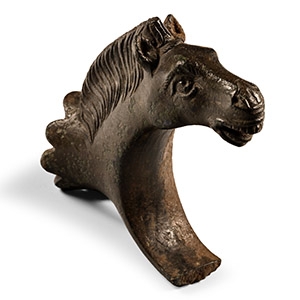
Roman Bronze Horse-Head Mount
2nd-3rd century A.D.Estimate: £1,200 - 1,700 (+bp*)
Hollow-formed mount formed as a crescent with horse-head finial modelled with flying mane and mouth open; to the rear, a deep flared socket with dentilled rim. 106 grams, 63 mm
Acquired on the German art market, 1989-1995. with The Museum Gallery, 19 Bury Place, London, WC1A 2JB, 1998-2003. Property of a London based academic, 2003-present.
This is beautiful Roman workmanship, probably derived from Hellenistic prototypes, which finds comparisons in similar mounts at the Metropolitan Museum of Art in New York and the British Museum. It could be a bed mount (for bed or triclinium) or a furniture element. It is also possible that it was a cart or chariot element. -
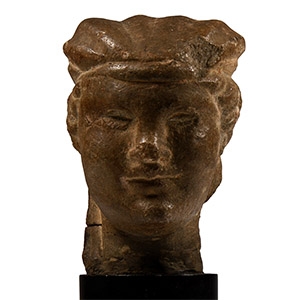
Roman Marble Female Head
2nd century A.D.Estimate: £1,000 - 1,400 (‡+bp*)
Carved in the half-round, showing a mature female with rounded facial features and hair drawn back in a chignon; band and ridged body of the headdress in Egyptianising style; mounted on a custom-made wooden display stand. 520 grams total, 17 cm including stand
Private collection, Munich, Germany. with Heritage of Ketterer, Munich, Germany. with Auction House Ursula Nusser E.K., Germany, 2011, no.4021. -
.jpg)
Roman Marble Torso of Aphrodite
1st century B.C.-2nd century A.D.Estimate: £8,000 - 10,000 (‡+bp*)
Carved in the round as a torso of a slender female with hips turned, probably in contrapposto pose; mounted on a custom-made display stand. 23.4 kg total, 44 cm including stand
Ex private collection. with Artemis Gallery, Munich, Germany, early 1990s. Acquired from the above, 1999. Private European collection. Accompanied by an academic report by Dr Raffaele D'Amato. This lot has been checked against the Interpol Database of stolen works of art and is accompanied by a search certificate number no.12101-218196. -
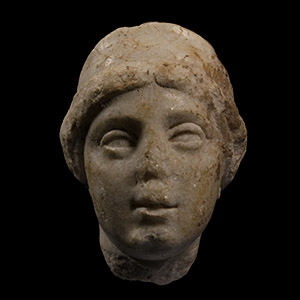
Roman Marble Head of a Woman
1st-3rd century A.D.Estimate: £1,800 - 2,400 (‡+bp*)
Carved in the round with carinated diadem in the hair, heavily lidded eyes, small mouth with pursed lips. 620 grams, 95 mm
Acquired in the mid 1980s-1990s. From the family collection of Mr S.A., Switzerland, thence by descent. Private collection since the late 1990s. This lot has been checked against the Interpol Database of stolen works of art and is accompanied by a search certificate number no.12102-218191. -
.jpg)
Roman Marble Portrait Head of Gaius Caesar
Augustan, circa 5 B.C.-1 A.D.Estimate: £30,000 - 40,000 (+bp*)
Modelled in the round probably using Parian marble, head of a youth depicted turning slightly to his left, hair trimmed in the Julian style; believed to be of Gaius Iulius Caesar Vipsanianus (20 B.C.- 4 A.D.); mounted on a custom-made stand. 17.4 kg total, 48 cm high including stand
Acquired on the London art market in the 1970s by the previous owner’s late father. with Christie’s London, 25 April 2007, no.260. UK private collection, London. Anonymous sale, Bonhams, London, 16 April 2015, no.130. Accompanied by an academic report by Dr Raffaele D’Amato. This lot has been checked against the Interpol Database of stolen works of art and is accompanied by a search certificate number no.163499-10061.
Gaius Caesar (20 B.C.-4 A.D.) and his brother Lucius Caesar (17 B.C.-2 A.D.) held significant positions in the political and dynastic plans of Emperor Augustus. Born to Augustus' daughter Julia and his advisor Marcus Vipsanius Agrippa, they were adopted by Augustus in 17 B.C. to become his heirs, since he lacked natural-born sons. Portraits of the brothers depicted them as resembling Augustus, indicating their importance within the imperial family. Gaius' portraits were classified into five types, with this head identified as Type IV, likely created in 1 A.D. to celebrate his consulship. A similar portrait of Gaius exists in Corinth alongside his brother and Augustus. In 1 B.C., Gaius was appointed to govern the eastern provinces, where he successfully negotiated a peace treaty with Parthia's King Phraates V. However, tragedy struck when Gaius fell ill in Anatolia and died at 23, following the death of his brother Lucius. These deaths disrupted Augustus' plans for succession and led him to adopt Tiberius, his stepson, who eventually became emperor in 14 A.D. -
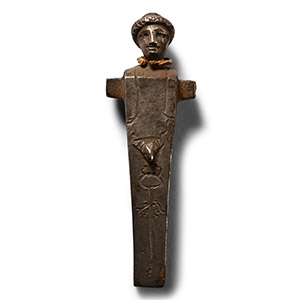
Roman Silver Miniature Herm
1st-3rd century A.D.Estimate: £2,500 - 3,500 (‡+bp*)
Comprising a square-section tapering body with lateral stub arms; head of Mercury (Greek Hermes) above with applied twisted gold collar, low-relief shoulder panels, genitals modelled in the round, low-relief horned figure below. 27 grams, 52 mm
Acquired in the mid 1980s-1990s. From the family collection of Mr S.A., Switzerland, thence by descent. Private collection since the late 1990s. This lot has been checked against the Interpol Database of stolen works of art and is accompanied by a search certificate number no.12103-218207.
This object, was likely votive and perhaps belonged to a small domestic altar of the Roman imperial era, reproduced in miniature size a Hermaic pillar. These were terminals made of stone or wood which were often placed on the roads, near crossings; they served to indicate the right path and therefore were supposed to protect travellers when traveling. In Roman times, these pillars were often topped with busts or portraits and were also found in the gardens of wealthy homes; gods (Hermes and Bacchus in particular) or philosophers were the subjects thus represented. -
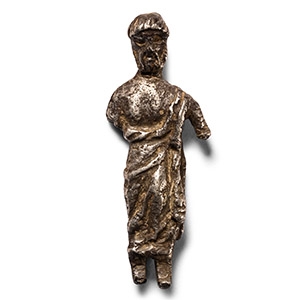
Roman Silver Figure of a Man
1st-3rd century A.D.Estimate: £500 - 700 (‡+bp*)
Standing erect wearing a draped toga, bearded and with thick bowl-cut hair. 9.05 grams, 39 mm
Acquired in the mid 1980s-1990s. From the family collection of Mr S.A., Switzerland, thence by descent. Private collection since the late 1990s. -
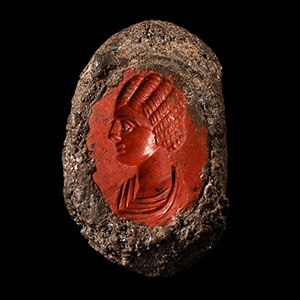
Roman Silver Ring with Portrait Gemstone
Circa 200 A.D.Estimate: £800 - 1,000 (+bp*)
Ellipsoid jasper insert with profile portrait bust of a female with tiered hairstyle and palla. 9.85 grams, 25.65 mm overall, 17.84 mm internal diameter (approximate size British G, USA 3 1/4, Europe 4.92, Japan 4)
From a London gentleman's, UK, collection, in the 1990s.

