-
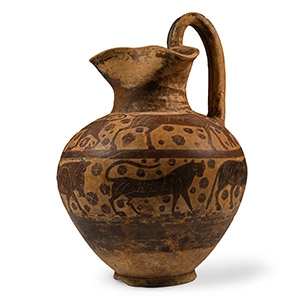
Corinthian Black-Figure Oinochoe
6th century B.C.Estimate: £4,000 - 6,000 (‡+bp*)
Decorated with two superimposed friezes of animals including panthers, bulls and grazing ibexes; flowers and rosettes in the field; restored. 675 grams, 26.5 cm
Private collection, Old City of Jaffa, Israel. with Archeological Center, Tel Aviv, Israel. Accompanied by a thermoluminescence analysis report no.N124d54 from Oxford Authentication. -
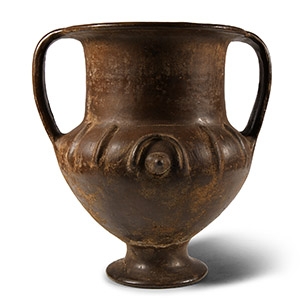
Villanovan Impasto Handled Amphora
Circa 750-700 B.C.Estimate: £800 - 1,000 (+bp*)
Comprising a wide foot beneath a squat stem with a bulbous body, a sloped shoulder beneath a columnar neck, a flared rim, and a pair of applied strap handles arching between rim and shoulder; body decorated with eight slender, vertical ribs surrounded by pecked stippling; two lateral bosses beneath a parabolic arch; surface burnished throughout; foot restored. 1.29 kg, 22.1 cm
From the collection of Eleanor Hilowitz (1913-2007), an abstract expressionist painter and sculptor, New York, USA; acquired between 1956 and 1975. Acquired by Randall Hixenbaugh of Hixenbaugh Ancient Art, New York, USA, in 2007. with Artemis Gallery, 26 September 2019, lot 54 (US$2,000-3,000). Property of a South Australian private collector, with collection reference 20.03. Accompanied by detailed collector's catalogue pages including description and photograph. -
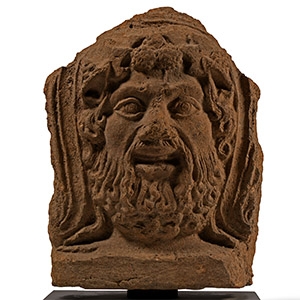
Etruscan Terracotta Satyr Antefix
4th century B.C.Estimate: £3,000 - 4,000 (+bp*)
D-shaped in profile with high-relief mask of a satyr within a looped frame; hanks of curling hair to the brow and temples with berries to the fillet, lentoid eyes, broad nose, curling moustache and beard; ledge below and arched ridge to the reverse; mounted on a custom-made stand. 6.77 kg total, 30 cm including stand
Acquired from Faustus Ancient Art Ltd, London, 1990. Private American collection. with Christie’s, London, 27 October 2009, no 9. Accompanied by copies of the relevant Christie's catalogue pages. Accompanied by an academic report by Dr Raffaele D’Amato. This lot has been checked against the Interpol Database of stolen works of art and is accompanied by a search certificate number no.12062-217441.
The antefix belongs to the typical decorative scheme of alternating maenad and satyr head antefixes that were mainly produced in Cerveteri. Heads were often placed in temples and displayed identifying features such as wavy hair and large, almond-shaped lidded eyes, and were lavishly painted. These typologies of antefixes generally look quite similar and appear to have identical colour schemes with dark red skin, and with darker shade of red applied to the hair below the ears and on top of the head and inside the ears. -
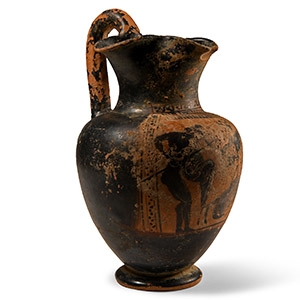
Greek Black-Figure Oinochoe
6th century B.C.Estimate: £1,800 - 2,400 (‡+bp*)
With pinched three-lobe mouth and strap handle; threads and details highlighted in purple; decorated scene in square metope comprising two dancing figures, one male and the other female, probably symposiasts; the male naked, holding a stick in his right hand and with the other arm carrying his coat; the female, a hetaera, dancing and running to the right, wearing a long chiton and a coat. 423 grams, 20.3 cm
Acquired in the mid 1980s-1990s. From the family collection of Mr S.A., Switzerland, thence by descent. Private collection since the late 1990s. This lot has been checked against the Interpol Database of stolen works of art and is accompanied by a search certificate number no.12089-218152. -
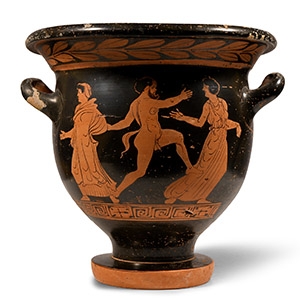
Greek Lucanian Red-Figure Bell-Krater
Circa 380-370 B.C.Estimate: £10,000 - 14,000 (‡+bp*)
Decorated with a meander with saltire squares below the figural scenes, and a laurel below the rim; Side A: a nude gesticulating satyr with short curly hair and long beard, running to the right with his left leg raised and his arms outstretched, characteristic pointed ears and pug nose, towards a maenad moving right and looking back at him, her hair short and curly, her body draped in a chiton, with another maenad standing behind him, facing left, draped in a himation over a chiton; Side B: three youths in draped cloaks with hoods thrown back; professionally restored. 2.1 kg, 29 cm wide
Fine condition, professionally restored.
Belgian private collection, 1950s. with Christie's, New York, 4 June 2008, no.190. Private central European collection. Accompanied by a copy of the relevant Christie's catalogue pages. Accompanied by an academic report by Dr Raffaele D’Amato. This lot has been checked against the Interpol Database of stolen works of art and is accompanied by a search certificate number no.12067-218141.
The style allows us to attribute this vase to an unknown artist of Lucanian origin: it is in ancient Lucania (a region which is located between present-day Calabria and Basilicata, in Southern Italy and between the Tyrrhenian Sea and the Ionian Sea, with Metaponto as a well-known city) that the first Italic style of red-figure painting developed. -
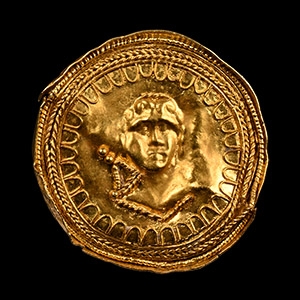
Greek Gold Ring with Roundel
Hellenistic, 3rd-1st century B.C.Estimate: £1,800 - 2,400 (‡+bp*)
Flat-section hoop and discoid cell with inset panel, filigree ropework border enclosing band of U-shaped filigree and repoussé central motif of a facing bust with applied granule detailing. 4.14 grams, 23.21 mm overall, 18.15 x 16.08 mm internal diameter (approximate size British N, USA 6 1/2, Europe 13.72, Japan 13)
Private collection, Germany. with Artemis Gallery, Munich, 1990s. Private European collection, 2001. This lot has been checked against the Interpol Database of stolen works of art and is accompanied by a search certificate number no.12091-218184. -
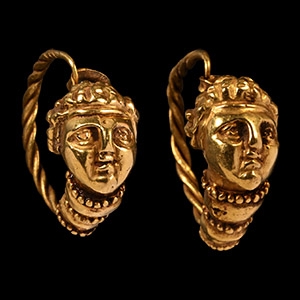
Greek Gold Earrings with Female Heads
Hellenistic, 2nd-1st century B.C.Estimate: £1,500 - 2,000 (+bp*)
Each a hollow-formed female head with stephane to the brow, granulated collars flanking biconvex bulbs, tapering twisted shank curved to meet the gussetted loop above the head. 5.93 grams total, 25-28 mm
From the collection of a gentleman, acquired on the London art market in the 1990s. -
.jpg)
Graeco-Phoenician Mottled Agate Scaraboid with Three Line Inscription
6th-5th century B.C.Estimate: £1,200 - 1,700 (+bp*)
Plano-convex with three lines of incised text to the underside within a hatched border; supplied with a museum-quality impression. 2.11 grams, 16 mm
From the Fadel family collection, London, UK, 1970s. -
.jpg)
Monumental Greek Apulian Red-Figure Calyx-Krater
Late 4th century B.C.Estimate: £18,000 - 24,000 (‡+bp*)
With elegant fluted body, drum foot and elaborate up-swung handles, displaying polychrome panels on both sides, between a laurel wreath below the rim and a band of Greek meander motif; Side A: the hero Bellerophon riding Pegasus, wearing a Thessalian hat (petasos), depicted nude except for a cloak fastened at the centre of the neck by a round clasp, the hero towering above the other two mythological characters beneath him: Princess Filinoe, on the left, crowned and dressed in a long chiton, and King Iobates of Lycia, dressed in Persian fashion with a long sleeved red tunic worn under a long dress, the field with a representation of an altar, two palm branches over a volute krater, a shield, a javelin, a lotus flower, and above the hero a hanging shield and two clamydes; Side B: figure of a young beardless man, wrapped in a large cloak and holding a staff, with windows and floral scrolls on the background. 7.6 kg, 56 cm high
Acquired in the mid 1980s-1990s. From the family collection of Mr S.A., Switzerland, thence by descent. Private collection since the late 1990s. Accompanied by an academic report by Dr Raffaele D’Amato. This lot has been checked against the Interpol Database of stolen works of art and is accompanied by a search certificate number no.12068-218200.
The decoration is very different on the two sides: on the main one, the painter has created a large mythological scene as if it was a summary. The scene comprising the famous hero Bellerophon riding Pegasus, the winged horse, flying above Iobates and his daughter (who will become the hero's wife). The king sent Bellerophon to perform impossible mission, among which the best known is the fight against the Chimera (monster with the body of a lion and a goat, with a snake's tail and two heads, one of a lion and the other of a goat). -
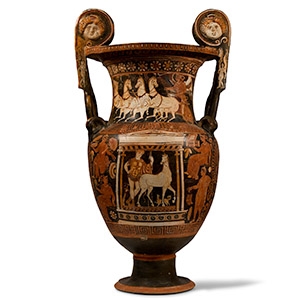
Monumental Apulian Red-Figure Volute Krater Attributed to the Licurgus Painter
Circa 330 B.C.Estimate: £50,000 - 70,000 (‡+bp*)
With a flared and carinated foot, meander patterns around the lower body, band of rosettes encircling the neck, gusseted handles with masks to the outer faces opening to two columnar legs, broad shoulder with loops flanking the handles; red-figure scenes to the neck and body: Side a: above, a quadriga with Nike at the reins, wings spread; below, naiskos with flanking columns, hero standing beside his horse, resting on his spear, wearing a muscled armour, surrounded by seated and reclining females and youths in various poses, one of the youths holding the hero's pointed boots in his hand; Side b: above, a palmette, below column with decorative ribbons flanked by two seated males and two females offering votive gifts; some restoration. 13.85 kg, 78.5 cm high
Private collection, Neuchâtel, Switzerland. Ex collection H.& P. Payot, Clarens, by descent. Accompanied an academic report by Dr Raffaele D’Amato. This lot has been checked against the Interpol Database of stolen works of art and is accompanied by a search certificate number no.12066-218199.
Monumental kraters such as this one are typical of the Apulian red-figure production that developed between circa 440 and 300 B.C. in the region of the Greek colonies of Taranto and Metaponto in Southern Italy, where they were used as tomb markers in cemeteries. Here the painter focuses on the celebration of the hero-warrior, surrounded by young women and men, the image of the victorious leader is emphasised by the full panoply and iconography of Nike. -
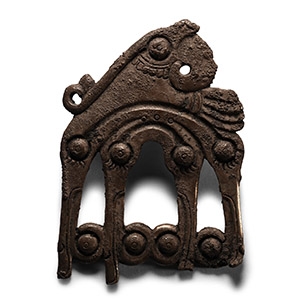
Thracian Silver Pendant
6th-3rd century B.C.Estimate: £500 - 700 (‡+bp*)
Openwork plaque depicting a stylised horse with curved body, bosses to the hips and shoulders, head turned backwards along the spine with looped reins; ribbed loop to the reverse. 41.5 grams, 75 mm
Acquired in the mid 1980s-1990s. From the family collection of Mr S.A., Switzerland, thence by descent. Private collection since the late 1990s. -
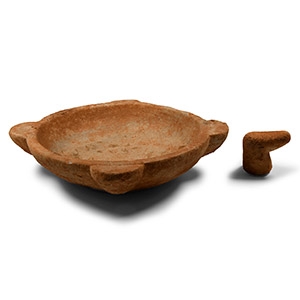
Roman Marble Mortar with Pestle
2nd-4th century A.D.Estimate: £1,800 - 2,400 (‡+bp*)
Broad squat carved mortarium with basal pad and four D-section ribs to the outer face; separate pestle shaped like a thumb. 1.96 kg total, 5.6-24.8 cm
Ex private collection, Mrs L.S., 1990s. Acquired from the above, 2000. Private European collection. This lot has been checked against the Interpol Database of stolen works of art and is accompanied by a search certificate number no.12095-218195.

