-
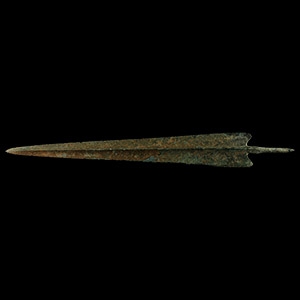
Large North-Western Persian Bronze Sword Blade
11h-7th century B.C.Estimate: £180 - 240 (+bp*)
With prominently curved guard extending out from the ricasso partly framing the hilt, thick midrib extending slightly above the ricasso. 385 grams, 44 cm
Acquired 1980-2015. Ex Abelita family collection.
The hilt of such swords was made separately and unfortunately is nearly always missing from the archaeological records. Similar daggers had a northern Iranian background and excavated examples have been recorded from the South Caspian area from Tomadjan and Ghalekuti. Their chronology ranges from the late 2nd millennium B.C. to the 7th century B.C. -
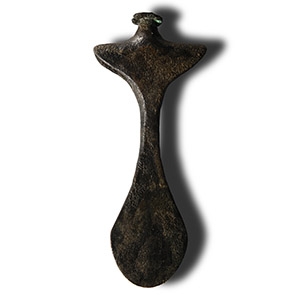
Margiana Bronze Axehead
Late 2nd millennium B.C.Estimate: £200 - 300 (+bp*)
With a narrow neck and rounded bill-shaped blade, rounded wings to the socket and square-headed stud behind. 289 grams, 18.3 cm
Ex Abelita family collection, 1988.
These categories of axes were of Oriental production, coming from the territories of Bactria and Margiana, occasionally imported to Elam and Luristan. The anthropomorphic and zoomorphic patterns are sometimes visible, and the button at the back of the heel (very common) is related to examples from Luristan, but the style differs markedly. -
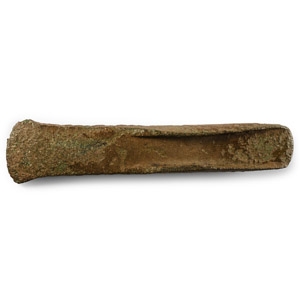
Bronze Age 'Yorkshire' Palstave Axehead
2nd millennium B.C.Estimate: £120 - 170 (+bp*)
Short-flanged with slightly curved butt, small lateral flanges to each face, long blade with lateral flanges to each face. 115 grams, 11.3 cm
Found whilst searching with a metal detector in Yorkshire, UK. -
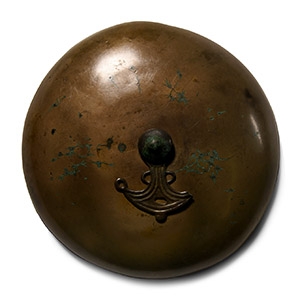
Bronze Age Shield Boss
Early 1st millennium B.C.Estimate: £400 - 600 (+bp*)
Domed in profile with applied hub and openwork pelta-shaped plaque. 68 grams, 12.2 cm
Ex London, UK, collection, 1990s. -
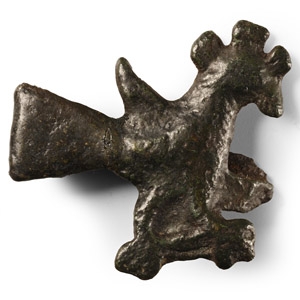
Viking Bronze Bird Brooch
10th-12th century A.D.Estimate: £150 - 200 (‡+bp*)
Modelled in profile with radiating tripartite crest, triangular stub wing, splayed feet, catch and pin-lugs to the reverse. 10.9 grams, 38 mm
From the collection of a North American gentleman, formed in the 1990s.
Bird brooches from the late Viking era have been found in Scandinavia as well in the English Danelaw, through to the early Norman era; such brooches can be dated to the 11th and even early 12th century. -
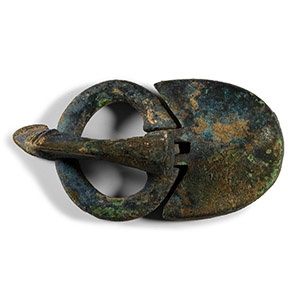
Germanic Bronze Belt Buckle
Circa 450 A.D.Estimate: £400 - 600 (+bp*)
D-shaped buckle plate with shallow sidewall, hinge-knuckles connecting to the belt-loop, hinged triangular-section tongue with zoomorphic detailing. 134 grams, 90 mm
UK private collection before 2000. On the UK art market. Property of a London gentleman. -
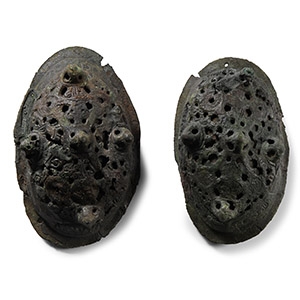
Large Viking Age Bronze Tortoise Brooch Pair
9th-10th century A.D.Estimate: £1,200 - 1,700 (+bp*)
Comprising: two elliptical bronze tortoise brooches, each a domed openwork shell with raised ornament of five bell-shaped studs and four Borre Style beasts; frieze of profile beasts to the lower edge and flange rim; catchplate, pin-hinge and pendant attachment bar to the reverse with mineralised remains of textile backing; repaired. 218 grams total, 10.8-11.5 cm
From the private collection of a London gentleman, from his grandfather's collection formed before the early 1970s. -
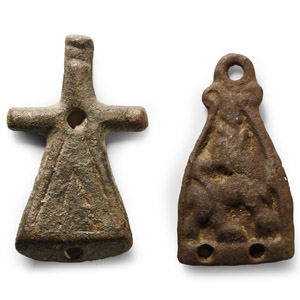
Anglo-Scandinavian Viking Bronze Stirrup Apex Mount Group
11th century A.D.Estimate: £150 - 200 (+bp*)
Comprising: a tongue-shaped mount of Williams's Class A Type II with pierced trefoil final, high-relief wolf in profile with head raised, two rivet-holes to the base and narrow ledge to the reverse; a triangular mount of Williams' Class A Type 14 with three radiating arms at the apex and rivet-hole between, low-relief chevron to the plaque, angled ledge to the lower edge with median rivet-hole. 43.3 grams total, 49-53 mm
Acquired on the UK art market in the 1980s. From an East Anglian private collection. -
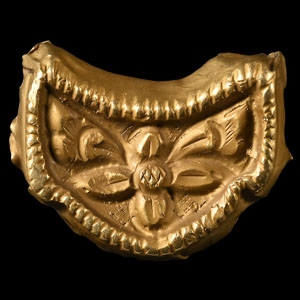
Medieval Gold Dagger Escutcheon
Circa 14th-16th century A.D.Estimate: £200 - 300 (+bp*)
Tongue-shaped with ropework border, central panel with a low-relief floral motif; two pins to the reverse. 1.98 grams, 20 mm
Ex property of a late Japanese collector, 1970-2000s. -
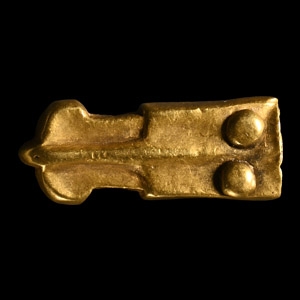
Medieval Gold Belt Buckle Strap End
Circa 1500 A.D.Estimate: £180 - 240 (+bp*)
Hollow-formed with a tongue-shaped finial, two attachment studs in situ to the other end. 2.50 grams, 22 mm
From a late Japanese specialist collector, 1970-2000s. -
.jpg)
Medieval Limestone 'Pictish Type' Fish Carving
Circa 15th-16th century A.D. or earlierEstimate: £500 - 700 (+bp*)
Rectangular block with high-relief carving to the upper face, comprising two fishes placed side-by-side, one with heavy scale detailing, the other with a bifurcated tail; mounted on a custom-made display stand. 24 kg total, 51 cm wide including stand
Discovered in part of a stone garden wall during demolition. Ex Stamford deceased estate, Lincolnshire, UK. Property of a Cambridgeshire, UK, gentleman.
The carving style bears similarities to the low-relief carvings on Pictish picture stones, although a close match for the subject matter is absent. A stone recorded at Dunnicaer, Scotland, is carved with a fish symbol but its execution is very sparse and linear in comparison with the heavy detailing of the present piece. See Noble, G., The Problem with the Picts, in Current Archaeology, issue 134, June 2020. -
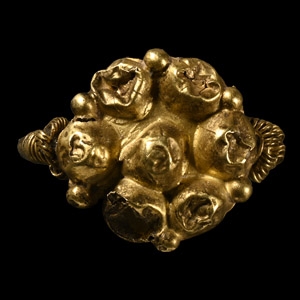
Medieval Gold Ring with Floral Bezel
Circa 15th-16th century A.D.Estimate: £400 - 600 (+bp*)
Comprising a round-section hoop with an applied floral bezel, small pellet between each petal; decorative wire wrapped around the hoop on each side of the bezel, probably modified from an earlier Hellenistic earring. 2.88 grams, 20.87 mm overall, 16.33 x 15.63 mm internal diameter (approximate size British H 1/2, USA 4, Europe 6.81, Japan 6)
From the property of the late Mr SM, London, UK, 1969-1999.

