-
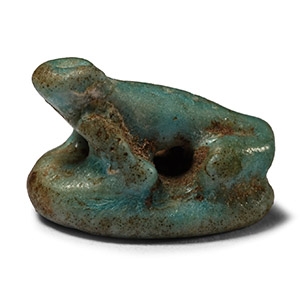
Egyptian Faience Frog Scarab
Ptolemaic Period, circa 300 B.C.Estimate: £500 - 700 (‡+bp*)
Discoid base with crouching frog pierced longitudinally for threading; underside with a solar disc and unidentified symbol. 0.56 grams, 13 mm
Ex R. Liechti (1934-2010) Geneva, Switzerland, formed between 1950-1990s. Accompanied by a copy of an old collection inventory note. -
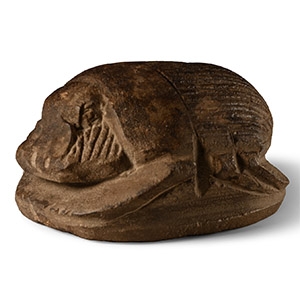
Egyptian Carved Stone Scarab
1st millennium B.C.Estimate: £500 - 700 (+bp*)
With textured carapace and detailed head and legs; underside blank. 159 grams, 63 mm
Acquired on the German art market, 1989-1995. with The Museum Gallery, 19 Bury Place, London, WC1, UK, 1998-2003. Property of a London based academic, 2003-present. -
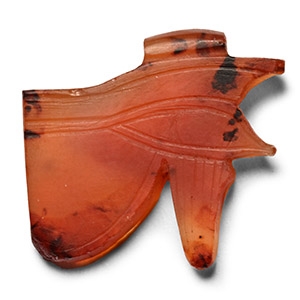
Egyptian Carnelian Eye of Horus Amulet
Circa 1000 B.C.Estimate: £1,000 - 1,400 (‡+bp*)
With exceptional eye detailing carved in low-relief to one face. 1.64 grams, 19 mm
Ex R. Liechti (1934-2010) Geneva, Switzerland, formed between 1950-1990s. Accompanied by a copy of an old collection inventory note.
The wedjat-eye amulet is a representation of the healed eye of the god Horus, featuring both human and falcon elements. The name wedjat in ancient Egyptian means ‘the one that is sound.’ According to Egyptian mythology, Horus' eye was wounded or taken by the god Seth and restored by Thoth. The wedjat-eye amulet was thought to protect its wearer and bestow the power of recovery and regeneration onto them. It was very popular and used by both the living and the dead. -
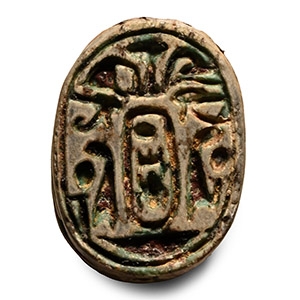
Egyptian Steatite Scarab for Thutmose III
New Kingdom or later, circa 1334-332 B.C.Estimate: £400 - 600 (+bp*)
Underside with cartouche of Pharaoh Thutmose III (Men-kheper-Re). 3.85 grams, 20 mm
Ex North London gentleman's collection, 1990s. Property of a Cambridgeshire, UK, gentleman.
The popularity of this great Egyptian pharaoh was such that his name appeared on scarabs during his reign and into the Late Period. -
.jpg)
Egyptian White Stone Scarab with Uraei and Falcons
New Kingdom-Late Period, 1550-332 B.C.Estimate: £400 - 600 (+bp*)
Underside with design including hieroglyphs and falcons and uraei. 3.8 grams, 21 mm
Ex North London gentleman's collection, 1990s. Property of a Cambridgeshire, UK, gentleman. -
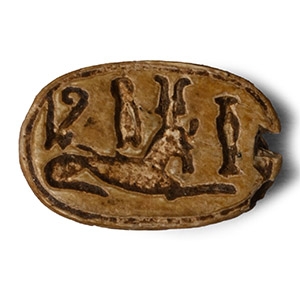
Egyptian Steatite Scarab
1st millennium B.C.Estimate: £500 - 700 (‡+bp*)
With detailed carapace and mouth, hieroglyphs to the underside depicting a pharaoh-headed recumbent lion, with hes-vase in front and the crowns of Lower and Upper Egypt behind. 0.80 grams, 12 mm
Ex R. Liechti (1934-2010) Geneva, Switzerland, formed between 1950-1990s. -
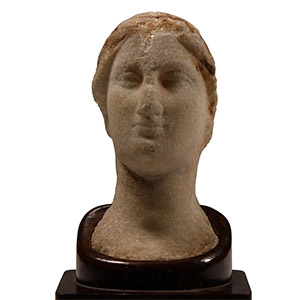
Egyptian Marble Head of a Queen
Ptolemaic Period, 323-30 B.C.Estimate: £3,000 - 4,000 (‡+bp*)
Modelled in the half-round with a stephane and centre-parted hair, serene facial features including hooded eyes and pert lips; mounted on a custom-made wooden display stand. 313 grams total, 10 cm high (14.3 cm high including stand)
Ex Hanna Saba collection, Ambassador to Egypt-USA-France (1909-1992). Private European collection. This lot has been checked against the Interpol Database of stolen works of art and is accompanied by a search certificate number no.12083-218194. -
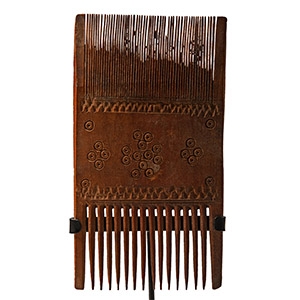
Egyptian Decorated Wooden Comb
Coptic, 3rd-7th century A.D.Estimate: £600 - 800 (+bp*)
Rectangular in plan with fine-cut teeth to one short edge and coarse-cut to the other; obverse with regular pattern of ring-and-dot motifs, zigzag borders; mounted on a custom-made stand. 111 grams total, 20.4 cm including stand
Ex J.P. collection, 1960s. Private collection London, UK, 1980s. From the private collection of J.L., Surrey, UK, 2000s. -
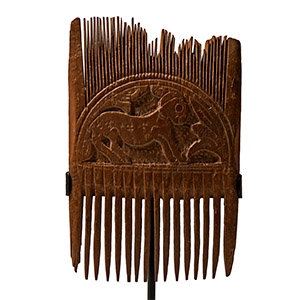
Egyptian Decorated Wooden Comb
Coptic, 3rd-7th century A.D.Estimate: £600 - 800 (+bp*)
Rectangular in plan with fine-cut teeth to one short edge and coarse-cut to the other; reserved low-relief image to each face of a D-shaped cell and ram running amid vegetation on a textured field; mounted on a custom-made stand. 73 grams total, 12.8 cm including stand
Ex J.P. collection, 1960s. Private collection London, UK, 1980s. From the private collection of J.L., Surrey, UK, 2000s. -
.jpg)
Egyptian Limestone Female Bust
Coptic, 3rd-6th century A.DEstimate: £8,000 - 10,000 (‡+bp*)
Modelled in the half-round on a flat background as a bust of a woman with stern expression, dressed in a tunic emphasising the rounded shape of the bosom, and a mantle worn on the shoulders descending to the arms; beaded collar to the chest and detailed head-covering; significant remains of polychrome (red, black, and traces of blue) on the face, clothing and hair; mounted on a custom-made display stand. 6.77 kg, 27 x 19.5 cm
From the collection of Nicolas Koutoulakis, Paris-Geneva, 1967. Ex Barbier-Mueller, Geneva, Switzerland. with Boisgirad, Arts D'Orient, 16 November 2007, no.88. Acquired on the French art market in 2007. European private collection. Accompanied by an academic report by Dr Raffaele D’Amato. Accompanied by copies of the relevant Boisgirad, Arts D'Orient catalogue pages. This lot has been checked against the Interpol Database of stolen works of art and is accompanied by a search certificate number no.12065-218189.
The base, back and sides are flat and rough-hewn: it is possible that it served as a funerary stele, perhaps placed as a “lid” of a niche or a loculus. The Egyptian stelae and statues found at the site of Oxyrhynchos (present-day Benhasa) provide the best parallels for the style that characterises this image. These are most often funerary works showing men, women or children (stelae in very high-relief and statues) which are still little known - and even the chronology of which is subject of discussion: current opinion one inclines towards an earlier dating, between the 3rd and 4th centuries A.D., rather than the Coptic period which was previously favoured. In fact these figures, which are devoid of the attributes linked to Christian iconography, generally hold or carry objects which relate to "classical" cults (ie. Isis). Despite a certain naivety of the work, typical of Egyptian sculptures from this region, the woman depicted on this stele certainly belonged to the high contemporary nobility as is evidenced by the richness of her well-pleated clothing and the abundance of adornment, comprising a large necklace with two rows of pearls and some brooches; likewise, the hairstyle, organised in small curls and spiral locks, is worthy of a high-ranking personage. -
.jpg)
Minoan Stone Vessel
2nd millennium B.C.Estimate: £1,800 - 2,400 (‡+bp*)
Of conical profile with raised ropework detailing to the broad shoulder. 1.48 kg, 14.6 cm wide
Private European collection, 1992. Thence by descent. This lot has been checked against the Interpol Database of stolen works of art and is accompanied by a search certificate number no.12086-218214. -
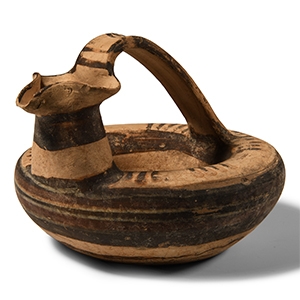
Etrusco-Corinthian Ring Askos
Circa 575 B.C.Estimate: £1,000 - 1,400 (+bp*)
With strap handle positioned over the central hole; black-figure decoration with fired umber (reddish-brown) consisting of a broad band heightened with crimson and white round the upper part of the wall, and a wavy band on the reversed area below; broad band of black (fired umber) inside the ring and around the neck below the spout; groups of transverse lines with faded petals around the top, horizontal lines across the handle; intact. 349 grams, 16.5 cm
Acquired from Charles Ede Gallery, London, in 1982. Prominent Palm Springs, California, USA, collection. with Artemis Gallery, Colorado, USA, 14 July 2012, lot 30 (US$2,500-3,000). Property of a South Australian private collector, with collection reference 14.08. Accompanied by detailed collector's catalogue pages including description and photograph.
Etrusco-Corinthian pottery is a local imitation of Corinthian pottery, made from the late seventh to the mid-sixth century B.C., with production concentrated on the southern Etruscan cities of Caere, Veii and Vulci. The forms predominately employed include various forms of jug (olpai, oinochoe) and unguent containers (aryballoi and alabastra) as well as amphorae and craters. The askos is the name given in modern parlance to a type of Greek pottery vessel used to pour small quantities of liquids such as oil. It is recognisable from its flat shape and a spout at one or both ends that could also be used as a handle; they were usually painted decoratively like vases and were mainly used for storing oil and refilling oil lamps. They were extensively traded in and around the Mediterranean, and local types emerge in Italy from the early Iron Age in Italy (cf. CVA Taranto – Museo Nazionale I, pl. 1.1 (Inv. 2400) – refer photo at 14.08 – 3); also CVA British Museum 7, pl. 4.4). The original meaning of ἀσκός is “wineskin” which can be seen in the shapes of early askoi. This askos has unique painted decoration for which a parallel has not been found to date. For an earlier variant of this type, see CVA Tarquinia – Museo Archeologico Nazionale III, pl. 27.7-8 (Inv. RC. 1892). Described as 'Italo- Geometric' and dated to third quarter of the seventh century; askos is 10.2cm high, 11.5cm diameter; dark brown paint. Neck is longer than on Inv.14.08, and different decorations, but otherwise an early parallel (refer photos at 14.08 – 4 & 5). Another variant of this type can be seen in CVA Museo Civico d’Archeologia Ligure di Genova, I, pl. 1.2-3 (Inv. 1101). Described as Italo-Corinthian but undated, askos is 11.0cm high 11.5cm diameter; neck is longer than on Inv.14.06, with handle not curving, and different decorations (see photos 14.08 – 6; 7). The groups of horizontal line decoration can be seen on earlier types, cf. late eighth to early seventh century footed cup in the Museo Archeologico della Maremma (CVA Grosetto Museo Archeologico I, pl. 26.3 (Inv. 24294)). See askos at the Museo Nazionale di Villa Giulia from the Polledrara necropolis at Vulci, dated to 625–600BC (refer photo at 14.08 – 8).

