-
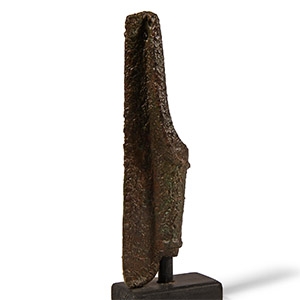
Western Asiatic Bronze Side-Blade Axehead
2nd-1st millennium B.C.Estimate: £300 - 400 (+bp*)
Comprising a tapering tubular socket with integral reinforcing strap, broad blade developing directly from the shank. 477 grams total, 22 cm high including stand
From London, Mayfair gallery, 1990s. -
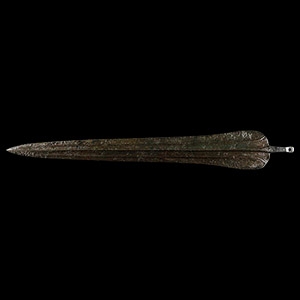
North-West Persian Bronze Short Sword with Blood Channels
2nd-1st millennium B.C.Estimate: £250 - 350 (+bp*)
Shaped as a two-edged bronze blade, leaf-shape with short rectangular tang with fastening hole, corrugated midrib extending almost to the tip and flared at the shoulder. 439 grams, 44.2 cm
Acquired 1980-2015. Ex Abelita family collection.
The metalworking techniques used in making bronze weapons in Luristan were very complex. Surfaces were often finished in repoussé work, and some of the weapons were chased and others engraved. Many of the graves dating from the era of Kassite hegemony contain bronze and iron artefacts, including various type of weapons. These swords with shallow fullers tapering to a sharp tip have been dated by P.R.S. Moorey to the end of the 2nd millennium B.C. -
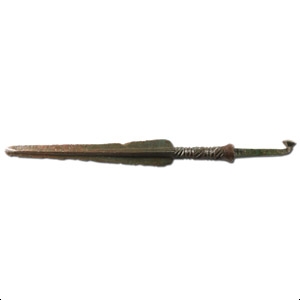
Western Asiatic Bronze Spearhead with Decorative Supports and Blood Channels
2nd millennium B.C.Estimate: £300 - 400 (+bp*)
With a long triangular blade, strongly marked midrib divided into five grooves, rectangular-section tang; engraved and reinforced shaft with diagonal and horizontal grooves. 474 grams, 43 cm
Acquired 1980-2015. Ex Abelita family collection.
This homogeneous subtype (LF 2a of Gernez) is characterised by a set of morphological particularities which constitute a functional and aesthetic outcome. The tapered blade, triangular (like in our case) or ogival, is reinforced by a strong median bulge. The intermediate part often bears an incised or moulded decoration and the base is with a marked widening or with a stopper disc. The tang, square in section, is curved and widens at the end almost at a right angle. -
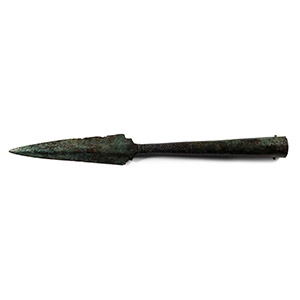
Elamite Socketted Spearhead
1st millennium B.C.Estimate: £300 - 400 (+bp*)
With tapering split socket, stepped shoulders and two-edged triangular head; pronounced midrib, bands of low-relief chevron and braid detailing, attachment pin. 180 grams, 28 cm
From a Mayfair, London, gallery, 1990s. -
.jpg)
Smith and Wesson Old Model No 2 Revolver
1861-1874 A.D.Estimate: £600 - 800 (+bp*)
Also known as 'Model No 2 Army' with hinged frame, six shot .32 calibre rimfire cylinder with 'PATENTED APRIL 3 1855 JULY 5 1859 & DEC 18 1860' and 15cm (6") octagonal barrel marked 'SMITH & WESSON SPRINGFIELD MASS' to top with fixed extractor pin and spur trigger; serial number 47946 to butt strap with plain wood grip scales; action working. 690 grams, 27 cm
Acquired from Bolk Antique Arms, Netherlands, 2016. Ex Kusmirek Collection, UK. Accompanied by an original Bolk invoice.
Sold as an exempt item under Section 58 (2) of the Firearms Act, 1968, to be held as a curiosity or ornament. No license required but buyer must be over 18 years of age. Overseas bidders should note that, due to UK regulations governing export of all firearms, overseas buyers will need to make arrangements for shipping this lot out of the UK directly, by air freight, with a specialist company or agent. -
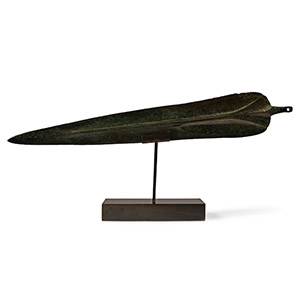
Luristan Bronze Sword Blade
Late 2nd-early 1st millennium B.C.Estimate: £600 - 800 (+bp*)
A substantial leaf-shaped blade with raised midrib extending to a short tang, ribbed fullers with curved ends extending to the shoulders. 883 grams total including stand, sword: 44 cm
From London Mayfair gallery, 1990s.
Luristan was hardly an ethnic or political entity, but the people of Luri had relations through warfare and trade with Sumerians, Lullubi, Assyrians, Babylonians and Elamites in a large time period, spanning from the 3rd to the 2nd millennium B.C. The ruling elites of warrior horsemen were buried in the graves with their weapons and horses which are the main sources of the Luristan bronze weapons. -
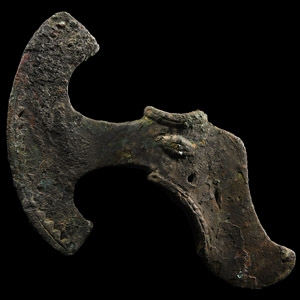
Bactrian Bronze Eye Axehead
3rd-2nd millennium B.C.Estimate: £200 - 300 (+bp*)
Fan-shaped blade; an apotropaic eye in relief to each side of the socket; wing-shaped extension to the rear. 327 grams, 16 cm
From an old London, UK, collection. Ex London, UK, gallery.
Most of these axes are believed to have originated in Bactria, but some objects come from well documented contexts in Margiane (Gonur), Lut (Shahdad) and Kermanshah (Khinaman). According to Gernez they were made for ceremonial use. -
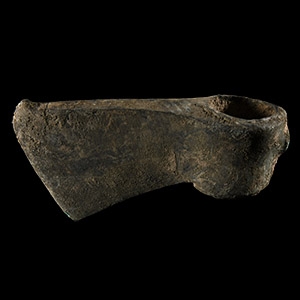
Heavy Western Asiatic Bronze Axehead
Late 3rd millennium B.C.Estimate: £100 - 140 (+bp*)
With swept blade, large socket with shallow raised circumferential rib and a vertical rib to the rear. 741 grams, 14.5 cm
Acquired 1980-2015. Ex Abelita family collection.
In the middle of the 3rd millennium B.C., the most widespread types of axes were those made for splitting and those for cutting. In the last third of this millennium there emerged a sharp differentiation between such axes. Such a sharp division by function should be associated with the influence of the Syro-Palestinian tradition. Such differentiation, in the absence of some multifunctional forms, can be observed from the end of the 4th millennium B.C. and during the 3rd millennium B.C. -
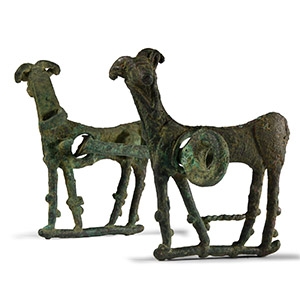
Luristan Bronze Horse Bit with Animals
Circa 11th-7th century B.C.Estimate: £1,000 - 1,400 (+bp*)
Comprising a pair of ram-shaped cheek-pieces with a hole through the body for the straight mouthpiece with looped terminals. 690 grams, 17.5 cm wide
From a collection formed in Paris in the 1990s.
The horse bits were transformed by Luristan people in to expressions of applied art. Metalworkers employed animal motifs, both realistic and imaginary, for their cheek-pieces. The question of whether these horse bits were for real use or only for use in a funerary context is superfluous, as signs of wear have been documented, and the goads and loops on interiors are functionally designed. The use of such horse bits is clearly documented in Assyrian reliefs of the time of Sennacherib (705-681 B.C.). -
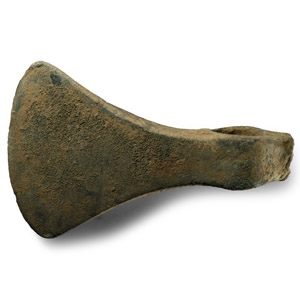
Large Western Asiatic Bronze Socketted Axehead
3rd-2nd millennium B.C.Estimate: £120 - 170 (+bp*)
With wide swept blade, large socket with shallow raised circumferential rib, hammer to the rear. 1.34 kg, 19 cm
Acquired 1980-2015. Ex Abelita family collection. -
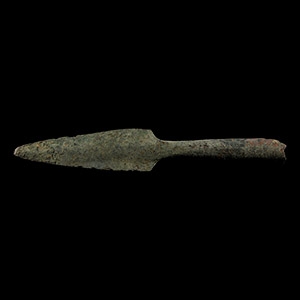
Luristan Bronze Socketted Spearhead
13th-6th century B.C.Estimate: £100 - 140 (+bp*)
With broad leaf-shaped blade and tapering tubular socket. 155 grams, 24 cm
Acquired 1980-2015. Ex Abelita family collection.
The spear belongs to the type VIII classified by Khorasani (spearheads with well-projecting midribs and long folded sockets) and more specifically to subtype C (with leaf-shaped blade and short hollow socket). Usually the willow-leaf blade has an almost straight shoulder base and a wide, flat midrib tapering towards the point. -
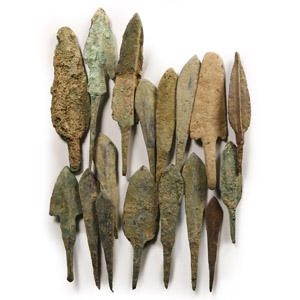
Luristan Bronze Arrowhead
Circa 13th-7th century B.C.Estimate: £100 - 140 (+bp*)
Including teardrop, barbed, leaf-shaped and other types, all tanged. 148 grams total, 52-91 mm
Acquired 1980-2015. Ex Abelita family collection.

