-
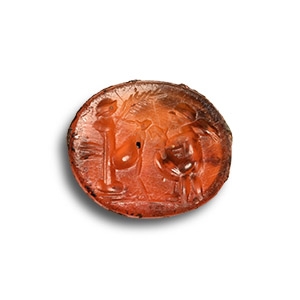
Roman Gemstone with Eros Before Herm
2nd-3rd century A.D.Estimate: £400 - 600 (+bp*)
Ellipsoid carnelian gemstone with intaglio scene of a Herm beside a peacock with a frond above, facing a putto with a cockerel; supplied with a museum-quality impression. 0.58 grams, 12 mm
From a Swiss collection, 1980s onwards. Property of a North London, UK, gentleman. -
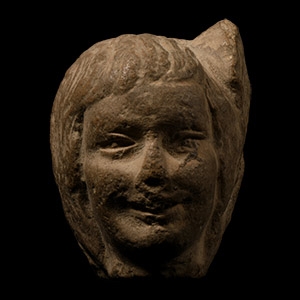
Roman Limestone Head of a Woman
1st-4th century A.D. or laterEstimate: £300 - 400 (‡+bp*)
Carved in the round with collar-length flowing hair; part of a frieze or group. 345 grams, 80 mm
Acquired in the mid 1980s-1990s. From the family collection of Mr S.A., Switzerland, thence by descent. Private collection since the late 1990s. -
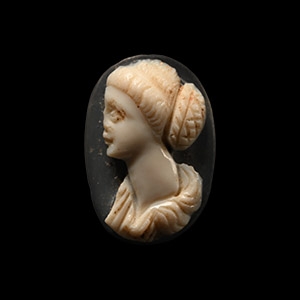
Roman Carved Cameo of a Female
Late 2nd century A.D.Estimate: £300 - 400 (‡+bp*)
Ellipsoid in plan with reserved female profile portrait bust, the hair dressed in a chignon. 0.64 grams, 13 mm
Acquired in the mid 1980s-1990s. From the family collection of Mr S.A., Switzerland, thence by descent. Private collection since the late 1990s. -
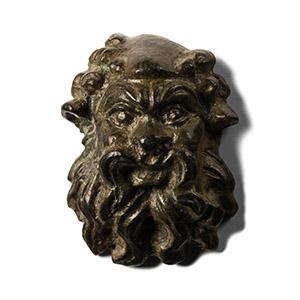
Roman Bronze Silenus Mount
1st-3rd century A.D.Estimate: £350 - 450 (+bp*)
Mask of Silenus modelled in the half-round with curly hair and luxuriant beard; hollow to the reverse. 31.5 grams, 36 mm
Ex German art market, 2000s. Acquired from an EU collector living in London. From the collection of Surrey, UK, gentleman. -
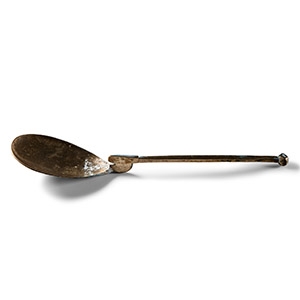
Roman Silver Spoon with Handle
5th-6th century A.D.Estimate: £400 - 600 (+bp*)
Shallow piriform bowl attached to a stepped baluster, square-section handle with knop finial. 39 grams, 18.8 cm
Ex London, UK, gallery, 1971-early 2000s.
Cochlearia like this one have been discovered in treasure hoards. They were used in Christian times for administration of the Holy Communion. The absence of Christian symbolism or of a Christian inscription on this spoon might suggest that it dates from a pre-Christian era, or that its owner/commissioner was pagan, or simply that this spoon was intended for domestic use. -
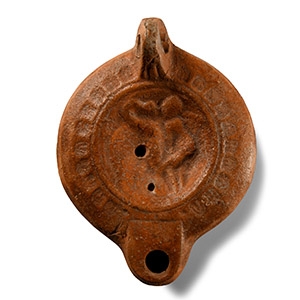
Roman Oil Lamp with Leda and The Swan
2nd century A.D.Estimate: £200 - 300 (+bp*)
A Roman North African terracotta oil lamp with grooved ring handle; discus decorated with the mythological scene depicting Leda and the swan embracing. 77 grams, 10.3 cm
Dr Suzanne Gozlan, thence by descent. Suzanne Gozlan (1921-2022), a doctor of History and Archaeology, served as a professor at the Ecole Normale d'Instituteurs de Chartres and lectured at the University of Paris 4 Sorbonne. Property of a Bristol, UK, gentleman.
In Greek mythology, Leda was the wife of King Tyndareus and queen of Sparta. According to the myth, Zeus, the king of the gods, was captivated by Leda's beauty and appeared before her in the form of a swan. He then either raped or seduced her and impregnated her. The same night, Leda slept with her husband who also impregnated her, as a result of these two unions she laid two eggs, each containing one set of twins. According to later Greek mythology Leda bore Helen (of Troy) and Polydeuces, children of Zeus, while at the same time bearing Castor and Clytemnestra, children of her husband. -
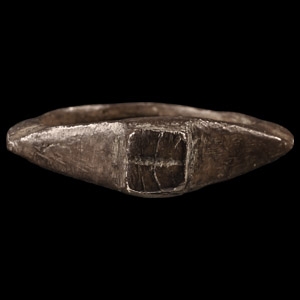
Late Roman Silver Ring with Cross
4th-6th century A.D.Estimate: £100 - 140 (+bp*)
With angular shoulders expanding towards the rectangular bezel, the bezel with an incised cross motif. 2.98 grams, 23.35 mm overall, 17.22 mm internal diameter (approximate size British L, USA 5 3/4, Europe 11.24, Japan 10)
From the property of late Mr SM, London, UK, 1969-1999. Accompanied by an old collection ticket. -
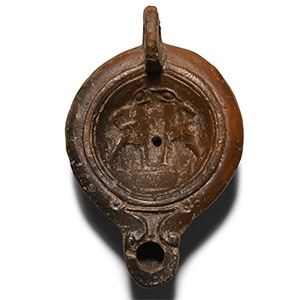
Roman Terracotta Lamp with Fighting Gladiators
1st-2nd century A.D.Estimate: £500 - 700 (+bp*)
Composed of a discoid body with sunken discus bearing a scene of two gladiators in combat in relief, tabula ansata below, ring handle and roughly D-shaped nozzle with volutes; old crack to base. 84 grams, 12.4 cm
From a German collection. Ex Cambridge, UK, collection, 1980s.
The two gladiators seem to be wearing the armaturae of murmillones. All gladiators began their career as provocatores; the learning of their combat technique was polyvalent and allowed the fighters to specialise as a large shield-bearer (the scutati) like murmillones, or as a small shield-bearer, parmati, like the oplomachus. -
.jpg)
Roman 'The Wakefield' Bronze Founding of Rome Commemorative Military Phalera
1st century B.C.-1st century A.D.Estimate: £800 - 1,000 (+bp*)
With high-relief image depicting a she-wolf in profile advancing beneath a tree, with an infant or boy (Romulus?) on its back, nude and looking up towards the tree. 39 grams, 62 mm
Mostly intact, good condition.
Believed to have been found in Wakefield, UK, in the 1960s. From the Roman 'Invasion Period' private collection of Brian Riley, Wakefield, UK, 1960s-2007. Acquired from Brian Riley, Yorkshire, UK, circa 2007. Property of a Stowmarket, UK, gentleman. Accompanied by an academic report by Dr Raffaele D’Amato.
Military phalerae usually depicted heads of the gods, spirits of the underworld, birds and lions. The higher officers in the Roman army had the custom of wearing a rich suite of phalerae with its straps directly attached to leather garments or doublets, worn over their armour. These decorations were awarded in sets, commonly of nine, although sources confirm that this was not an always the case. -
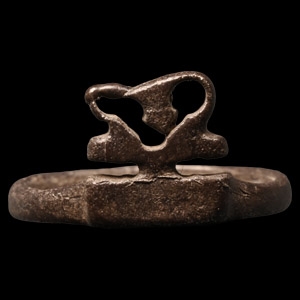
Roman Silver Key Ring with Fretwork Heart
1st century A.D.Estimate: £100 - 140 (+bp*)
The bezel formed with an openwork vine and leaf motif. 2.11 grams, 18.62 mm overall, 16.39 mm internal diameter (approximate size British L, USA 5 3/4, Europe 11.24, Japan 10)
Acquired 1980-2015. Ex Abelita family collection. -
.jpg)
Gemstone with Sacrifice Scene
Roman, 1st century A.D. or laterEstimate: £400 - 600 (+bp*)
Ellipsoid carnelian gemstone with intaglio scene of a kilted figure sacrificing a goat beside a tree; supplied with a museum-quality impression. 0.40 grams, 12 mm
From a Swiss collection, 1980s onwards. Property of a North London, UK, gentleman. -
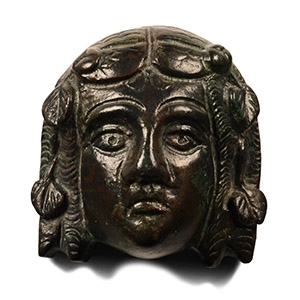
Roman Bronze Dionysus Attachment
1st-2nd century A.D.Estimate: £400 - 600 (+bp*)
Mask of Dionysus with vine leaves in the hair; hollow reverse filled with lead. 90.7 grams, 40 mm
Ex German art market, 2000s. Acquired from an EU collector living in London. From the collection of Surrey, UK, gentleman.

