-
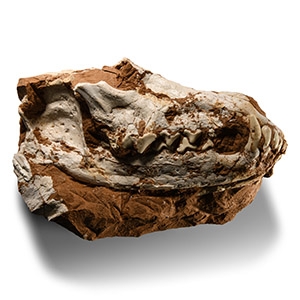
Natural History - Fossil Wolf Skull in Matrix
Late Pliocene-early Pleistocene Period, circa 5.3 million-60,000 years B.P.Estimate: £700 - 900 (+bp*)
The majority of Canis teilhardi skull in matrix with some other bone fragments. 1.28 kg, 19 cm
From the private collection of a London gentleman formed since 2003. -
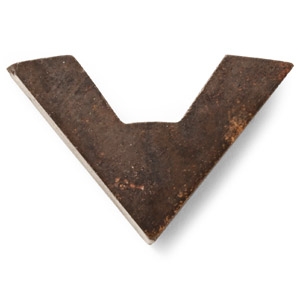
Egyptian Hardstone Architectural Amulet
Late Period, 664-332 B.C.Estimate: £250 - 350 (+bp*)
Amuletic model of a stonemason's plummet. 2.38 grams, 25 mm
with Hotel des Ventes, Drouot, Paris, France. From the collection of Mr H. Naudy, Paris, France. Acquired at between 2004-2010. Property of a French collector.
The stonemason’s plumb bob amulet symbolised integrity, moral uprightness, emotional equilibrium, and balance. -
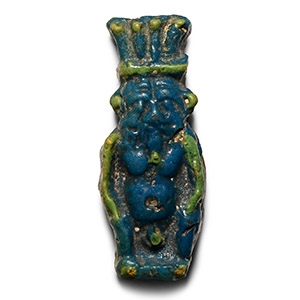
Egyptian Blue-Glazed Amulet of Bes
Ptolemaic Period, 332-30 B.C.Estimate: £200 - 300 (+bp*)
Faience amulet of the god Bes with his body of a dwarf, leonine head, and feather headdress; with a bright blue satin glaze and raised accents in yellow, modelled similarly on both sides; pierced through the neck for suspension 8.2 grams, 46 mm
From the P.C. collection, 1990s. Ex London gallery. Property of a Bristol, UK, gentleman.
Bes became one of ancient Egypt's most popular apotropaic deities from the New Kingdom onwards. Despite his somewhat fearful appearance, Bes was the patron and protector of pregnant women and children. He was also believed to protect from snakes. -
.jpg)
Egyptian Painted Wooden Model of a Cow Giving Birth, Together with Two Figures
Middle Kingdom, 11th-12th Dynasty, 2023-1862 B.C.Estimate: £3,500 - 4,500 (+bp*)
Composed of three figures: a standing cow or other quadruped giving birth to its young, its head, neck and forelegs emerging from the mother's rear, both with a black and white speckled coat; a standing male figure with articulated arms and pierced hands, wearing a kilt and cropped wig and with stylised facial detailing; a kneeling figure also with articulated arms, open-palm hands, wearing a kilt and cropped wig, stylised facial features; extensive remains of polychrome pigment. 111 grams total, 9.5-16 cm
From an early 20th century Home Counties collection. This lot has been checked against the Interpol Database of stolen works of art and is accompanied by search certificate no.11597-199209.
Such models would have been deposited in tombs; the purpose of such a scene was probably to evoke the season of spring, when calves were born, and the floodplain where farmers lived and raised their livestock. -
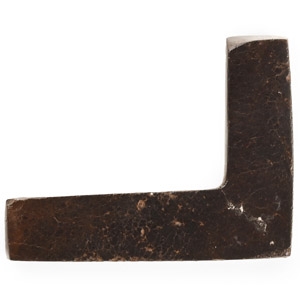
Egyptian Hardstone Architectural Amulet
Late Period, 664-332 B.C.Estimate: £250 - 350 (+bp*)
Carved haematite representation of a carpenter's or stonemason's set-square. 3.15 grams, 24 mm
with Hotel des Ventes, Drouot, Paris, France. From the collection of Mr H. Naudy, Paris, France. Acquired at between 2004-2010. Property of a French collector.
The L-shaped carpenter's or stonemason's square was used to measure right angles. Amulets of this tool symbolised integrity, moral uprightness, emotional equilibrium, and balance. -
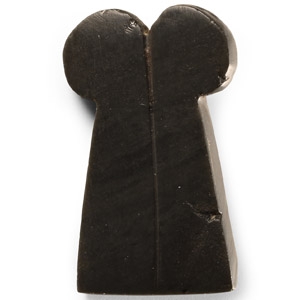
Egyptian Hardstone Double Plume Amulet
Late Period, 664-332 B.C.Estimate: £250 - 350 (+bp*)
Carved with integral ribbed loop to the reverse; unfinished. 4.4 grams, 31 mm
with Hotel des Ventes, Drouot, Paris, France. From the collection of Mr H. Naudy, Paris, France. Acquired at between 2004-2010. Property of a French collector.
This ancient amulet represents two ostrich feathers or shuty. Interestingly, these feathers were also present on the Atef crown of Osiris, the god of the afterlife and the dead. This suggests the amulet was believed to imbue the wearer with Osiris' divine power and protection. -
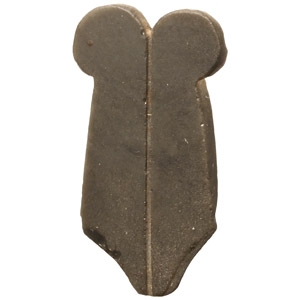
Egyptian Hardstone Double Plume Amulet
Late Period, 664-332 B.C.Estimate: £250 - 350 (+bp*)
Carved with integral loop to the reverse; old inked collector's reference 'ES716'. 2.58 grams, 27 mm
with Hotel des Ventes, Drouot, Paris, France. From the collection of Mr H. Naudy, Paris, France. Acquired at between 2004-2010. Property of a French collector.
This ancient amulet represents two ostrich feathers or shuty. Interestingly, these feathers were also present on the Atef crown of Osiris, the god of the afterlife and the dead. This suggests the amulet was believed to imbue the wearer with Osiris' divine power and protection. -
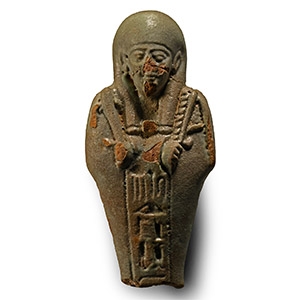
Egyptian Blue Glazed Hieroglyphic Shabti Fragment for Neith
26th Dynasty, 664-525 B.C.Estimate: £400 - 600 (+bp*)
Pale grey-green composition fragment of the upper half of a mummiform shabti wearing a tripartite wig, holding a pick, hoe, and cord for a seed bag, which hangs over the left shoulder; a vertical band to the chest and lower body inscribed with hieroglyphic text giving the opening 'The illuminated one, the Osiris' and the name or title beginning with 'Neith'. 62 grams, 89 mm
Acquired on the German art market, 1989-1995. with The Museum Gallery, 19 Bury Place, London, WC1, UK, 1998-2003. Property of a London based academic, 2003-present. -
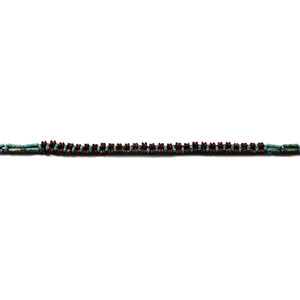
Egyptian Faience Mummy Bead Necklace
Late New Kingdom, 1295-1069 B.C.Estimate: £400 - 600 (+bp*)
Restrung designer necklace using tubular green-glazed beads in a double row, interspersed with small two-holed beads; the central feature a net-like composition of small brown and blue-glazed ring-shaped beads. 9.54 grams, 46 cm long
By repute, 'Excavated at Gurob by Prof. Flinders Petrie. From a quantity of beadwork taken from the neck of a mummy'. Ex 1920s UK collection. -
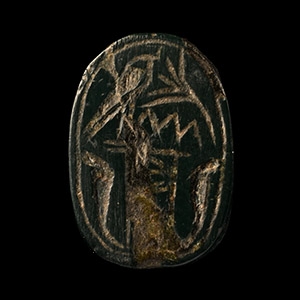
Phoenicio-Egyptian Hardstone Scarab with Hieroglyphs
Circa 6th-4th century B.C.Estimate: £400 - 600 (+bp*)
Haematite scarab with underside incised Horus falcon and lotus flower atop a fire-altar(?) flanked by uraei. 2.21 grams, 16 mm
Collected from 1969-1999. From the collection of the late Mr S.M., London, UK. -
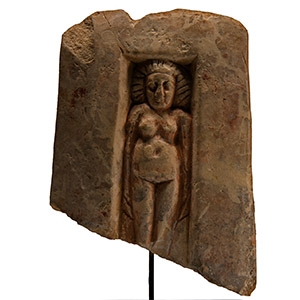
Egyptian Female Fertility Figurine Plaque
Late Period-Ptolemaic Period, 664-31 B.C.Estimate: £1,200 - 1,700 (+bp*)
Carved rectangular plaque with central recess, carved image of a nude female modelled in the half-round with a deeply striated bag wig, arms by her side; traces of red and black pigment on the body; mounted on a custom-made stand. 502 grams total, 17.1 cm including stand
From a central London collection, formed 1980-2000. From the private collection of Mr David Barker, London, UK; thence by descent.
The rectangular limestone plaque almost certainly represents a shrine. Such plaques first appeared in Lower Egypt and became widespread in the Late Period and Ptolemaic era. They may have developed from earlier female figurines depicted on beds and are usually associated with the female goddesses Isis and Hathor, both powerful protectors of women and childbirth and associated with fertility. -
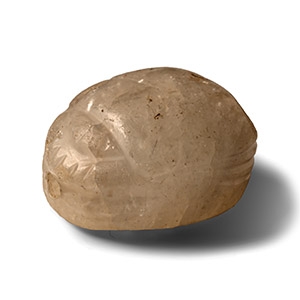
Egyptian Rock Crystal Scarab
Late Period, 664-332 B.C.Estimate: £200 - 300 (+bp*)
With segmented carapace, plain underside. 4.45 grams, 18 mm
From the property of the late Mr SM, London, UK, 1969-1999.

