-
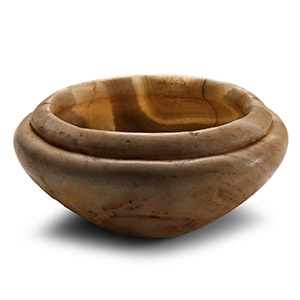
Egyptian Alabaster Bowl
1st Dynasty, circa 3000 B.C.Estimate: £1,800 - 2,400 (‡+bp*)
Of conical profile with flattened base, carinated shoulder and stepped rounded rim, possibly for accepting a lid. 380 grams, 11.6 cm wide
Property from an American deceased estate, acquired between 19770-1989. with Bonhams, London, 28 October 2009, no.16 (Part). Private European collection. Accompanied by copies of the relevant Bonhams catalogue pages. This lot has been checked against the Interpol Database of stolen works of art and is accompanied by a search certificate number no.12071-215259. -
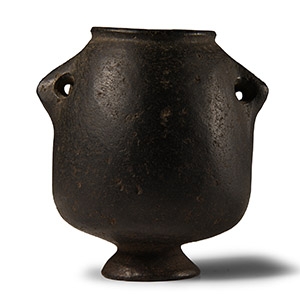
Egyptian Predynastic Basalt Vase
Naqada I-II, circa 3900-3300 B.C.Estimate: £5,000 - 7,000 (‡+bp*)
Barrel-shaped in profile with tapering neck and trumpet-shaped foot, two lateral pierced lug handles, flared rim (damaged). 330 grams, 86 mm
French private collection. From the 'Yvelines Department', Northern France. with Mme Digard, Drouot, Paris, 7 February 2011, no.107. Accompanied by a copy of a French cultural passport. This lot has been checked against the Interpol Database of stolen works of art and is accompanied by a search certificate number no.12072-218133. -
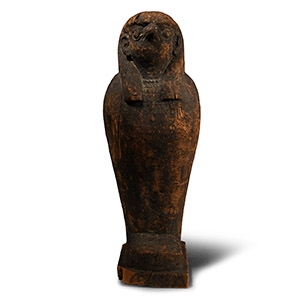
Egyptian Wooden Sarcophagus with Falcon Mummy
Late Period-Ptolemaic Period, 664-31 B.C.Estimate: £8,000 - 10,000 (‡+bp*)
Two-part wooden (sycamore?) falcon-headed mummiform coffin carved from a single piece of wood, with a tripartite wig and human ears, painted detailing to the eyes, and broad decorative collar; the whole covered with black paint with traces of yellow decoration and inscriptions; inside a mummified falcon wrapped in linen strips. 2.3 kg, 49.5 cm
Ex R. Liechti (1934-2010) Geneva, Switzerland, formed between 1950-1990s. Accompanied by a copy of an old collection inventory note. Accompanied by an academic report by Egyptologist Paul Whelan. This lot has been checked against the Interpol Database of stolen works of art and is accompanied by a search certificate number no.12074-218220.
This falcon-headed coffin once contained a so-called 'corn mummy' - a mummiform effigy impregnated with grain, which germinated. Such 'corn mummies' were associated with Osirian regeneration, fertility, and rebirth concepts. The falcon-headed coffin was associated with the powerful funerary deity Sokar-Osiris or Ptah-Sokar-Osiris. It seems that the original contents of this coffin were either lost or discarded and replaced with a mummified bird (falcon?). Interestingly, the most significant number of falcon-headed coffins come from Tuna el-Gebel, the site of an extensive animal mummy necropolis. -
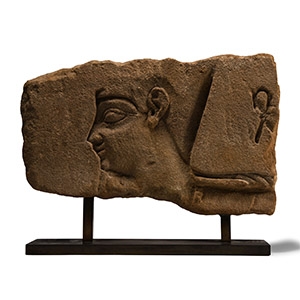
Egyptian Sandstone Relief
Late Period or Ptolemaic Period, 664-31 B.C.Estimate: £4,000 - 6,000 (+bp*)
Rectangular frieze fragment with low-relief profile bust wearing the double crown; sa symbol (of protection) to the rear; mounted on a custom-made stand. 2.8 kg total, 27 cm wide
From Galerie Orient-Occident, Paris, France. with Cahn Auctions, 19 October 2002, no.527. From the Keane private collection, Kent, UK. This lot has been checked against the Interpol Database of stolen works of art and is accompanied by a search certificate number no.12077-216770.
Possibly a sculptor's trial piece or model. -
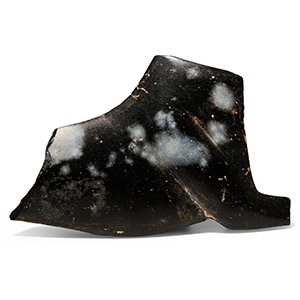
Egyptian Body of Anubis Glass Inlay
Late Period-Ptolemaic Period, 664-30 B.C.Estimate: £1,200 - 1,700 (+bp*)
With gently curved obverse and flat reverse, section of an inlay depicting Anubis, with thick neck and beginning of extended foreleg. 108 grams, 96 mm
Acquired on the French art market, 1980s. with Bonhams, London, 13 April 2011, lot 21. Accompanied by copies of the relevant Bonhams catalogue pages. -
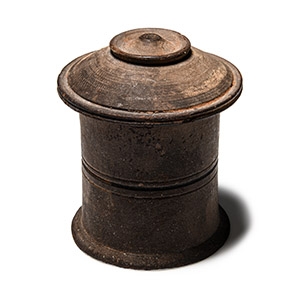
Egyptian Decorated Wooden Pyxis
Late Period-Ptolemaic Period, 664-30 B.C.Estimate: £400 - 600 (+bp*)
Lathe-turned body and separate lid, incised bands to the equator, flared base, and fillet to the domed lid. 60 grams, 73 mm high
Ex UK collection, 1930-1940s. -
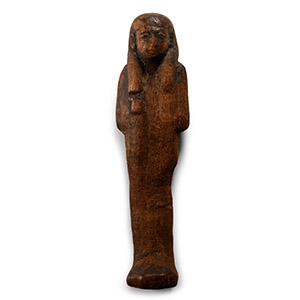
Egyptian Wooden Funerary Shabti Figurine
2nd-1st millennium B.C.Estimate: £1,800 - 2,400 (‡+bp*)
Carved in the round with D-shaped base, carefully modelled hair and ears with beard absent, the right hand visible, not holding any work tools, the body has the appearance of a mummy entirely draped in a shroud with rather elongated proportions, the broad and rounded face with a slightly ‘smiling’ expression, framed by a tripartite hairstyle without stripes, which continues down the back and two lappets on the chest. 39 grams, 14.5 cm
Ex R. Liechti (1934-2010) Geneva, Switzerland, formed between 1950-1990s. This lot has been checked against the Interpol Database of stolen works of art and is accompanied by a search certificate number no.12079-218221. -
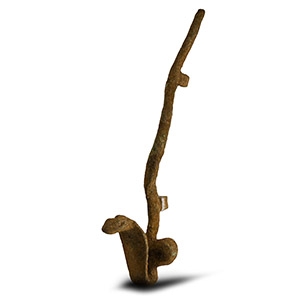
Egyptian Bronze Cobra Mount
Late Period, 6th century B.C.Estimate: £1,200 - 1,700 (‡+bp*)
Cobra-shaped mount with head raised and hood expanded, two mounting studs to the reverse; mounted on a custom-made stand. 182 grams, 22 cm
Private Israeli collection. Ex Archaeological Center, Tel Aviv, Israel, 2015. Private European collection.
The mount most likely adorned the Atef crown of a statue of Osiris. -
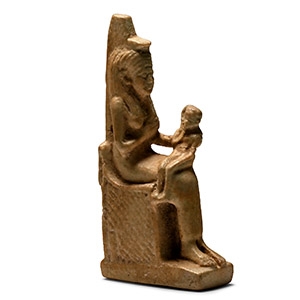
Large Egyptian Faience Amulet of Isis Nursing Baby Horus
Late Period, 664-332 B.C.Estimate: £1,000 - 1,400 (+bp*)
Amulet of Isis seated on an elaborate throne decorated with a crosshatch pattern, holding the infant Horus to her breast, supporting his head with her left hand; wearing a long close-fitting sheath dress and striated tripartite wig, surmounted by a crown in the form of her hieroglyphic name-sign, the "throne"; Horus wearing the sidelock of youth and holding his finger to his mouth; horizontal piercing just above the throne at the back for suspension. 20.16 grams, 65 mm
Ex Foxwell collection. Acquired from a London gallery. Ex Mr A.S. collection, 1990s.
In ancient Egyptian mythology, Isis was the sister-wife of Osiris and the mother of the sky god Horus. She is associated with aspects of fertility and motherhood and is often depicted in various artworks seated in a nursing pose with her son Horus on her lap. -
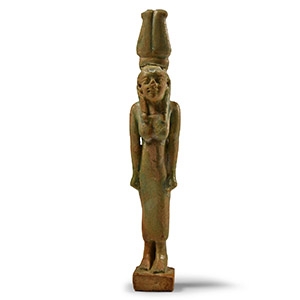
Large Egyptian Faience Amulet of the Goddess Isis
Late Period-Ptolemaic Period, 664-30 B.C.Estimate: £1,200 - 1,700 (‡+bp*)
The goddess dressed in a long tight-fitting tunic to her ankles, standing with her left leg forward, her straight arms descending to her thighs; vulture headgear surmounted two long feathers; dorsal pillar with hieroglyphic text; repaired. 50 grams, 14 cm
Private collection Mr E. Saad, Cairo, Egypt-Montreux, Switzerland, 1970s. Ex private collection of Mr S.A., acquired from Mr Saad in 1997.
In ancient Egyptian mythology, Isis was the sister-wife of Osiris and the mother of the sky god Horus. She is associated with aspects of fertility and motherhood. This amulet unusually depicts her with a two-plumed crown, which may associate her with the goddess Sothis. -
.jpg)
Egyptian Steatite Scaraboid for Pharaoh Shabaka
Late 8th-early 9th century B.C.Estimate: £2,000 - 3,000 (+bp*)
Bifacial carved scaraboid; reverse with royal cartouche for Pharaoh Shabaka, flanked by the uraeus of Lower and Upper Egypt, surmounted by the Pharaonic epithet “King of the Upper and Lower Egypt” (“king of the reed” and “king of the bee”) and by the title “the son of Ra” and below, the sign of neb (damaged) “lord”; obverse with on the left, wedjat (winged cobra with the red crown – Lower Egypt), embracing with his wings shen (solar symbol) and in the centre, a lion with a ram's head, crowned and on the right, wedjat with the white crown of the Upper Egypt; on the upper section, a scarab with opened wings, instead of a lotus flower is depicted on the lower section. 7.65 grams, 27 mm
UK private collection before 2000. On the UK art market. Property of a London gentleman. This lot has been checked against the Interpol Database of stolen works of art and is accompanied by a search certificate number no.12081-217354. -
.jpg)
'Egyptian Blue' Counter Weight Menat Amulet
Late Period, 664-525 B.C.Estimate: £800 - 1,000 (+bp*)
Amuletic pendant with broad bale, keyhole-shaped plaque with gusset to the rim. 14 grams, 67 mm
Acquired on the German art market, 1989-1995. with The Museum Gallery, 19 Bury Place, London, WC1A 2JB, 1998-2003. Property of a London based academic, 2003-present.
The menat necklace was a sacred item of great importance to female Egyptian goddesses, particularly Hathor. Priestesses of Hathor and other powerful goddesses used the necklace as a rattle, holding it in their hand by the counterpoise and evoking protection from the sound of the shaken beads. The amuletic menat counterweight symbolised the whole elaborate necklace. The menat was considered a powerful magical amulet throughout Egyptian history, offering good luck and protection against evil spirits. It was often buried with the dead for protection in the afterlife and was believed to promote fertility and good health for women while signifying virility for men.

