-
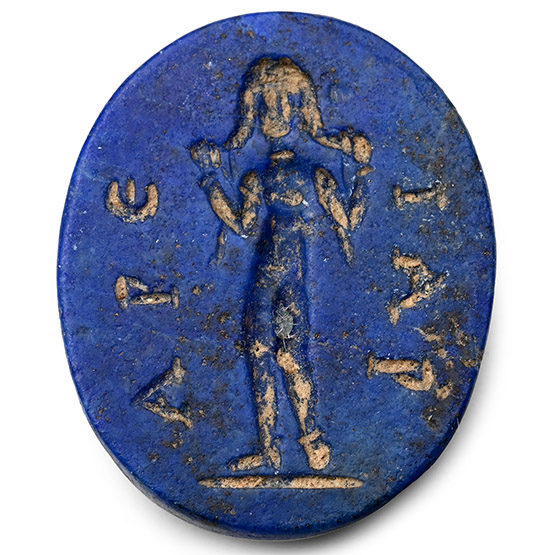
Roman Lapis Lazuli Gnostic Gemstone with Aphrodite Anadyomene
4th-5th century A.D.Sold for (Inc. bp): £715
Ellipsoid in plan with enigmatic Greek legend 'BPE/IMW' to underside, facing figure of Aphrodite Anadyomene to obverse on baseline with Greek legend 'APE IAP', possibly an abbreviation for ΑΡ[ΌΡΙΦ]ΡΑ[Σ]Ι[Σ]. 1.38 grams, 17 mm
Private collection, acquired on the German art market in 1993; thence by descent.
The gemstone belongs to a series of blue gemstones, usually of lapis lazuli or blue glass, showing the famous image of Aphrodite Anadyomene ('rising from the sea'). In some of these gemstones, we find the magical word arôriphrasis, which transliterates an Egyptian title of the goddess Hathor as 'The Lady of the Blue Stone'. Since Hathor and Aphrodite were assimilated in Graeco-Roman Egypt, there is some logic to the appearance of the name and Aphrodite on these stones. -
.jpg)
Egyptian Bronze Figure of Khnum, the Creator God
Late Period, 664-332 B.C.Sold for (Inc. bp): £11,700
A substantial figure of the ram-headed god Khnum advancing, wearing a tripartite wig with low central modius drilled for a separately cast headdress and finely pleated kilt, with ram's horns and eyes recessed for inlay, raised left hand, the right arm along the side; mounted on a custom-made stand. 466 grams, 22 cm high (803 grams total, 23.8 cm high including stand)
Bronze H: 19.6 cm, W: 5.4 cm, D: 6.9 cm Condition Surface has been extensively cleaned, in fair condition.
With Stendahl Art Gallery, Los Angeles, by at least circa 1950s, accompanied by an inventory card #39, with a matching number on the original base, and a photograph. Private collection, Hollywood, California, acquired from the above, circa 1950s. Accompanied by a copy of an Art Loss Register certificate, no.S00256888. This lot has been checked against the Interpol Database of stolen works of art and is accompanied by search certificate no. 13240-251804.
The god Khnum (or Khnemu), the 'Moulder', was one of the earliest gods of Egypt, worshipped especially at Philae and Elephantine, both in Nubia. He was thought to have made mankind out of clay on a potter's wheel. It was Khnum who helped Isis to gather the severed fragments of the body of the god Osiris and reassemble them. He was considered the father of the gods, along with Amun-Ra and Ptah. -
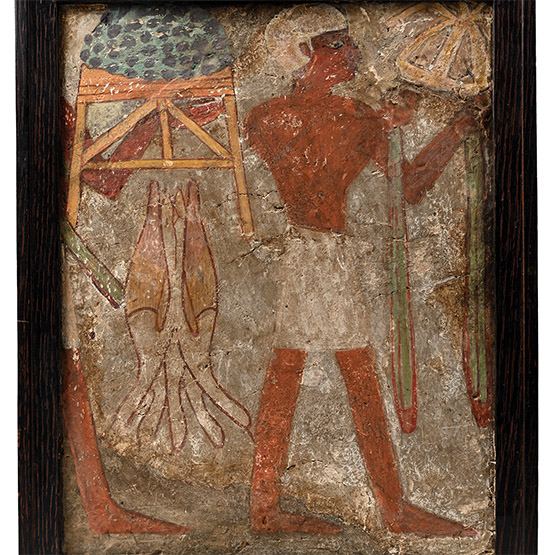
Egyptian Limestone Fresco with Servant Carrying Geese
New Kingdom, 1580-1077 B.C.Sold for (Inc. bp): £9,100
Rectangular frieze fragment with advancing figure in profile wearing a shendyt kilt holding up two poles in his raised hands; to his rear, part of a second figure with an openwork wooden frame (footstool) and other items; mounted in sturdy wooden frame with suspension rings to the reverse; surface has been extensively cleaned, restored, and repainted. 6.8 kg, 40.5 x 32.2 cm
Mounted in an early 20th-century wooden frame bearing a stamped inscription reading “Exposition Paris …” From the collection of L.V. (1950-1960), Paris, France. Collection of Monsieur X. (1931-2017), dispersed for the benefit of the Monaco Red Cross. Private collection, Europe. This lot has been checked against the Interpol Database of stolen works of art and is accompanied by a search certificate number no.13224-249307.
The servant is carrying geese, like in many other representations of the New Kingdom. Many portrayals of ducks and geese in ancient Egyptian art show the importance of the birds as food. Servants plucking geese are visible in the tomb of Nakht, in Luxor (1567-1320 B.C.), and in the famous tomb of Nebamun, at the British Museum, a fresco fragment shows workers standing in front of a gaggle of geese. -
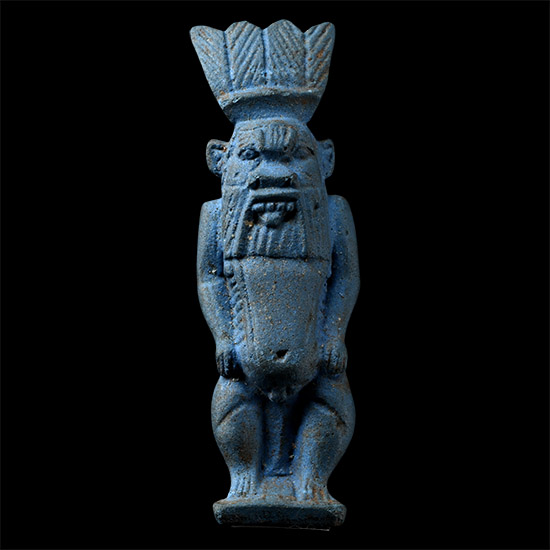
Egyptian Blue Glazed Amulet of Bes
Third Intermediate Period, circa 1069-735 B.C.Estimate: £1,000 - 1,400 (+bp*)
Modelled in the round, Bes standing nude with a lion's tail, wearing a feathered headdress. 3.07 grams, 42 mm
Olivia Tiano, Paris, 1993. Private collection, London, UK.
From the New Kingdom onwards, Bes became one of ancient Egypt's most popular apotropaic deities. Despite his somewhat fearsome appearance, Bes served as the patron and protector of pregnant women and children and was also believed to shield them from snakes. -
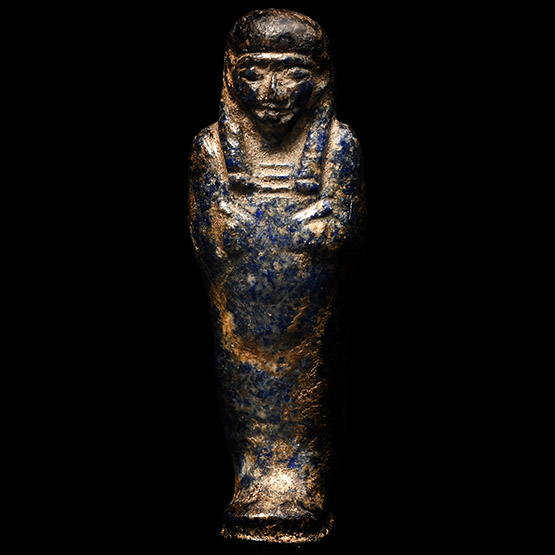
Egyptian Lapis Lazuli Shabti Amulet
New Kingdom, 1550-1070 B.C.Estimate: £1,500 - 2,000 (‡+bp*)
Carved in the round as a mummiform figure, with a detailed collar and tripartite wig; rear suspension loop. 3.12 grams, 31 mm
Private collection, acquired on the Swiss art market in 1992; thence by descent. -
.jpg)
Egyptian Bronze Kneeling Figure of a King
Late Period-Ptolemaic Period, circa 664-30 B.C.Estimate: £30,000 - 40,000 (‡+bp*)
A solid cast statuette modelled in the round as a kneeling pharaoh wearing a thigh-length shendyt kilt, a broad collar and a nemes headdress adorned with a uraeus to the brow; with open hands positioned as though they once held an object, palms facing inward; mounted on a custom-made stand. 1.62 kg total, 16.7 cm high including stand
Private collection, E.M. (1880-1954), since the 1930s. Accompanied by an academic report by Egyptologist Paul Whelan. This lot has been checked against the Interpol Database of stolen works of art and is accompanied by search certificate number no.13196-249244.
The figure's overall appearance, particularly the muscular upper body, resembles two kneeling bronze figures – Brooklyn Museum 71.11 and Pennsylvania Museum E.13004 – both bearing the cartouche of 26th Dynasty pharaoh Necho II (610-595 BC). Unlike the varied poses of kneeling stone statues, those in bronze consistently rest on their knees and toes, with heels positioned under their buttocks. Figures with this hand gesture are often thought to have originally held an offering vessel or ritual object. However, none of the existing examples shows signs of having held an object. Instead, the gesture may symbolise both giving and receiving, representing veneration, offering, and a plea for protection to a particular deity. -
.jpg)
Egyptian Basalt Bassinophore Fragments for the Customs Official Wahibre, son of Paeftchawy
Late Period, 26th Dynasty, Reign of Amasis, circa 570-525 B.C.Estimate: £80,000 - 100,000 (+bp*)
Modelled in the round kneeling on an integral base and wearing a broad rounded wig, holding a fragmentary offering basin before him; dorsal pillar engraved with a single vertical column of hieroglyphs, translating: 'The Count, Overseer of the Entrance to the Hill Countries, Chief Supervisor of the Shrines [of Neith], Wahibre, son of Paeftchawy'; upper rim of the basin further inscribed with a ritual formula intended to be recited during the presentation of its contents. 107.7 kg total, figure: 40 cm high, fragments: 47-58 cm wide including stand
For the two basalt sections: UK private collection, formed 1970s-1990s. Princely collection, until 2014; thence to a private foundation. Acquired by the current owner from Rupert Wace, London, UK. For the kneeling basalt figure: European private collection, since the mid-19th century. Sold at Christie’s, New York, 8 June 2001, no.114. Sold at Drouot-Richelieu, Paris (Boisgirard), 14 February 2005, no.313. European private collection, acquired at the above sale; thence by descent to the previous owners. This lot has been checked against the Interpol Database of stolen works of art and is accompanied by search certificate number no.13193-250115.
The figure on this vessel represents the customs official Wahibre, son of Paeftchawy, a well-attested individual known from at least fourteen other sculptures. Additional evidence for Wahibre’s identity is provided by a fragment of his mummiform sarcophagus, found at el-Hagar, within the territory of his native city of Sais. The titles inscribed on his surviving monuments reflect a career that combined priestly responsibilities with significant administrative and military authority. In southern Egypt, Wahibre served as chief customs officer and commanded a contingent of foreign troops tasked with protecting the frontier, probably Greek mercenaries from Caria. -
.jpg)
Egyptian Faience Bead with Cartouches of Pharaoh Amasis
Late Period, 26th Dynasty, circa 664-525 B.C.Sold for (Inc. bp): £2,340
Square in plan with transverse piercing, obverse with three panels: the left bearing a cartouche surmounted by two plumes containing the pharaoh’s birth name, i͗Ꜥms sꜢ nt (Ahmose, son (of) Neith); the right, a similar cartouche containing his throne name, ẖnm-i͗b-RꜤ (He who embraces the heart of Re); the centre inscription reads, ḥpw Ꜥnḫ sꜢ ḥpt(?) (the living Apis, son [of] Hepet?) two with a cartouche for Amasis, text to the centre. 4.96 grams, 26 mm
Ex private collection, Germany. with Galerie Günter Puhze, Freiburg, Germany, prior to 2003. Private collection, acquired on the German art market, 2004. This lot has been checked against the Interpol Database of stolen works of art and is accompanied by search certificate number no.13186-249203.
The three-column text arrangement closely resembles that of another rectangular spacer bead, engraved with Ahmose II’s cartouches flanking a central inscription, now held at The Walters Art Museum, Baltimore (accession number 42.377). Although the central inscription differs in content, the bead’s connection to the Apis bull is shown on the opposite side, where the sacred animal is depicted. Amasis II (Egyptian: Ahmose II), fifth king of the 26th Dynasty (Saite Period), reigned c. 570–526 BC. Rising to power after overthrowing Apries, Amasis presided over a period of renewed stability and prosperity in Late Period Egypt. His reign is characterised by administrative reform, economic growth, and an active foreign policy, including close diplomatic and commercial relations with the Greek world, evidenced by Greek mercenaries in Egyptian service and the granting of Naukratis as a trading enclave. Amasis undertook extensive temple building and restoration programmes throughout Egypt, particularly at Sais, Memphis, and in Upper Egypt, consciously aligning himself with earlier pharaonic traditions. His royal titulary appears widely on monuments, scarabs, amulets, and architectural elements, often reflecting an emphasis on divine legitimacy and Maʿat. Amasis died shortly before the Persian conquest of Egypt under Cambyses II; his reign represents the final florescence of independent Egyptian kingship before Achaemenid rule. -
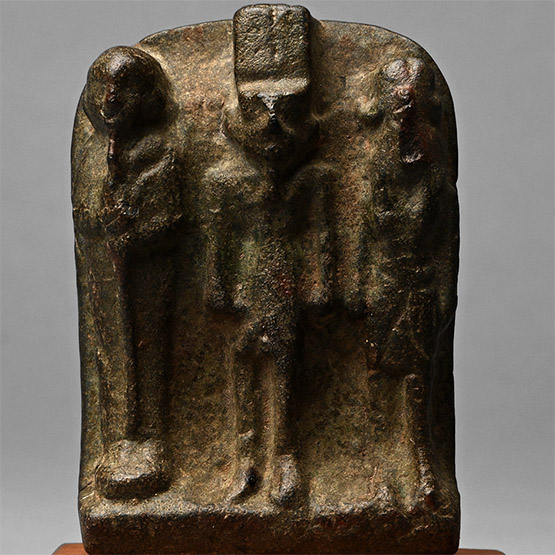
Egyptian Faience Ptah, Amun-Ra and Ra-Horakhty Triad Amulet
Ptolemaic Period, 332-30 B.C.Estimate: £3,000 - 4,000 (‡+bp*)
Rectangular plaque with a ledge along the lower edge, featuring the half-round figures of Ptah, Amun-Ra, and Ra-Horakhty; each invoked in offering formulae written in three vertical columns on the back; a fragmentary suspension loop at the rear; mounted on a wooden display stand. 88.8 grams total, 85 mm including stand
From a deceased American estate, 1970-1989. with Bonhams, London, 28 October 2009, no.81. Private collection, Europe. Accompanied by a copy of an Art Loss Register certificate, no.S00066707. This lot has been checked against the Interpol Database of stolen works of art and is accompanied by search certificate number no.13190-249206. -
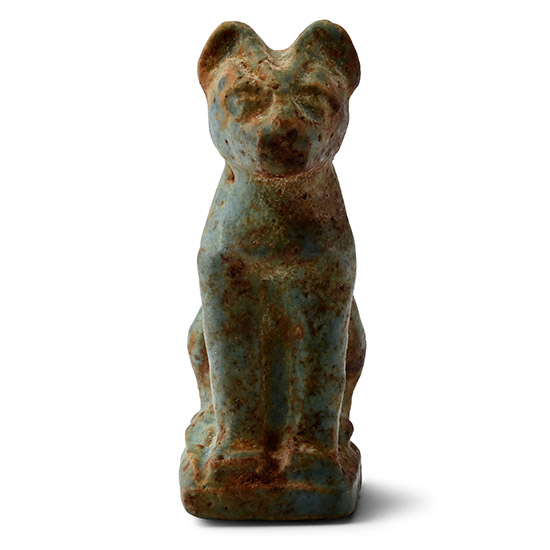
Large Egyptian Faience Cat Amulet
Late Period, 664-332 B.C.Sold for (Inc. bp): £1,105
Modelled seated on a tongue-shaped base, with simple facial detailing and suspension loop to the shoulders. 12.46 grams, 40.75 mm
Ex early 20th century London, UK, collection.
The cat was sacred to Bastet, a protective mother goddess and the daughter of the sun god Re. Amulets were believed to provide the wearer with the goddess's protection. -
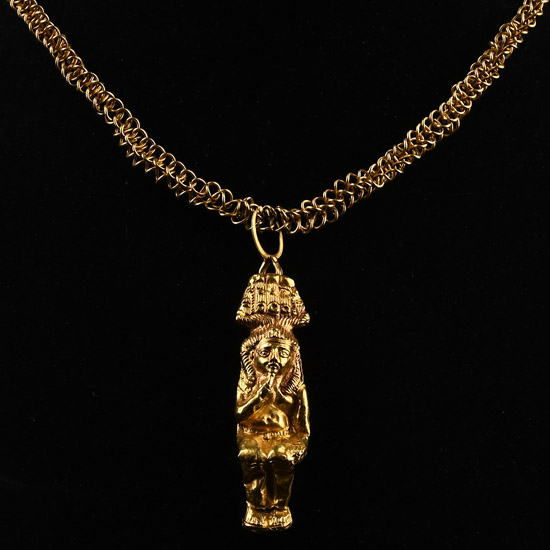
Egyptian Gold Necklace with Harpocrates Pendant
Roman Period, 1st century B.C.-1st century A.D.Estimate: £15,000 - 20,000 (‡+bp*)
Gold chain of double-looped links terminating in corrugated end elements, with hook-and-eye clasp; suspension ring embellished with applied granulation and a ribbed loop; hollow-formed sheet-gold pendant in the round depicting Harpocrates seated, his right forefinger raised to his mouth, wearing a finely detailed nemes headdress surmounted by a complex hemhem, crown incorporating multiple hedjet elements, flanking uraei, and ram's horns. 49.80 grams, 40.5 cm
Ex Elie Boustros collection, Lebanon. Private collection, acquired in the late 1980s-early 1990s; thence by descent. This lot has been checked against the Interpol Database of stolen works of art and is accompanied by search certificate number no.13203-249297.
The fully three-dimensional modelling of the pendant aligns it with a group of high-quality Roman-period Egyptian goldwork characterised by pronounced plasticity and sculptural ambition. A pertinent comparison may be drawn with the gold diadem depicting Serapis from the Dush Treasure, discovered concealed within the wall of a Roman fort in the Baris Oasis (Reddé, M., Douch IV. Le trésor de Douch, DFIFAO 28, Cairo, 1992). That assemblage, plausibly associated with a nearby temple of Serapis and Isis, demonstrates a similarly bold treatment of divine imagery in precious metal. Comparable small-scale representations of Harpocrates in gold - often amuletic in function - are known from Roman Egypt, though examples combining such intricate crown iconography with fully rounded modelling remain relatively rare. The present piece therefore occupies an interesting position between personal adornment and cultic or apotropaic object, reflecting both Alexandrian iconographic synthesis and provincial workshop virtuosity. Harpocrates is the Greek version of the Egyptian Hor-pa-khered, which means ‘Horus the Child’. This name refers to Horus as the divine infant of Isis and Osiris. Wearing an amulet of Harpocrates was believed to provide the same protection that Isis offered to her beloved son. -
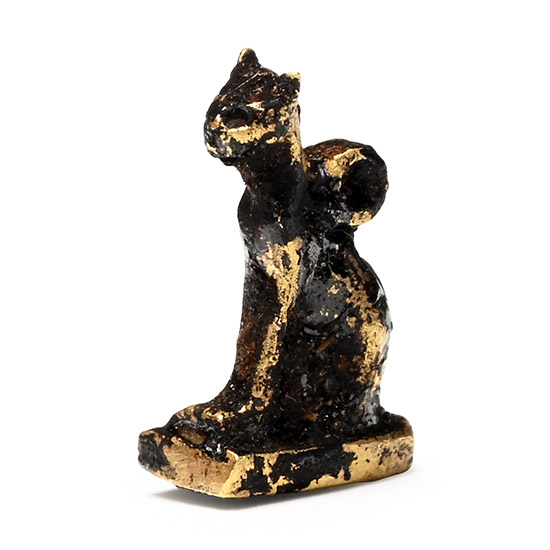
Egyptian Gold Bastet Seated Cat Amulet
Late New Kingdom-Third Intermediate Period, circa 1069-900 B.C.Sold for (Inc. bp): £468
Modelled seated on a tongue-shaped base, with simple facial detailing and suspension loop to the back. 0.51 grams, 8 mm
Ex French collection, early 20th century.
The goddess Bastet was believed to be the daughter of the sun god and was shown with the features of a lion up until about 1000 B.C. when she was first portrayed as a cat or human with a cat head. As the daughter of Ra she was associated with the rage inherent in the sun god's eye, which was considered to be his instrument of vengeance. Her development into a cat goddess occurred during the New Kingdom but did not fully develop until the Late Period. She was still associated with the destructive power of the sun and was shown on the prow of the solar boat, decapitating the evil serpent Apophis in the Book of the Dead. The maternal, protective and hunting characteristics of the cat are obvious in Bastet, and she was seen as a protector of pregnant women and young children. In the Pyramid Texts, she is invoked by the deceased king to act as his protector and to help him reach the sky to join the sun god; the king proclaims that Bastet is his mother and nurse. Like her counterpart, Sekhmet, Bastet has an aggressive side and, in a text from Karnak, Amenhotep II described his enemies being slaughtered like the victims of Bastet. The goddess had a shrine at Karnak, where she is known as the 'Lady of Asheru', which aligns her closely with the goddess Mut, the consort of Amun-Ra. Her most famous shrine was in the north-east Delta region, at Bubastis, and was known as Per-Bastet or 'the House of Bastet.' Herodotus describes the festival of Bastet as one of the most elaborate in all of Egypt and identifies her with the Greek Artemis. Cemeteries of cats have been excavated at Bubastis, and at Saqqara and Memphis.

