-
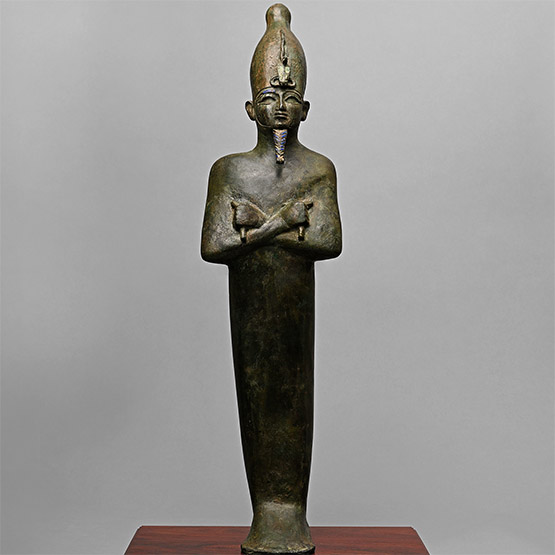
Large Egyptian Bronze Figure of Osiris with Lapis Lazuli Inlays
Late Period, 664-525 B.C.Estimate: £80,000 - 100,000 (+bp*)
Standing mummiform figure of Osiris wrapped in a body-hugging shroud; the figure wearing a tall Hedjet crown – representing the central element of Osiris’s lateral plume-flanked Atef crown; three vertical slots visible on either side of the preserved crown represent the mortices for the attachment of the separately cast plumes; a raised uraeus at the front of the crown, with a body coil on each side and a slightly undulating tail extending vertically up the crown; the broad face rendered with deeply recessed eyebrows, one still retaining a portion of lapis-lazuli inlay, almond-shaped eyes deeply recessed for inlay, a straight nose, and a small, closed mouth; once inlayed chin straps run from the temples to the chin, where a separately cast divine beard is attached, with deep chevron-like recesses, some retaining traces of blue inlay; arms crossed over the chest, with the hands emerging from the wrappings to hold the god’s traditional attributes – the crook (heka) and flail (nekhakha) – of which only the lowest portions are visible; holes for insertion of the separately fashioned upper parts present at the top of the fists; mounted on wooden base and supplied with custom fitted case. 19 kg total, the case: 89.5 x 36 x 41 cm (10.65 kg total, 69.5 cm high including stand)
with Seiyou Kobijyutsu, Osaka, Japan, 20th century. The acquisition was facilitated by Ichikawa Kiyoshi (September 1897–1976), a prominent consultant to the firm at the time. Private Japanese collection, Kumamoto, Kyushu, Japan, acquired in the 1960s by a medical doctor residing in Kumamoto, reportedly on the recommendation of Ichikawa Kiyoshi; thence by descent within the family until 2023. Accompanied by an academic report by Egyptologist Paul Whelan. The sculpture is accompanied by a Japanese wooden fitted box bearing the signature and seal (hanko) of Ichikawa Kiyoshi, supporting the attribution and authenticity. This lot has been checked against the Interpol Database of stolen works of art and is accompanied by search certificate number no.13192-250114.
As the principal god of the underworld, Osiris was worshipped continuously for more than 2,500 years, from the late Old Kingdom to the Roman period. The deity played a central role in Egyptian funerary belief, and his consistently mummiform imagery became widely incorporated into both royal and non-royal iconography. A major phase in the development of his cult occurred during the Middle Kingdom, when Abydos in Upper Egypt emerged as the principal cult centre and an important pilgrimage site for both royal and non-elite individuals. By the Late Period, the influence of the Osirian cult is clearly reflected in the material record, most notably in the widespread distribution of bronze statuettes across temple sites in Egypt. While such objects are often interpreted as expressions of personal devotion, their standardised forms and large-scale production may equally point to more formalised, institutionally mediated ritual practices. -
.jpg)
Greek Gold and Bead Drop Earrings
Hellenistic, 2nd-1st century B.C.Estimate: £8,000 - 10,000 (‡+bp*)
Matched pair of hooked wire earrings, each with an inset cabochon, articulated dangles and other ornaments. 5.15 grams total, 46 mm each
Private American collection, 1970s-1980s. with Robert Haber, New York, USA, circa 1990s. Private collection, Europe. Accompanied by a copy of an Art Loss Register certificate, 8 September 2004. This lot has been checked against the Interpol Database of stolen works of art and is accompanied by search certificate number no.13187-249264.
This pair belongs to the Hellenistic group of earrings with pendants, a broad group including pendants shaped as amphorae, birds, erotes and other exotic elements. Most of them come from sites around the Aegean or the Eastern Mediterranean and were probably produced in workshops in these regions. They usually date from the 2nd to the 1st centuries B.C. -
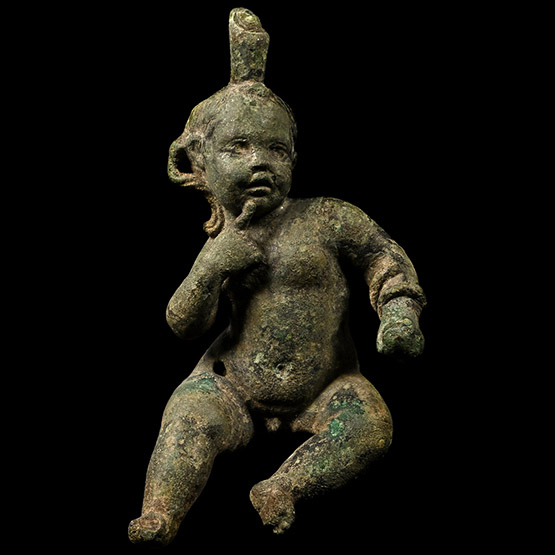
Roman Bronze Figure of Harpocrates, the God of Secrecy
1st century A.D.Estimate: £2,000 - 3,000 (‡+bp*)
Modelled in the round, sitting with miniature double-crown, serpent arm-ring on left wrist, sidelock; fixing socket to right thigh. 145 grams, 72 mm
Private collection, Me. A., Florida, USA, early 1990s. European private collection, acquired in Germany, September 2000. This lot has been checked against the Interpol Database of stolen works of art and is accompanied by a search certificate number no.12683-234609. -
.jpg)
Roman Wooden Wax Tablets from a Codex
Circa 2nd-3rd century A.D.Sold for (Inc. bp): £9,100
Two well-preserved rectangular wax tablets of a polyptych, each made of dark hardwood, probably acacia; the inner leaf in two adjoining parts, with recessed panels on both sides, covered with dark layers of wax; the second is the rear cover of the polyptych, with a recessed wax covered writing panel to the inner face, the outer face flat and not inscribed; both tablets with two pairs of holes on the left frame for linking them together; remains of stylus engraved Greek script on all three writing panels; on the second tablet 11 lines in cursive Greek script, mentioning inter alia a gymnasiarchos, a local magistrate in Roman Egypt, probably from an accounting codex. 263 grams total, 18.6 x 17 cm
Property of a North London gentleman; previously in the Dean family collection since 1975. Accompanied by a copy of an illustrated academic report by Professor Dr phil. Peter Rothenhöfer. This lot has been checked against the Interpol Database of stolen works of art and is accompanied by search certificate number no.13177-248472.
Wax tablets written in Greek or Latin, were used by Romans as account registers (codices accepti et expensi); for transactions (for example, the tablets of the banker Lucius Caecilius Iucundus found in Pompeii); for lists of goods, inventories, and notes to be kept and archived; for Roman magistrates to annotate the salient events of their bureaucratical activities; for writing letters; for drawing up legal texts of various kinds: legacies, declarations of births and citizenship, reports of trials and diplomata militaria. -
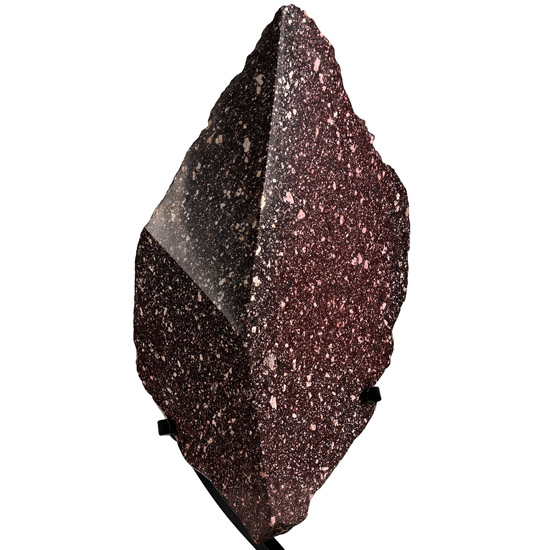
Historic Roman Cut and Polished Roman Imperial Purple Porphyry Section
Sold for (Inc. bp): £1,170
Comprising a triangular piece, cut and polished on several sides, probably recycled material mined in ancient Roman times between the 1st and 5th centuries A.D.; mounted on a custom-made metal display stand. 5.97 kg total, 38 cm including stand
Acquired on the UK art market since the 1990s. From the private collection of a Somerset gentleman.
Mons Porphyrites (today Jabal Abu Dukhkhan) is the mountainous site of a group of ancient quarries in the Red Sea Hills of the inhospitable eastern desert in Egypt, a five-day trip from the Nile during Roman times. They were discovered by Caius Cominus Leugas in 18 A.D., and during the Roman Empire, the mines officially belonged to the emperor and were the only known source of the Imperial Porphyry, Mons Porphyrites. This dark purple stone was associated with royalty and used for prestigious sculpture and architecture. The location of the mines was lost sometime in the 5th century and rediscovered in the early 19th century. Excavations in the area have revealed the well-preserved quarries and the dwelling places of the quarrymen, and also thousands of ostraca have been discovered containing messages that provide details of how the quarrying took place, and of how the highly skilled quarrymen ordered their food. -
.jpg)
Byzantine Bronze Oil Lamp
6th-7th century A.D.Estimate: £500 - 700 (+bp*)
Comprising: a squat body and large nozzle with shallow socketed rim, hinged lid to filler-hole with striped pattern, handle formed with lobed cross and loop to rear, annular foot. 376 grams, 13.7 cm
From the collection of a gentleman, acquired on the London art market in the 1990s.
The great success of this type of lamp in the Eastern Roman Empire brought about the establishment of several production centres, as can be confirmed by the frequent appearance of some of the details, e.g., the shape of the lid or of the cross and the length of the spout. Despite their wide distribution across Asia Minor, Greece and the Balkan Peninsula, these lamps also spread throughout Syria and reached Egypt, Morocco and even central Europe. -
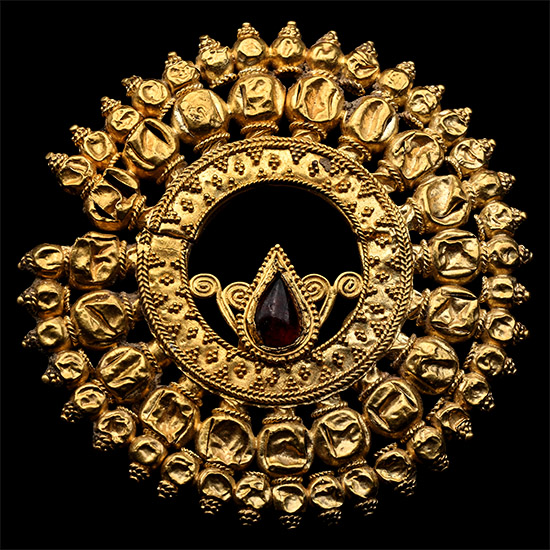
Achaemenid Elaborate Gold Earring
Circa 5th century B.C.Estimate: £3,000 - 4,000 (+bp*)
Crescent plaque with granulated inner borders and radiating triangles of granulation surrounded by a band of nineteen spheres, representing pomegranates, each with a filigree collar above and below, the outer band consisting of smaller spheres with a granulated pyramidal finial, at the centre a teardrop-shaped garnet cabochon set in a cell with a granulated border flanked by spirals. 13.55 grams, 51 mm
Ex David Lindhal, London, UK, in the 1990s. From a privately held London, UK, collection from the 1980s-1990s. This lot has been checked against the Interpol Database of stolen works of art and is accompanied by search certificate number no.13267-253966.
Fruits were generally considered to be a symbol of sensuality, temptation and fertility; the giving and accepting of fruit may be regarded as a symbolic sexual act, or at least a prelude to marriage. It follows naturally that the pomegranate, with its innumerable fleshy seeds symbolising life and fecundity, was an attribute of Aphrodite. -
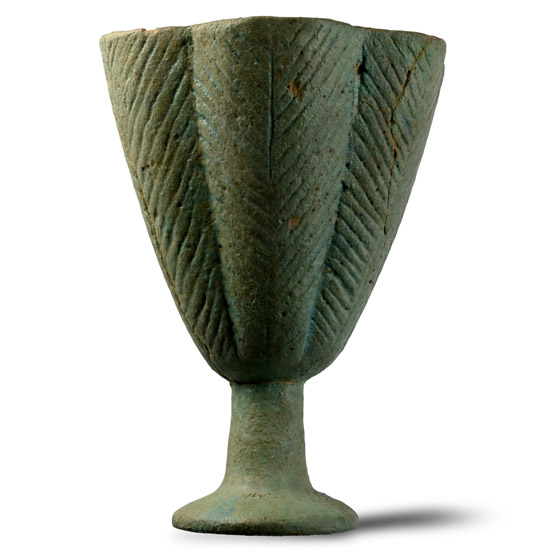
Egyptian Blue-Glazed Faience White Lotus Chalice
New Kingdom-Third Intermediate Period, 1315-945 B.C.Estimate: £4,000 - 6,000 (+bp*)
The lotiform cup modelled as an open lotus flower with incised petal detailing to the outer face, short stem and flared foot; some restoration. 205 grams, 12.1 cm
Acquired 1970s-1996. Property of a North American collector. London collection, 2016. This lot has been checked against the Interpol Database of stolen works of art and is accompanied by search certificate number no.12937-243177.
Faience chalices shaped like the flowers of the white lotus (Nymphaea albicans) first appeared in the 18th Dynasty and are believed to be drinking vessels. -
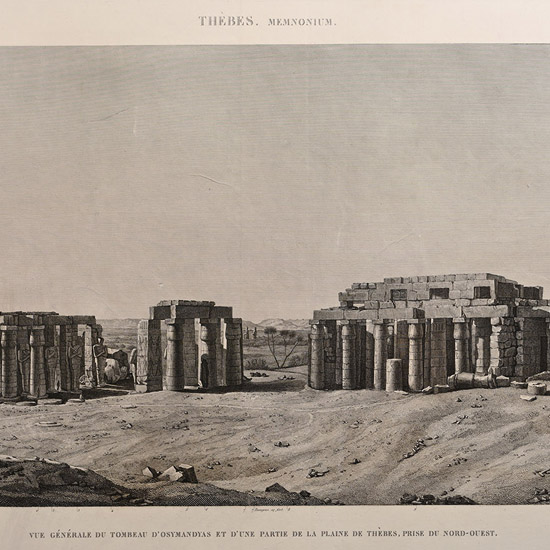
Very Large Egyptian Expedition Lithograph of the Memnonium at Thebes
Early 19th century A.D.Sold for (Inc. bp): £91
Proof etching on laid paper of plate 23 from Vol.II of Description de l'Égypte : ou, Recueil des observations et des recherches qui ont été faites en Égypte pendant l'expédition de l'armée française. entitled Thèbes. Memnonium. Vue générale du tombeau d'Osymandyas et d'une partie de la plaine de Thèbes prise du ord-ouest. 226 grams, 105 x 69.5 cm
From the collection of a North American priest. Acquired between 1981-1996. Property of a North American collector.
Produced between February 1802 and 1830 on the orders of Napoleon Bonaparte; published between 1809 and 1828. Just 1,000 copies were distributed to various institutions, printed on laid paper with an 'Égypte ancienne et moderne' watermark. The book is subtitled Recueil des observations et des recherches qui ont été faites en Égypte pendant l’expédition de l’Armée française, publié par les ordres de Sa Majesté l’Empereur Napoléon le Grand (Gathering of observations and discoveries which were made in Egypt during the expedition of the French army, published on the orders of His Majesty the Emperor Napoleon the Great). It was the world's first encyclopedia devoted exclusively to the remains of ancient Egypt. The plates of this book are the first to present the archaeological sites of Thebes (Luxor). The "Memnonium" is the Greek name for the mortuary temple of Ramesses II, now known as the Ramesseum. -
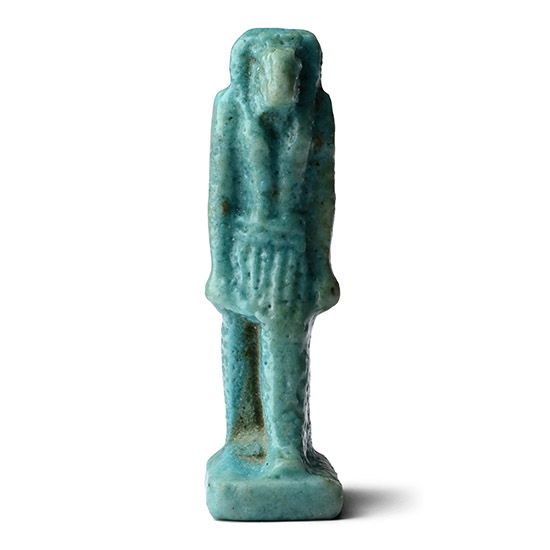
Egyptian Faience Thoth Amulet
Late Period, 664-332 B.C.Sold for (Inc. bp): £351
Modelled in the round as the ibis-headed human figure of Thoth, with a plain dorsal pillar, pierced at the top for suspension. 8.71 grams, 48.29 mm
Ex early 20th century London, UK, collection.
The ibis-headed form of Thoth is particularly significant in funerary contexts, as this depiction of the god frequently appears in Weighing of the Heart scenes, where the dead are judged before a divine tribunal for entry into the Hereafter. Thoth's role was to record the final judgement, which determined whether the deceased had led a virtuous life. -
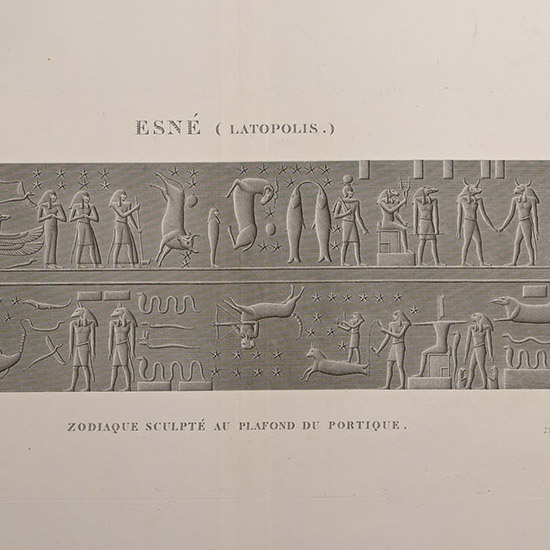
Very Large Egyptian Expedition Lithograph of Reliefs at Esna
Early 19th century A.D.Sold for (Inc. bp): £1,430
Proof etching on laid paper of plate 79 from Vol .I of Description de l'Égypte : ou, Recueil des observations et des recherches qui ont été faites en Égypte pendant l'expédition de l'armée française. entitled Esné (Latopolis) Zodiaque sculpté au plafond du portique. 187 grams, 105 x 70 cm
From the collection of a North American priest. Acquired between 1981-1996. Property of a North American collector.
Produced between February 1802 and 1830 on the orders of Napoleon Bonaparte; published between 1809 and 1828. Just 1,000 copies were distributed to various institutions, printed on laid paper with an 'Égypte ancienne et moderne' watermark. The book is subtitled Recueil des observations et des recherches qui ont été faites en Égypte pendant l’expédition de l’Armée française, publié par les ordres de Sa Majesté l’Empereur Napoléon le Grand (Gathering of observations and discoveries which were made in Egypt during the expedition of the French army, published on the orders of His Majesty the Emperor Napoleon the Great). It was the world's first encyclopedia devoted exclusively to the remains of ancient Egypt. The plates of this book are the first to present the archaeological sites of Thebes (Luxor). The Temple of Khnum at Esna in Upper Egypt has elements from the New Kingdom, but most of it dates to the Ptolemaic and Roman periods. This elaborate zodiac dates to the reign of Ptolemy III. -
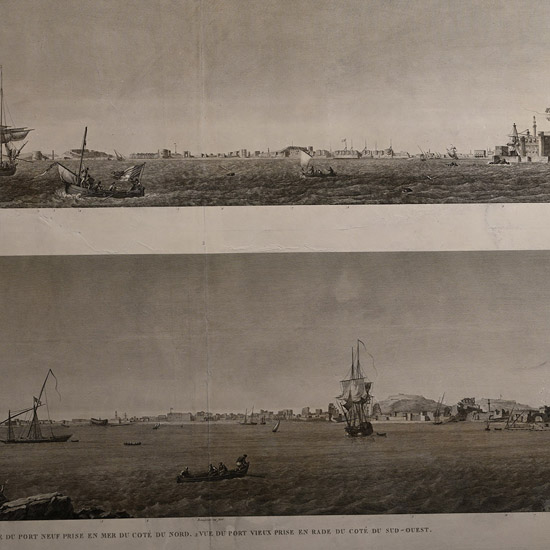
Very Large Egyptian Expedition Lithograph of Views of Alexandria
Early 19th century A.D.Estimate: £80 - 100 (+bp*)
Proof etching on laid paper of plate 88 from Description de l'Égypte : ou, Recueil des observations et des recherches qui ont été faites en Égypte pendant l'expédition de l'armée française. entitled 1. Vue du port neuf en mer du cote du nord. 2. Vue du port vieux prise en rade du cote du sud-ouest. 259 grams, 104.5 x 69 cm
From the collection of a North American priest. Acquired between 1981-1996. Property of a North American collector.
Produced between February 1802 and 1830 on the orders of Napoleon Bonaparte; published between 1809 and 1828. Just 1,000 copies were distributed to various institutions, printed on laid paper with an 'Égypte ancienne et moderne' watermark. The book is subtitled Recueil des observations et des recherches qui ont été faites en Égypte pendant l’expédition de l’Armée française, publié par les ordres de Sa Majesté l’Empereur Napoléon le Grand (Gathering of observations and discoveries which were made in Egypt during the expedition of the French army, published on the orders of His Majesty the Emperor Napoleon the Great). It was the world's first encyclopedia devoted exclusively to the remains of ancient Egypt. The plates of this book are the first to present the archaeological sites of Thebes (Luxor).

